IC Markets





































A Trader Who Rode Gold's Record Rally to $4,400: What the Trade Looked Like
One trader's run through gold's late-2025 surge past $4,000: entry, trailing stop and exit, and which parts were skill rather than timing.
 WriterAbir KhanWriterWrites the guides · checks every figure against primary sources View profileAbout Abir →
 Market analysisTanbir Habib RiyadForex & Crypto AnalystForex and crypto analyst · technical and fundamental analysis View profileAbout Tanbir →
 Fact-checking & riskJannatul FerdaushFact-Checker & Risk AnalystFact-checks every figure · risk analysis · Applied Statistics, University of Dhaka View profileAbout Jannatul →
 Trading reviewJowel RanaCo-Founder & Forex TraderCo-founder · forex trader · reviews guides from a trader's view View profileAbout Jowel →
 Final approvalRanjan NiskrityFounder, Owner & Forex TraderFounder and owner · forex trader · signs off every guide View profileAbout Ranjan →
Key takeaways
- A $6,000 account went long gold at $3,655 with a $65 stop on 0.01 lots, the smallest size, risking just over 1%.
- The stop was trailed under each confirmed higher swing low on the daily chart, never ahead of it.
- The trailed stop was hit at $4,180 after the October 2025 record, capturing about $525, roughly 9% of the account and 8 times the risk.
- The skill was in the exit and the patience, not in picking the entry.
About this case study: Anan, the trader in this example, is an illustrative composite, not a real person, and the account, trades and figures are not a real trading record. They are built from patterns that are common in retail trading so the maths can be shown step by step. Market events are simplified unless a date is given.
Gold's run in 2025, which took it above $4,000 an ounce for the first time on 8 October and to a record just under $4,400 on 20 October before a sharp drop the next day, was the kind of move that gets talked about for years. It also produced two very different sets of stories: traders who caught a chunk of it with a trailing stop and a plan, and traders who shorted it repeatedly on the way up because it looked overextended and lost account after account. This illustrative case is one of the first kind, and the trade is worth breaking down because the skill in it was almost entirely in the exit, not the entry.
The trader was in Bangkok, running a $6,000 account, and had been trading gold and USD/JPY for about two years. They were not a gold bull by conviction. They took the trade because the trend was up, the pullbacks were shallow, and their rule was to trade with the trend until it broke.
The entry
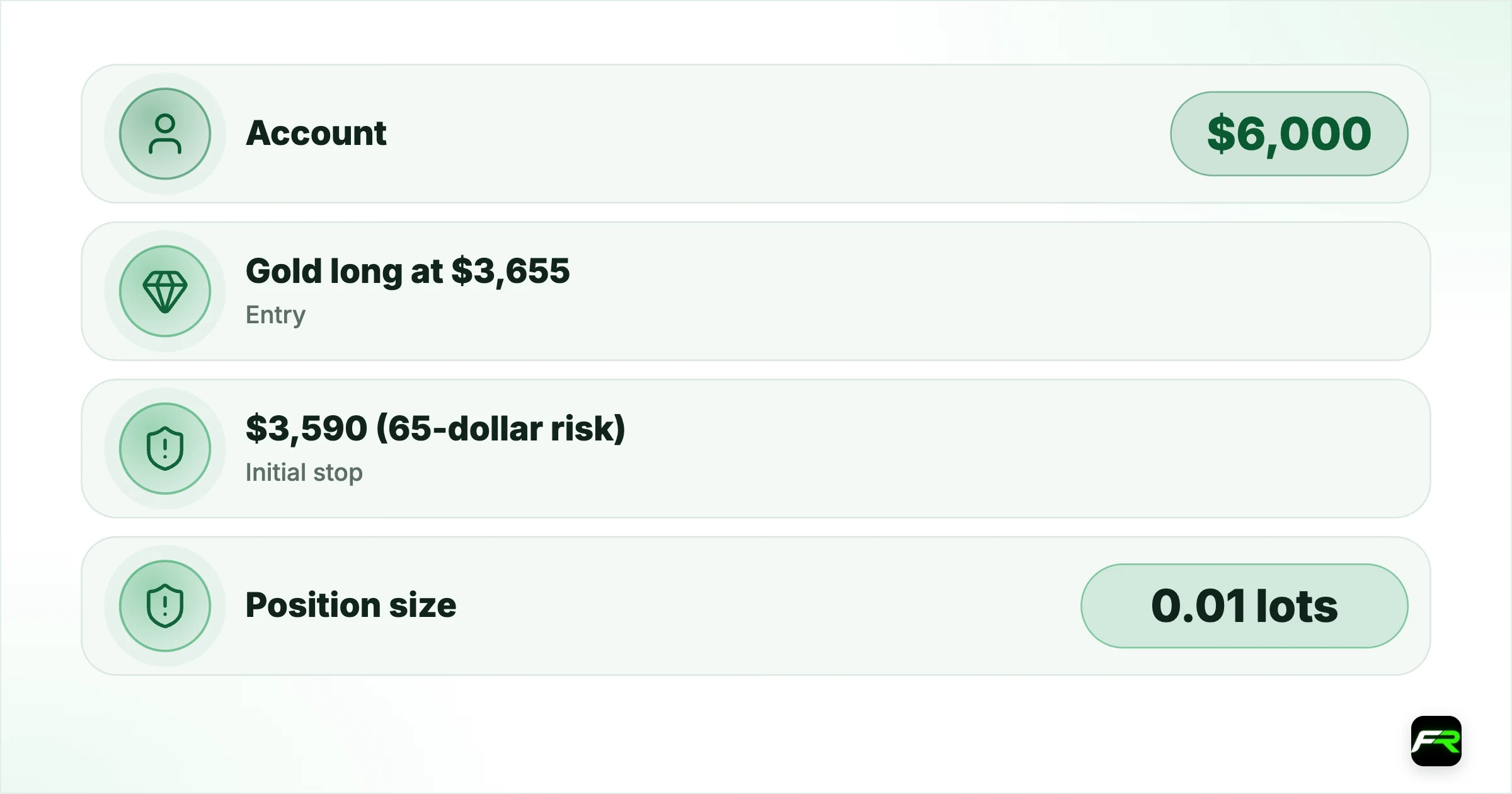
Gold was around $3,650 and had pulled back to a rising trendline and a prior area of support after a push to $3,720. The trader went long at $3,655 with a stop at $3,590, a 65-dollar stop. On a $6,000 account risking one per cent, $60, the position size works out to 0.0092 lots, because one standard lot of gold is 100 ounces and moves $100 for every $1 change in price. The trader rounded to 0.01 lots, the smallest size most brokers allow, which moves $1 for every $1 in gold and made the actual risk $65, just over one per cent. A small position, because the stop was wide.
There was nothing special about the entry. It was a with-trend pullback buy at support, the kind of setup that appears dozens of times in a strong uptrend. If the trend had failed there, it would have been a one-per-cent loss and forgotten. The entry did not need to be precise because the plan did not depend on it.
| Account | $6,000 |
|---|---|
| Entry | Gold long at $3,655 |
| Initial stop | $3,590 (65-dollar risk) |
| Position size | 0.01 lots ($65 risk, just over 1%) |
| Stop management | Trailed below each higher swing low |
| Exit | $4,180, on a trailed-stop hit after a sharp pullback |
| Move captured | ~$525 per ounce |
| Profit | ~$525 (~9% of the account, about 8 times the risk) |
The trailing stop
This is where the trade was made. As gold climbed, the trader moved the stop up to sit just below each new higher swing low on the daily chart. When gold pushed to $3,800 and pulled back to $3,720, the stop went to $3,690, locking in a small gain and making the trade risk-free. When it ran to $4,000 and consolidated near $3,920, the stop went to $3,890. Each time, the stop moved only after a confirmed higher low formed, never pre-emptively.
The trader resisted two temptations the whole way up. First, taking profit early because the gain was already large in dollar terms. From $3,800 onward the position was showing a gain of several times the original risk, and the urge to bank it was constant. Second, adding to the position as it ran, which would have increased the risk and turned a clean trade into a leveraged bet. They did neither. Same size, trailing stop, let it work.
Anan said the hardest day was when gold hit $4,000 and every headline was about a record. He was up about $345 on one position, more than five times what he had risked, and every instinct said to take it. His rule was that he only exits on a stop or a confirmed trend break, and neither had happened, so he did nothing. When it finally pulled back sharply from $4,200 and hit his trailed stop at $4,180, he was almost relieved. He booked about $525. He readily admits that if the pullback had come at $3,900 instead, he would have made a fraction of that, and that the size of the win was the market's doing, not his.
Why the exit was $4,180, not $4,400
Gold's push toward $4,400 is what makes this trade worth writing about, but $4,400 is not where the position closed, and that gap is the whole point of trading a trailing stop instead of trying to call the top. The stop was sitting below the most recent higher swing low, which at the time of the October spike was still down near $4,180. Gold set its record just under $4,400 on 20 October 2025, failed to hold it, and fell sharply the next day, dropping through the swing low fast enough that the stop filled at $4,180 rather than closer to the peak. The trader captured most of the move up to the spike, none of the spike itself, and that is what a trailing stop is supposed to do: bank the trend, miss the exact top every time, because knowing the top in advance was never part of the plan.
A trader who had instead set a fixed take-profit target near $4,400 would occasionally do better than this exit and would occasionally do much worse, closing early on a trend that kept running past the target with room to spare. The trailing stop gives up the chance of an exact-top exit in exchange for staying in every trend for as long as it lasts, which over many trades outperforms guessing where a rally ends.
What was skill and what was timing
The skill: sizing the position to a one-per-cent risk so a failed entry cost nothing meaningful, trailing the stop mechanically below higher lows rather than guessing tops, and not interfering with a working trade by taking profit early or adding. Those are repeatable. The trader would do the same thing on the next strong trend and it would work again, though probably for a smaller move.
The timing: gold happened to run $525 without a pullback deep enough to hit a sensibly trailed stop. That is unusual. Most trends give the trailing stop a reason to fire much sooner. If the trader ran this exact process on twenty trending markets, most would produce a modest winner or a small loss, and one or two would produce a monster like this. The monster pays for all the small ones. That is how trend-following works, and it is why the trader could not tell you in advance which trade would be the big one.
The wrong lesson from a trade like this is that you should hold every winner for a huge move. The right lesson is that you should let a trailing stop decide the exit, accept that most trades will be stopped for a small gain or loss, and stay in the rare one that keeps running.
Accounting for swap over a multi-month hold
The trade ran from $3,655 to $4,180, a move that took the better part of a trend spanning several months. Every night a long gold position stays open, most brokers charge or credit a swap rate that reflects the interest-rate differential the position is exposed to, and on gold that rate is typically a cost to the long side rather than a credit. Over a single day it is negligible. Over a hold spanning weeks or months it adds up: on a full standard lot it can run to hundreds of dollars, and even on a 0.01-lot position it is a noticeable slice of a $525 profit. It never appears on the entry ticket but comes straight out of the eventual result.
None of that changes the conclusion here: the trade still returned roughly $525 before swap, comfortably enough to absorb it. But a trader running the same trend-following approach on a smaller edge, or a pair where swap runs against the position more heavily, needs to check the swap rate before committing to a multi-month hold, not after closing it. Most platforms show the daily swap per lot in the instrument's contract specification, so the figure is available before you ever open the trade. The pip calculator handles the price side of the same sum.
The traders on the other side
For every trader who rode gold up, several tried to short it because it looked too high. $3,700 looked like a top. So did $3,900, $4,100, $4,300. Each short was sized to a tight stop because the trader was confident, each stop was hit as gold kept climbing, and several accounts were ground down over weeks of fighting the trend. Picking a top in a strong trend is one of the most expensive habits in trading. The trend was the information. It said up. The traders who respected that made money or stayed out. The traders who argued with it paid.
Frequently asked
Should I try to catch a move like this?
You cannot target a $525 move because you cannot know in advance which trend will run that far. What you can do is trade with the trend at correct size and use a trailing stop, which puts you in position to catch the big one when it happens. Most trades will be small.
How do I trail a stop without getting shaken out?
Trail it below confirmed higher swing lows on the timeframe you are trading, not below every small dip. A daily-chart trend uses daily swing lows. Moving the stop only after a clear higher low forms keeps it outside the noise.
Why not take partial profit on the way up?
Some traders do, closing a fraction at set multiples of risk. The trade-off is that partial profits reduce the size of the eventual big winner, which is where trend-following makes its money. This trader chose not to; it is a valid style choice either way.
Is shorting gold ever a good idea?
In a downtrend, yes. In a strong uptrend, repeatedly shorting because it 'looks high' is one of the fastest ways to lose an account. The trend is the primary information; trade with it or stay out.
What size should a $6,000 account trade gold?
One per cent is $60. With gold's wide stops of $30 to $70, that puts the position around 0.01 to 0.02 lots depending on the stop distance, because each 0.01 lot moves $1 for every $1 in the gold price. Gold's volatility forces small positions, so the same one-per-cent rule that works on a currency pair still holds the dollar risk fixed here.
Does holding a gold position for months cost anything besides the spread?
Yes, swap. A long gold position typically pays or charges an overnight swap rate every night it stays open, and on a multi-month trend-following hold that adds up to real money even though it never shows up on the entry ticket. Check the swap rate before holding a position for more than a few days, and net it against the trade's expected size before assuming the whole move on the chart is profit.
Related reading
The team behind this guide
Researched, checked and approved by five forex specialists
Every guide is written, fact-checked and edited before it goes live, and updated when the facts change. Spotted an error? Tell us.