IC Markets





































Why Most Retail Traders Are Still Losing Money in 2026
Around 70% of retail CFD accounts still lose money. What the data shows, and the habits that separate the minority who don't.
 WriterAbir KhanWriterWrites the guides · checks every figure against primary sources View profileAbout Abir →
 Market analysisTanbir Habib RiyadForex & Crypto AnalystForex and crypto analyst · technical and fundamental analysis View profileAbout Tanbir →
 Fact-checking & riskJannatul FerdaushFact-Checker & Risk AnalystFact-checks every figure · risk analysis · Applied Statistics, University of Dhaka View profileAbout Jannatul →
 Trading reviewJowel RanaCo-Founder & Forex TraderCo-founder · forex trader · reviews guides from a trader's view View profileAbout Jowel →
 Final approvalRanjan NiskrityFounder, Owner & Forex TraderFounder and owner · forex trader · signs off every guide View profileAbout Ranjan →
Regulated CFD brokers in the UK and EU are required to display the percentage of their retail accounts that lose money. At the 16 providers we checked in October 2026, the figures ran from 61 to 76.6 per cent, an average of 70.1 per cent. That is lower than the 74 to 89 per cent the European Securities and Markets Authority (ESMA) reported in 2018, before leverage was capped, but it still means most accounts lose. The reasons are not mysterious. They are a short list of behaviours, and the minority who avoid them are mostly doing the same few things right.
The honest data
The loss figure comes from the mandatory risk warnings of regulated brokers, each recalculated regularly over a recent 12-month period. It means that on any given broker, at any given time, most account holders are down. It does not mean trading cannot be profitable; it means the base rate is against a new trader, and the profitable minority are outliers who have built specific habits.
| What the losing majority tend to do | What the profitable minority do |
|---|---|
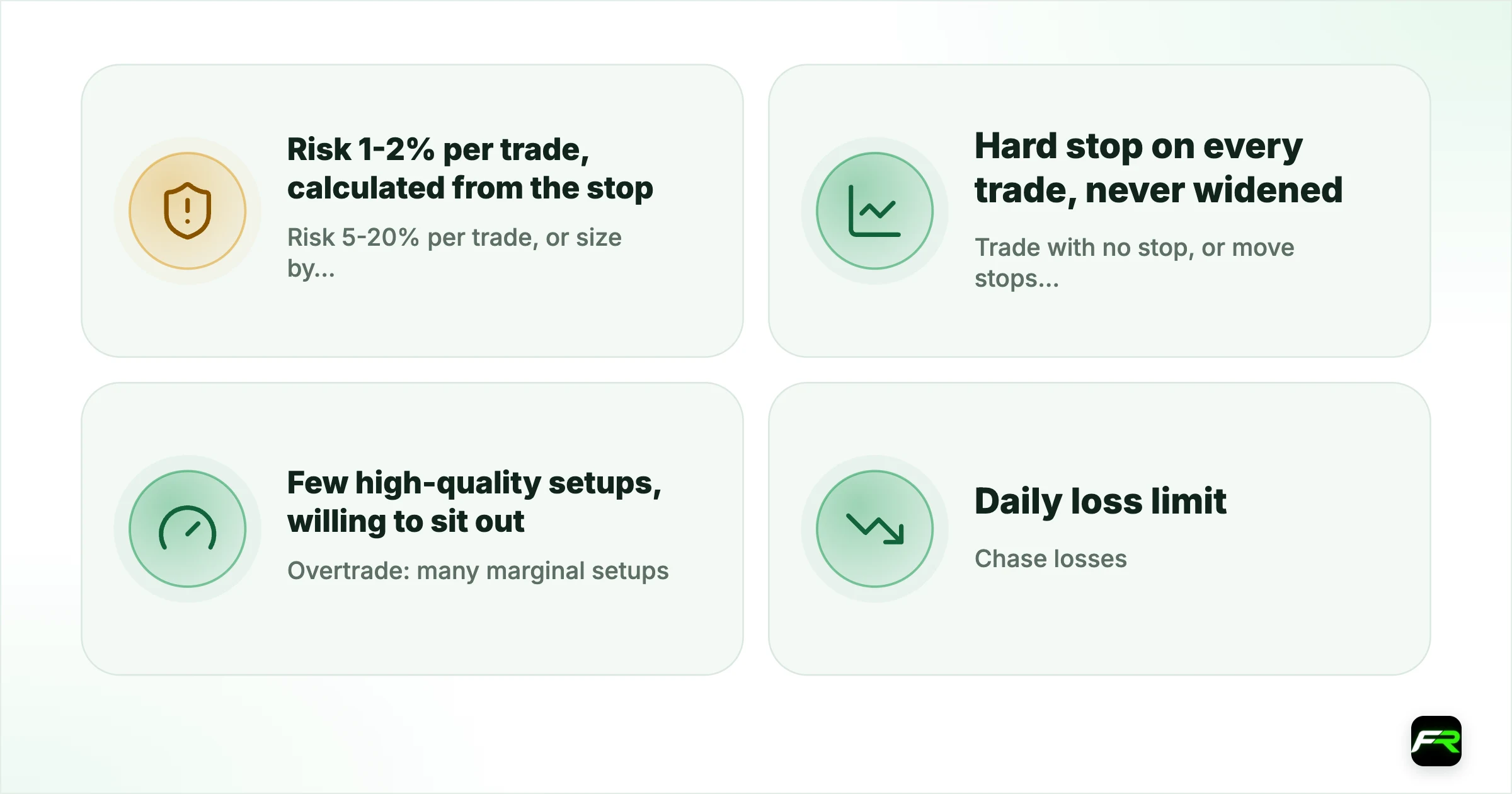
| Risk 5-20% per trade, or size by ‘gut’ | Risk 1-2% per trade, calculated from the stop |
| Trade with no stop, or move stops away | Hard stop on every trade, never widened |
| Overtrade: many marginal setups | Few high-quality setups, willing to sit out |
| Chase losses (revenge trading) | Daily loss limit; stop after two losses |
| Hold losers, cut winners short | Cut losers at the stop, let winners run to target |
| Trade through scheduled news | Flat or small around central-bank events |
| No review, repeat the same mistakes | Weekly review scored on plan-adherence |
Why these habits are hard
None of the profitable habits are complicated. They are hard because they run against instinct. Instinct says size up when you are confident, hold a loser until it comes back, and win the money back after a bad trade. Every one of those instincts is wrong for trading, and overriding them consistently requires structure: rules set in advance, when you are calm, that remove the decision at the moment your judgement is worst. The traders who succeed are not more disciplined by nature; they have built systems that do not depend on in-the-moment willpower.
The role of leverage and marketing
High leverage does not cause losses directly, but it enables the oversizing that does. An offshore entity offering 1:1000 lets a $500 account take a $500,000 position, and marketing that leads with the leverage number is aimed at traders who do not yet understand why regulated brokers cap it at 1:30. The leverage guide shows the maths. Combined with content that presents trading as an accessible income and earns commissions on your activity, the environment nudges a new trader toward exactly the behaviours in the losing column.
Melati was in the losing majority for over a year: no fixed risk, mental stops, revenge trading after losses, no review. She changed four things: 1 per cent risk calculated from the stop, a hard stop on every trade, a two-loss daily lockout, and a Sunday review scored on whether she followed her plan. Her strategy did not change. Within three months the account was making new highs for the first time. She says the changes felt like getting worse at trading, because she was taking more small losses and fewer thrilling wins, right up until the equity curve turned.
The path out of the majority
- Fix risk at 1-2% per trade, calculated from the stop, written down before entry.
- Put a hard stop on every trade, on the platform, and never widen it.
- Set a daily loss limit: stop after two losing trades.
- Cut the marginal trades. If you cannot explain the setup in one sentence, skip it.
- Stay flat or small around scheduled central-bank events.
- Review every week, scoring each trade on plan-adherence, not profit.
- Give it months, not weeks. The equity curve turns after the habits are in place, not before.
If you do all of the above for two to three months and still lose, then the strategy genuinely lacks an edge and that is worth examining. But in most cases the strategy is fine and the behaviours in the losing column are the reason. Fix those first.
The roughly 70 per cent figure is not a reason not to trade. It is a description of a base rate that a specific, boring set of habits moves you out of. The minority who make it are not smarter or luckier. They took more small losses, fewer exciting wins, and stayed alive long enough for a real edge to show.
Frequently asked
What percentage of retail forex traders lose money?
Mandatory risk warnings in the UK and EU showed that 61 to 76.6 per cent of retail CFD accounts lost money at the 16 providers FX Recap checked in October 2026, an average of 70.1 per cent. In 2018, before leverage caps, ESMA reported 74 to 89 per cent.
Why do most traders still lose, despite better technology?
Because the causes are behavioural, not technical: oversizing, no stops, overtrading, revenge trading, holding losers. Better platforms and more education have not changed the instincts that drive those behaviours.
What separates the profitable minority?
A short list of habits: 1 to 2 per cent risk per trade, a hard stop on every trade, a daily loss limit, trading few high-quality setups, cutting losers and running winners, staying flat around news, and a weekly review scored on plan-adherence.
How long does it take to become profitable?
For the minority who get there, usually one to three years, because the hardest skill is the psychology and it can only be practised with real money. Anyone promising it in weeks is selling something.
Is high leverage the reason people lose?
Not directly, but it enables the oversizing that causes losses. It lets a small account take a catastrophic position. Regulated brokers cap retail leverage at 1:30 for this reason.
Related reading
The team behind this guide
Researched, checked and approved by five forex specialists
Every guide is written, fact-checked and edited before it goes live, and updated when the facts change. Spotted an error? Tell us.