IC Markets





































$5,000 vs $500: Same Strategy, Two Account Sizes, Two Outcomes
Same USD/JPY strategy, accounts ten times apart: one grew, one blew up. The difference was how position sizing was scaled.
 WriterAbir KhanWriterWrites the guides · checks every figure against primary sources View profileAbout Abir →
 Market analysisTanbir Habib RiyadForex & Crypto AnalystForex and crypto analyst · technical and fundamental analysis View profileAbout Tanbir →
 Fact-checking & riskJannatul FerdaushFact-Checker & Risk AnalystFact-checks every figure · risk analysis · Applied Statistics, University of Dhaka View profileAbout Jannatul →
 Trading reviewJowel RanaCo-Founder & Forex TraderCo-founder · forex trader · reviews guides from a trader's view View profileAbout Jowel →
 Final approvalRanjan NiskrityFounder, Owner & Forex TraderFounder and owner · forex trader · signs off every guide View profileAbout Ranjan →
Key takeaways
- Same Tokyo-range strategy, same 48% win rate: the $5,000 account grew 12%, the $500 account was gone in three weeks.
- The difference was risk per trade: 1% versus about 13%, because small positions on a small account felt pointless.
- A 48% strategy will produce six- and seven-loss streaks; at 13% risk that wipes out the account.
- A small account needs the same 1% to 2% rule, not a bigger one.
About this case study: Both traders in this example, including Farid, are illustrative composites, not real people, and the accounts, trades and figures are not a real trading record. They are built from patterns that are common in retail trading so the maths can be shown step by step.
A common belief among new traders is that a small account has to be traded aggressively to grow, and a large account can afford to be careful. This gets it exactly backwards, and it is why so many small accounts never make it past the first few months. Here are two traders running the same simple USD/JPY strategy, one on $5,000 and one on $500, and what happened to each over a similar period.
The strategy in both cases: trade the Tokyo-session range, enter near the edge of the overnight high-low band, stop just outside it, target the opposite edge. It is a reasonable approach for the Asian session, which tends to be range-bound. Both traders had a similar win rate, around 48 per cent. The outcomes were not similar at all.
The $5,000 account
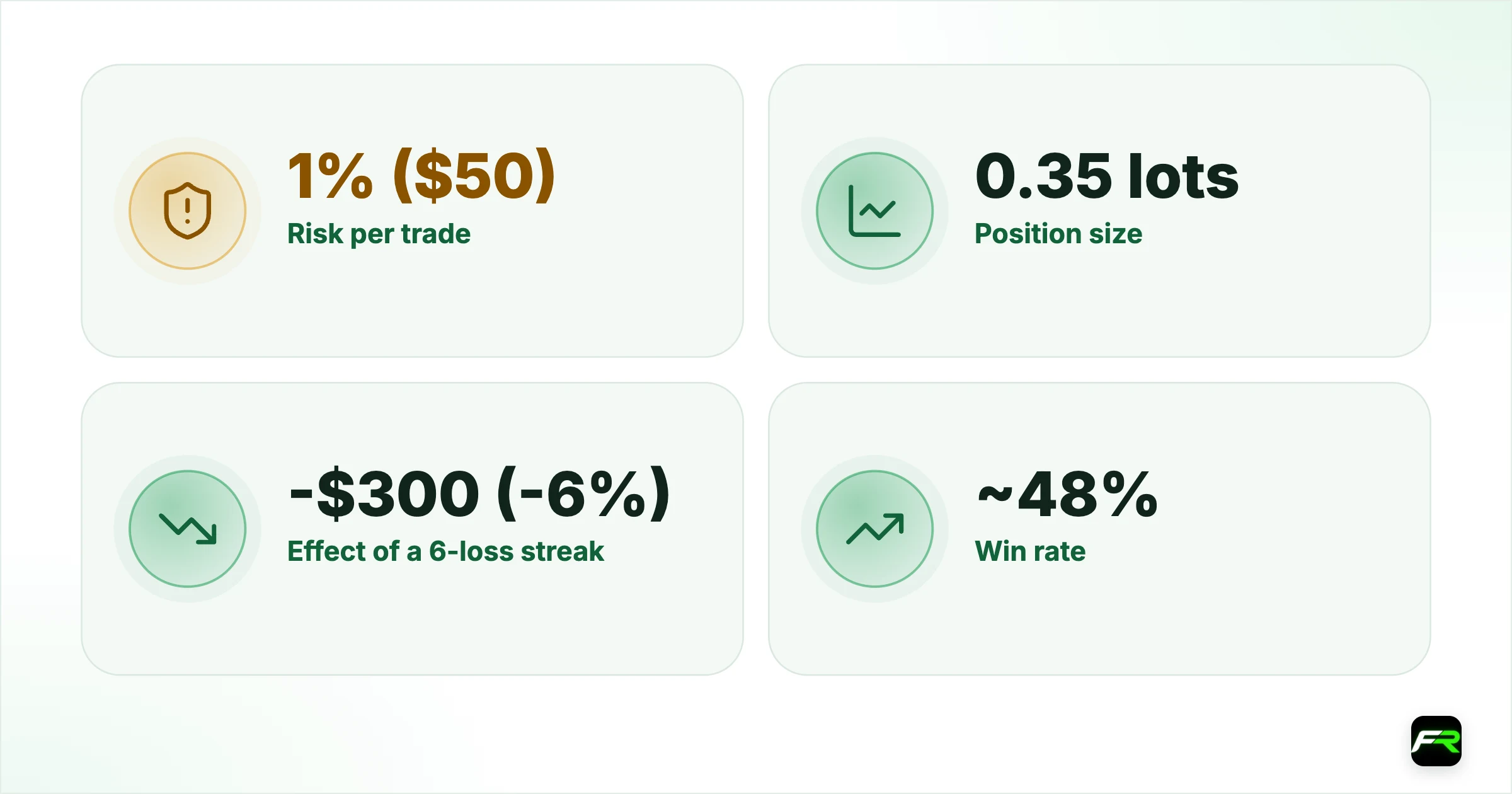
This trader risked one per cent, $50, per trade. On USD/JPY with a typical 20-pip range stop, that put the position around 0.35 lots, worth about $2.30 per pip. A losing trade cost around $50. A run of six losses, which happened in the second month, cost about $300, or six per cent of the account. Uncomfortable, but the account was still at $4,700 and the strategy carried on working. Over four months the account grew to about $5,600, a 12 per cent gain, with a worst drawdown of eight per cent.
The $500 account
This trader also thought of risk in one-per-cent terms at first, which is $5. On a 20-pip stop that is a position of about 0.035 lots, or $0.23 per pip. The trader looked at that and decided it was pointless. Making $5 on a good day felt like nothing. So they scaled up: 0.5 lots per trade, worth about $3.30 per pip, risking around $66 per trade on a $500 account. That is 13 per cent risk per trade.
The first three trades won and the account jumped to $650. Then a run of five losses in seven trades. At 13 per cent risk, five losing trades is roughly a 50 per cent drawdown, and the two winners in between did not cover it. The account fell below $300. The trader, now desperate to recover, went to 1 lot per trade. Two more losses and the account was under $80, effectively finished. Total time: about three weeks.
| $5,000 account | $500 account | |
|---|---|---|
| Risk per trade | 1% ($50) | ~13% ($66) |
| Position size (USD/JPY) | 0.35 lots | 0.5 lots |
| Effect of a 6-loss streak | -$300 (-6%) | -$396 (-79%) |
| Win rate | ~48% | ~48% |
| Strategy | Tokyo range | Tokyo range |
| Outcome after ~4 months / 3 weeks | +12% | Account gone |
Farid opened his first account with $500 because that was what he could spare. He knew the 1 per cent rule but ignored it because the position sizes felt insultingly small. He told himself a small account was different. After the account blew up in three weeks he reopened with the same $500, forced himself to trade 0.03 lots, and accepted that the account might take a year to double if it worked at all. Six months in it was at about $590. He says the boredom of trading tiny was the hardest part and the reason he failed the first time.
Why the same strategy produces opposite results
A strategy with a positive expectancy only makes money if you survive the losing streaks that are a normal part of it. A 48 per cent win rate strategy will regularly produce runs of five, six, seven losses. At one per cent risk, a seven-loss streak is a seven per cent drawdown: annoying, recoverable, and the strategy keeps working through it. At 13 per cent risk, a seven-loss streak is more than the whole account. The strategy never gets the chance to show its edge because the account is gone before the winning trades arrive.
The small-account trader was not unlucky. A seven-loss streak in a 48 per cent strategy is completely expected within the first fifty trades. They built a plan that could not survive a normal, predictable event.
The correct approach for a small account
A $500 account should risk one to two per cent, which is $5 to $10 a trade. Yes, the positions are tiny. Yes, a good week might make $30. No amount of leverage changes that safely. The account grows slowly if the strategy works, and the trader gets months of practice at correct sizing while the stakes are low. Then, if the account reaches $2,000 or $5,000 through a mix of trading and top-ups, the same one-per-cent risk produces position sizes that feel larger, and the habit is already built.
Scaling risk up because a small account 'needs' it is the single most reliable way to lose a small account. The position sizes are supposed to feel too small. That feeling is the cost of survival.
Making peace with trading amounts that feel too small
A $5 risk on a $500 account is not a rounding error to the trader taking it. It feels pointless, and that feeling is the actual mechanism that blows up small accounts: not a lack of knowledge, but the boredom and impatience of doing the right-sized trade over and over while the balance barely moves. Two things help. First, track the account in R multiples rather than dollars for a while. Plus 2R and minus 1R read the same whether the account is $500 or $50,000, and it is easier to feel good about a process working than about a $10 gain. Second, treat the small account explicitly as paid training rather than as a business that needs to produce an income, since that removes the pressure to make the dollar figure feel meaningful before the account has grown enough to support it.
If a $5 risk per trade genuinely is not worth your time, the honest conclusion is that the account is too small to trade for income right now, and the better move is to keep practising on a demo or a cent account while you save toward a balance where correct-sized positions produce numbers that feel like something, not to over-leverage the $500 into oblivion.
Frequently asked
Is $500 too small to trade forex?
It is enough to trade correctly at 0.02 to 0.05 lots and learn proper risk habits, but not enough to generate meaningful income. Treat a $500 live account as paid practice, not a business.
Why not use higher leverage to make small positions worthwhile?
Higher leverage does not change the risk maths. If you risk 1 per cent on a $500 account, that is $5 whether leverage is 1:30 or 1:1000. Using leverage to take a larger position just means you are risking more than 1 per cent, which is the mistake that blew up the small account here.
How long would it take to grow $500 meaningfully?
At a strong, sustained 3 per cent a month, $500 becomes about $700 in a year. Small accounts grow slowly by dollars even when the percentages are good. Adding to the account from savings is usually faster than trying to compound it aggressively.
Should the risk percentage be the same for every account size?
Broadly yes. One to two per cent per trade works from $500 to $500,000. What changes is the dollar amount, not the percentage. Some traders use a slightly lower percentage on larger accounts, never a higher one on smaller accounts.
What is a realistic win rate for a range strategy in the Asian session?
Around 45 to 55 per cent for a simple range approach, with the profitability coming from a favourable risk-to-reward on the winners rather than the win rate itself.
Related reading
The team behind this guide
Researched, checked and approved by five forex specialists
Every guide is written, fact-checked and edited before it goes live, and updated when the facts change. Spotted an error? Tell us.