IC Markets





































Turning $2,000 Into $8,000 on Gold: A Risk Breakdown
A gold account that grew four times in five months: the position sizing, stop placement and the one rule that kept wins bigger than losses.
 WriterAbir KhanWriterWrites the guides · checks every figure against primary sources View profileAbout Abir →
 Market analysisTanbir Habib RiyadForex & Crypto AnalystForex and crypto analyst · technical and fundamental analysis View profileAbout Tanbir →
 Fact-checking & riskJannatul FerdaushFact-Checker & Risk AnalystFact-checks every figure · risk analysis · Applied Statistics, University of Dhaka View profileAbout Jannatul →
 Trading reviewJowel RanaCo-Founder & Forex TraderCo-founder · forex trader · reviews guides from a trader's view View profileAbout Jowel →
 Final approvalRanjan NiskrityFounder, Owner & Forex TraderFounder and owner · forex trader · signs off every guide View profileAbout Ranjan →
Key takeaways
- A $2,000 gold account reached about $7,800 in five months with a stop on every trade and 2% risk.
- It won only about 41% of roughly 90 trades; winners averaged 3.4 times the size of losers.
- Half of each position was closed at 1:1 and the rest trailed, with no averaging down.
- The results came from risk management in a trending market, not from predicting the price.
About this case study: Mei Ling, the trader in this example, is an illustrative composite, not a real person, and the account, trades and figures are not a real trading record. They are built from patterns that are common in retail trading so the maths can be shown step by step. Market events are simplified unless a date is given.
Turning $2,000 into close to $8,000 in five months is a return of nearly 300 per cent. That is the kind of number that shows up in a screenshot with no context, and nine times out of ten the context is a single lucky trade at reckless size that is about to be given back. This one was different, and the difference is entirely in the risk management. The trader in this case, based in Kuching, did it with a stop on every trade, a fixed two per cent risk, and a strategy that fit the way gold moved in 2025.
Gold ran hard through 2025, closing above $4,000 an ounce for the first time on 8 October and setting a record just under $4,400 later that month. A trending market rewards a trader who can stay in winners and cut losers quickly. That is the whole story here. The edge was not prediction. It was letting the market pay for a lot of small losing trades with a smaller number of large winning ones.
The account and the rules
The starting balance was $2,000 on a broker offering gold with spreads around 20 to 30 cents and no commission. The trader risked two per cent per trade, which is $40 at the start. That is the top of the range we normally suggest, and it is a large part of why the result is as big as it is. Every position had a hard stop. Every position had a first target at 1:1 where half the position was closed, with the rest left to run behind a trailing stop. There was no averaging down, no adding to losers, and no trading in the two hours around the US session open on days with major US data.
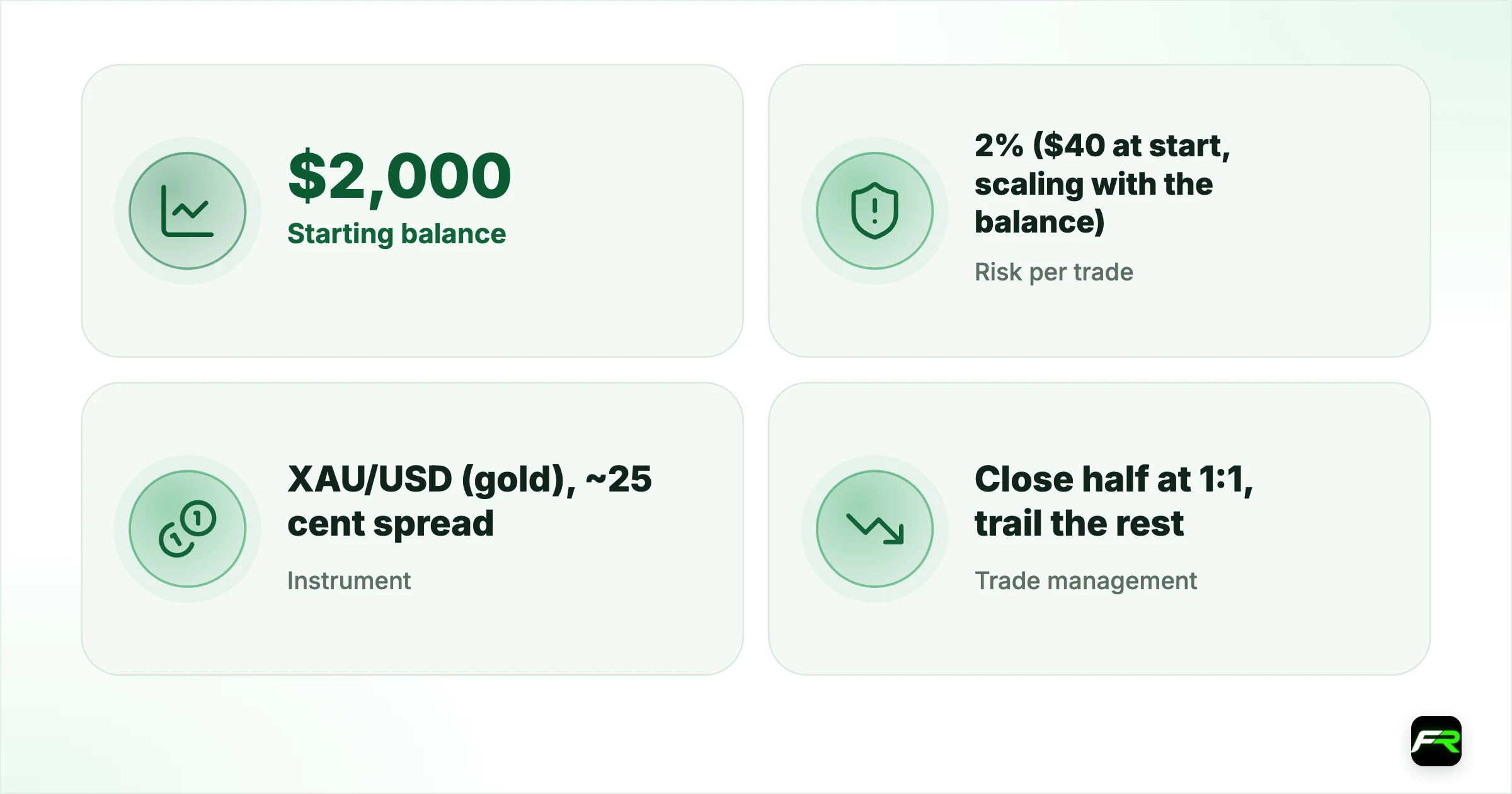
| Starting balance | $2,000 |
|---|---|
| Risk per trade | 2% ($40 at start, scaling with the balance) |
| Instrument | XAU/USD (gold), ~25 cent spread |
| Trade management | Close half at 1:1, trail the rest |
| Trades over 5 months | ~90 |
| Win rate | About 41% |
| Average winner vs average loser | 3.4 to 1 |
| Ending balance | ~$7,800 |
Why a 41% win rate still made money
Out of about 90 trades, only 37 were winners. More than half were losses. The account still came close to quadrupling because the average winning trade returned about 3.4 times the average losing trade. A trader who loses 53 times at 1R and wins 37 times at 3.4R comes out at about plus 73R over the period. At two per cent risk that compounds: each loss takes 2 per cent off the current balance, each average win adds about 6.8 per cent, and 37 wins against 53 losses works out to just under four times the starting balance. Because the risk figure grew as the balance grew, the later winners were worth more in dollars than the early ones. At one per cent risk, the same trades would have turned $2,000 into about $4,000, still a strong result, and a reminder of how much of the headline number comes from the risk setting.
This is the part beginners find hardest to accept. A strategy that is wrong most of the time can be highly profitable, and a strategy that is right most of the time can lose money if the few losses are large. Win rate on its own tells you almost nothing; what matters is expectancy, the average result per trade once win rate and reward ratio are both accounted for. The risk-reward guide works through why.
The stop placement that mattered
Gold's daily range through that run was often $40 to $70 or more. A stop placed 5 dollars away from entry would have been hit constantly on noise. The trader placed stops beyond the most recent swing high or low on the timeframe they were trading, which was usually $12 to $20 away. That meant fewer trades, because a wide stop plus a small risk figure means a small position, and it meant the position had room to survive an ordinary pullback before the trend resumed.
The gold stop-loss guide covers this in detail, but the principle is simple: on a volatile instrument, the stop has to sit outside the noise, which forces the position size down and keeps a single stop-out at two per cent instead of ten.
Mei Ling had blown two small accounts in the previous two years, both times by adding to losing gold positions until a margin call. The third time she wrote three rules on a sticky note on her monitor: two per cent risk, stop on every trade, never add to a loser. She kept a spreadsheet of every trade with the R multiple, timestamped against her broker's own trade history so she could not later round a bad number in her own favour. Her worst month was minus 6 per cent. Her best was plus 34 per cent. She says the account grew because she finally stopped trying to be right and started trying to be consistent, and that the sticky note did more for her results than any indicator.
Why it was repeatable
The test of whether a run like this is skill or luck is simple: could the trader show you, in advance, what a winning trade and a losing trade look like, and are the losses all roughly the same size? Here the answer was yes. Every loss was close to two per cent because every position was sized to a stop. The winners varied, but they were allowed to vary because half was banked at 1:1 and the rest trailed. There was no single trade that made the account. The largest winner was about 18 per cent of the balance at the time, roughly 9R, which is large but not account-defining.
What would break this approach is a market that stops trending. In a choppy, range-bound gold market the same rules would produce a slow bleed: lots of small losses, winners that never reach the trail, a flat or slightly negative equity curve. That is the honest risk. The strategy did well because it matched the conditions, and a disciplined trader adjusts size down or steps aside when the conditions change.
If you want to test whether your own results are repeatable, log every trade as an R multiple: plus 2.7R, minus 1R, minus 1R, plus 1.5R. If your losses are all near minus 1R and your winners vary above it, you have a process. If your losses are all different sizes, you do not have a risk rule yet.
Frequently asked
Can I expect a 300% return trading gold?
No, and planning for one is how accounts get destroyed. This result came from a strong trending market plus tight risk control, and it included months that were negative. A realistic target for a disciplined trader is a few per cent a month, with drawdowns along the way.
What does 'R multiple' mean?
R is your risk on a trade, the amount you lose if the stop is hit. A trade that makes twice your risk is plus 2R; a full stop-out is minus 1R. Logging trades in R terms strips out account size and lets you see whether your process works.
Why close half at 1:1?
Banking half the position at a 1:1 reward means the trade is now risk-free: even if the rest stops out at breakeven, you have locked a small gain. The remaining half is what captures the large trending moves. It is a way to have a decent win rate on partial closes while still letting winners run.
Is gold better than forex for a small account?
Not necessarily. Gold trends well but moves fast, and beginners lose money on it quickly for exactly that reason. See our guide on why new traders in Asia lose fastest on gold.
How much did spread and swap cost over the period?
A 25 cent spread costs $25 per standard lot. At the small sizes this account traded, a few hundredths of a lot, that was roughly $0.50 to $3 a trade, or around $100 to $150 across about 90 trades. Holding positions overnight added swap on top. On a small account costs look tiny per trade, but they come straight off the edge, which is why a marginal strategy is not enough.
Related reading
The team behind this guide
Researched, checked and approved by five forex specialists
Every guide is written, fact-checked and edited before it goes live, and updated when the facts change. Spotted an error? Tell us.