IC Markets





































MT4 vs MT5: Why the Older Platform Still Wins With Asian Traders
MT5 is technically better, yet MT4 still dominates in Asia thanks to copy trading, EAs and habit. An honest comparison.
 WriterAbir KhanWriterWrites the guides · checks every figure against primary sources View profileAbout Abir →
 Market analysisTanbir Habib RiyadForex & Crypto AnalystForex and crypto analyst · technical and fundamental analysis View profileAbout Tanbir →
 Fact-checking & riskJannatul FerdaushFact-Checker & Risk AnalystFact-checks every figure · risk analysis · Applied Statistics, University of Dhaka View profileAbout Jannatul →
 Trading reviewJowel RanaCo-Founder & Forex TraderCo-founder · forex trader · reviews guides from a trader's view View profileAbout Jowel →
 Final approvalRanjan NiskrityFounder, Owner & Forex TraderFounder and owner · forex trader · signs off every guide View profileAbout Ranjan →
Key takeaways
- MT5 is technically stronger: 21 timeframes, six pending order types, a built-in calendar and faster multi-currency testing.
- MT4 still dominates in Asia because of its copy-trading services, Expert Advisors and local-language tutorials.
- If you rely on a specific EA or copy service, use the platform it supports; otherwise MT5 is the better long-term default.
- Costs are set by account type, not platform, so check the broker's account page for the platform you plan to use.
MetaTrader 4 was released in 2005. MetaTrader 5 came in 2010 and is, on paper, the better platform: more timeframes, more order types, an economic calendar built in, faster backtesting, and it handles more asset classes. Yet across much of Asia, MT4 is still what most retail traders use by default. This is not nostalgia. It is a rational choice driven by the ecosystem that has grown up around MT4, and it is worth understanding before you pick.
The technical comparison
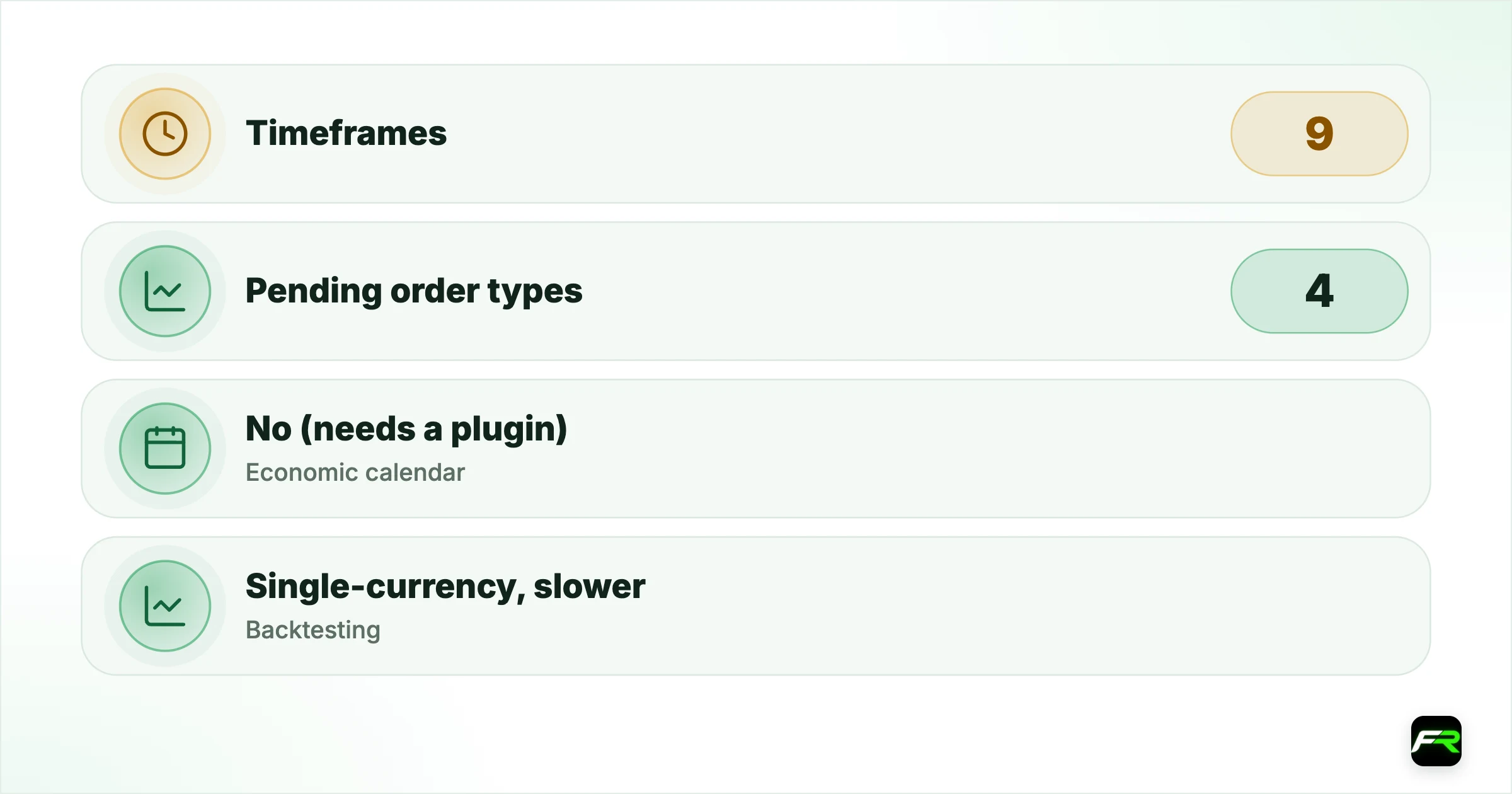
| Feature | MT4 | MT5 |
|---|---|---|
| Timeframes | 9 | 21 |
| Pending order types | 4 | 6 |
| Economic calendar | No (needs a plugin) | Built in |
| Backtesting | Single-currency, slower | Multi-currency, faster |
| Depth of market | Limited | Yes |
| Asset classes | Forex and CFDs mainly | Forex, CFDs, stocks, futures |
| Hedging (opposite positions on one symbol) | Yes by default | Yes, if the broker enables it |
On features alone, MT5 wins. If you are starting from scratch with no existing tools or habits, MT5 is the reasonable default and most brokers now push it.
Why MT4 persists in Asia
- The copy-trading ecosystem. A large share of the copy-trading and signal services popular across Southeast Asia were built for MT4 first. Many trading rooms, signal groups and social-trading platforms in the region still default to it.
- Expert Advisors. The huge library of free and paid EAs (automated strategies) is overwhelmingly written for MT4's MQL4 language. Traders who use a specific EA are locked to MT4 until it is ported, and many popular ones never are.
- Familiarity and teaching material. Most of the beginner content, YouTube tutorials and course material in local languages was made for MT4. A new trader following a Bahasa or Thai tutorial is usually being shown MT4.
- It is enough. For a discretionary trader placing a handful of trades a week on major pairs and gold, MT4's nine timeframes and four order types cover everything they actually use.
Aiman started on MT4 because that is what his trading group used and what every tutorial he watched showed. He tried MT5 once, found the layout slightly different, and switched back because the copy-trading service he follows only supports MT4. He is aware MT5 is technically better; it does not matter to how he trades, which is a few manual trades a week on EUR/USD, GBP/USD and gold.
Which should you choose
- If you plan to use a specific EA or copy-trading service, use whichever platform it supports. That decides it.
- If you are a discretionary trader with no external tools, either works; MT5 is the better long-term choice and most brokers offer it as standard now.
- If your learning material and trading community are all MT4, starting there reduces friction, and you can move to MT5 later with almost no relearning.
- Do not pick a broker on platform alone. A broker's licence, pricing and withdrawal record matter far more than MT4 versus MT5.
The trading logic is identical on both platforms. A trade placed on MT4 and the same trade on MT5 with the same broker behave the same way. Moving between them costs a day of getting used to a slightly different layout, not a relearning of how to trade.
The proprietary platform question
Some brokers also offer their own web and mobile platforms, and a few are genuinely good. They are usually cleaner for a beginner and better on mobile. The trade-off is that they lack the EA and copy-trading ecosystem, and if you leave the broker you cannot take your setup with you. For a discretionary trader who values a clean interface and does not use automation, a good proprietary platform is a valid choice. For anyone using EAs or copy trading, MetaTrader remains the practical option.
Frequently asked
Is MT5 better than MT4?
Technically yes: more timeframes, more order types, a built-in economic calendar, faster multi-currency backtesting, and support for more asset classes. For a simple discretionary strategy on major pairs, the extra features may not matter to you.
Why do so many Asian traders still use MT4?
The copy-trading services, signal groups and Expert Advisors popular across the region were mostly built for MT4 first, and most local-language tutorials teach MT4. For a discretionary trader, MT4 also does everything they actually use.
Can I use my MT4 Expert Advisor on MT5?
Not directly. MT4 EAs are written in MQL4 and MT5 uses MQL5. The EA has to be rewritten or ported, and many popular free EAs never are, which locks their users to MT4.
Does the trading work differently on MT4 and MT5?
No. The same trade on the same broker behaves identically on both. Switching platforms is a matter of getting used to a slightly different layout, not relearning how to trade.
Should I use a broker's own platform instead?
A good proprietary platform can be cleaner, especially on mobile, and is fine for a discretionary trader. The downside is no EA or copy-trading ecosystem and no portability if you change brokers. MetaTrader is the practical choice if you use automation.
Does platform choice affect trading costs or commissions?
Usually not directly. Spreads and commissions are set by the account type, such as standard or raw, not by whether you trade on MT4 or MT5, so the same account normally costs the same on either. The exceptions are brokers that offer a raw-pricing account only on certain platforms, or price their own proprietary platform differently, so check the broker's account comparison page for the platform you plan to use.
Related reading
The team behind this guide
Researched, checked and approved by five forex specialists
Every guide is written, fact-checked and edited before it goes live, and updated when the facts change. Spotted an error? Tell us.