IC Markets





































Daily Forex Turnover Hit $9.6 Trillion: What That Means for You
The BIS puts daily forex turnover around $9.6 trillion. What the number is made of, and what it means for a retail trader's fills.
 WriterAbir KhanWriterWrites the guides · checks every figure against primary sources View profileAbout Abir →
 Market analysisTanbir Habib RiyadForex & Crypto AnalystForex and crypto analyst · technical and fundamental analysis View profileAbout Tanbir →
 Fact-checking & riskJannatul FerdaushFact-Checker & Risk AnalystFact-checks every figure · risk analysis · Applied Statistics, University of Dhaka View profileAbout Jannatul →
 Trading reviewJowel RanaCo-Founder & Forex TraderCo-founder · forex trader · reviews guides from a trader's view View profileAbout Jowel →
 Final approvalRanjan NiskrityFounder, Owner & Forex TraderFounder and owner · forex trader · signs off every guide View profileAbout Ranjan →
Key takeaways
- The BIS put average daily FX turnover at $9.6 trillion in April 2025.
- Only about 31% is spot, the price you trade; FX swaps, mostly bank funding, are the largest share at about 42%.
- The dollar is on one side of about 89% of trades, and EUR/USD alone is roughly a quarter of turnover.
- Depth is concentrated in the majors during London and New York, and it disappears around big news.
Every three years the Bank for International Settlements runs the definitive survey of the global foreign exchange market. The most recent figure (the BIS Triennial Survey for April 2025) put average daily turnover at $9.6 trillion. It is a staggering number, and it is often quoted to reassure new traders that forex is so deep that no single participant can move it. That is broadly true, but the number is more nuanced than it looks, and understanding what it contains changes how you think about your own trading.
What the number is made of
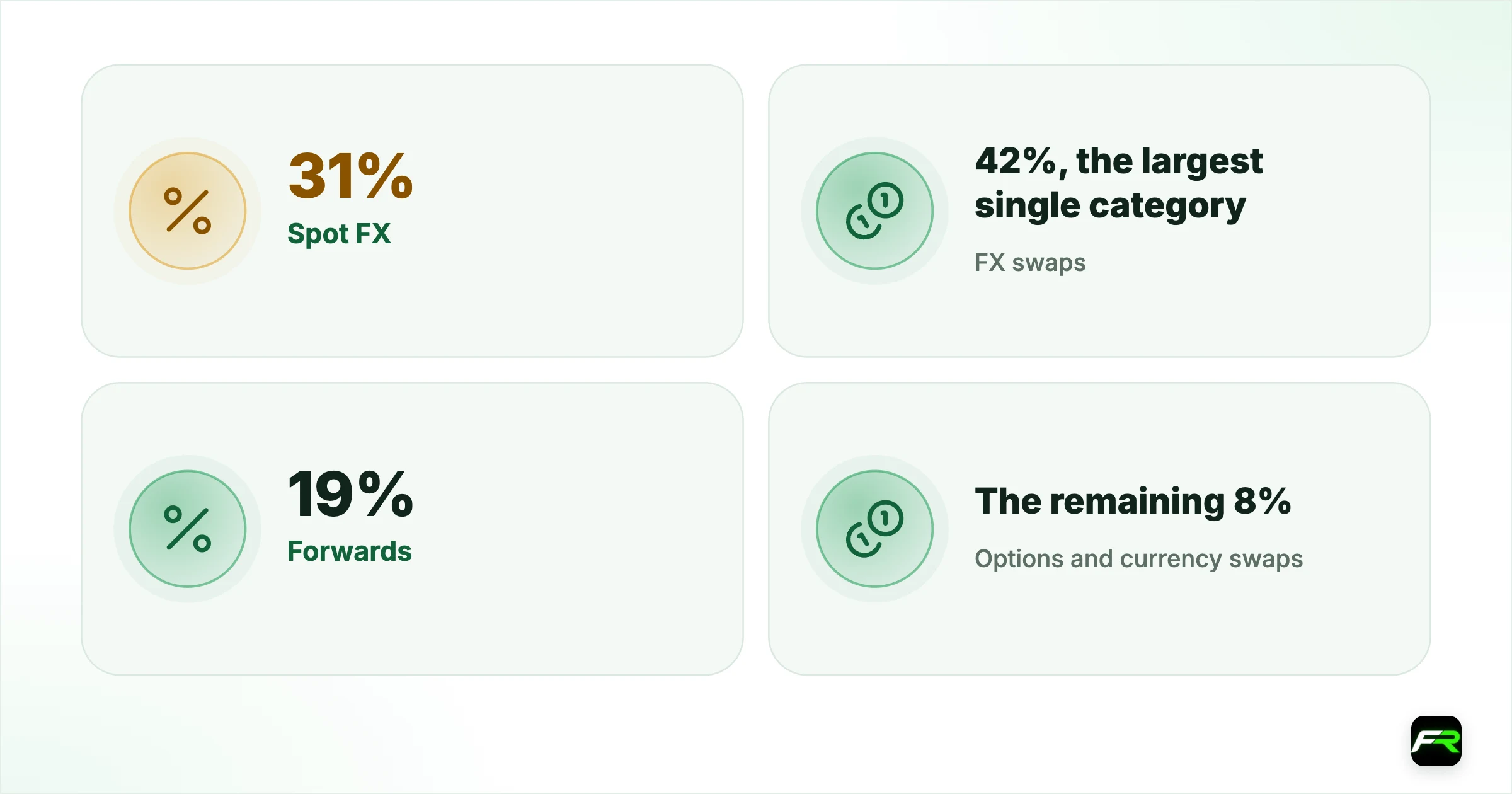
| Component | Roughly | Relevance to a retail trader |
|---|---|---|
| Spot FX | 31% | This is the price you trade; the rest is derivatives and swaps |
| FX swaps | 42%, the largest single category | Bank funding and hedging, not directional trading |
| Forwards | 19% | Corporate hedging and institutional positioning |
| Options and currency swaps | The remaining 8% | Mostly institutional risk management |
| Retail speculative flow | A small fraction of spot | You are a very small fish in a very large pond |
So the $9.6 trillion is not $9.6 trillion of people betting on direction. A large part is FX swaps, which banks use to manage funding across currencies and which have little to do with where EUR/USD closes today. The directional, price-moving part is a subset of the spot figure. Still enormous, but not the whole number.
Why ‘the deepest market’ still moves fast
Depth is not evenly spread. It is concentrated in the majors (EUR/USD, USD/JPY, GBP/USD) and in the London and New York hours. At 03:00 GMT on a JPY cross, or on an emerging-market pair any time, the book is a fraction of that depth. And even in the deepest pair, a scheduled event like a central-bank decision temporarily empties the book as market makers pull quotes to avoid being run over. That is why a $9.6 trillion market can still move 100 pips in seconds: the depth vanishes exactly when you would most want it.
Which currencies actually make up the volume
The dollar is on one side of about 89% of all trades, which is why almost every pair you trade is really a bet on something against the dollar. EUR/USD alone is the single most active pair, at roughly a quarter of global turnover, followed by USD/JPY and GBP/USD. Beyond those top few, the concentration drops off fast: the BIS's 2025 survey found the top seven pairs' combined share has actually fallen over time as trading spreads into a wider set of currencies, but the majors named above still dominate the liquidity a retail trader actually feels.
What it means for your fills
- In the deep majors during liquid hours, your market orders fill at or very near the quoted price, and slippage is minimal.
- In thin hours, on minors and exotics, or around news, slippage can be several pips, and stop orders can fill well past their level.
- Your own size is never the problem. A retail trader is not moving EUR/USD. The market moves because of institutional flow and the absence of quotes around events.
- The spread you pay is set by liquidity: tightest in the majors during the overlap, widest on exotics in quiet hours.
Ravi assumed that because forex was ‘the biggest market in the world’ his stops would always fill cleanly. Then he traded a JPY pair through a BoJ comment and his stop filled 22 pips past its level in a fast, quote-less moment. He learned that market depth is a function of time and pair and event, not a constant, and he now avoids market orders in thin conditions and stays flat around scheduled events, a habit the Tokyo session guide covers in more depth for Asian hours specifically.
The useful takeaway
The size of the forex market is real and it does mean your individual trades have no impact on price. But it does not mean the market is always liquid for you. Liquidity concentrates in the majors during London and New York, and it disappears around events. Trade the deep pairs in the deep hours and your costs and fills are good. Trade the thin pairs in the thin hours and the $9.6 trillion figure will not help you at all.
Frequently asked
Is daily forex turnover really $9.6 trillion?
That is the figure from the BIS Triennial Survey for April 2025, the most recent edition. It includes spot, forwards, swaps and options; the spot portion, which is the price you trade, is roughly a third of the total.
Does that mean I can’t move the market?
Correct. A retail trader’s size is a rounding error in a market this large. When price moves against you it is institutional flow or the absence of quotes around an event, not your order.
If the market is so deep, why do I get slippage?
Because depth is concentrated in the majors during London and New York hours. In thin hours, on minors and exotics, or around scheduled news when market makers pull quotes, the book is shallow and orders can fill well past their level.
What are FX swaps and why are they the biggest category?
FX swaps are agreements to exchange currencies now and reverse the exchange later, used by banks and companies to manage funding across currencies. They dominate the turnover figure but are not directional trading and do not drive the spot price the way speculative flow does.
Which currency pairs make up most of the $9.6 trillion?
The US dollar is on one side of about 89% of all trades. EUR/USD is the single most active pair at roughly a quarter of turnover, followed by USD/JPY and GBP/USD, per the 2025 BIS Triennial Survey.
How often does the BIS update this survey?
Every three years. The figure in this guide is from the April 2025 survey, published in September 2025; the next update is due in 2028.
Which pairs have the best liquidity for a retail trader?
EUR/USD, USD/JPY, GBP/USD and the other majors, especially during the London-New York overlap (12:00-16:00 GMT). Spreads are tightest and fills cleanest there.
Related reading
The team behind this guide
Researched, checked and approved by five forex specialists
Every guide is written, fact-checked and edited before it goes live, and updated when the facts change. Spotted an error? Tell us.