IC Markets




































Why Gold Trading Volume Rises During Indian Wedding Season
India's wedding seasons concentrate physical gold demand. How that shows up in volume and price, and how reliable the effect is.
 WriterAbir KhanWriterWrites the guides · checks every figure against primary sources View profileAbout Abir →
 Market analysisTanbir Habib RiyadForex & Crypto AnalystForex and crypto analyst · technical and fundamental analysis View profileAbout Tanbir →
 Fact-checking & riskJannatul FerdaushFact-Checker & Risk AnalystFact-checks every figure · risk analysis · Applied Statistics, University of Dhaka View profileAbout Jannatul →
 Trading reviewJowel RanaCo-Founder & Forex TraderCo-founder · forex trader · reviews guides from a trader's view View profileAbout Jowel →
 Final approvalRanjan NiskrityFounder, Owner & Forex TraderFounder and owner · forex trader · signs off every guide View profileAbout Ranjan →
Key takeaways
- Indian wedding demand peaks from October to December, alongside Diwali, with a second window from January to March.
- Importers buy ahead, so the pull on global demand starts weeks before the retail season.
- It is a mild seasonal tailwind that fades when prices have already run hard, as in 2026.
- The domestic premium over the world price is the best real-time gauge of wedding-season buying.
In India, gold is central to weddings. It is given as gifts, worn by the bride, and passed between families as a form of wealth transfer. With millions of weddings concentrated into a few auspicious months each year, the demand for gold jewellery spikes in a predictable seasonal pattern, and that physical buying flows back into the wholesale and import market, adding to global demand.
When the season runs
There are two main wedding windows in India. The larger one runs roughly from October, after the monsoon, through December, overlapping with the Diwali festival buying. The second runs through the spring, roughly January to March and into April and May depending on the year’s auspicious dates. Jewellers and importers buy ahead of these windows, so the demand pull on the global market starts a few weeks before the retail season.
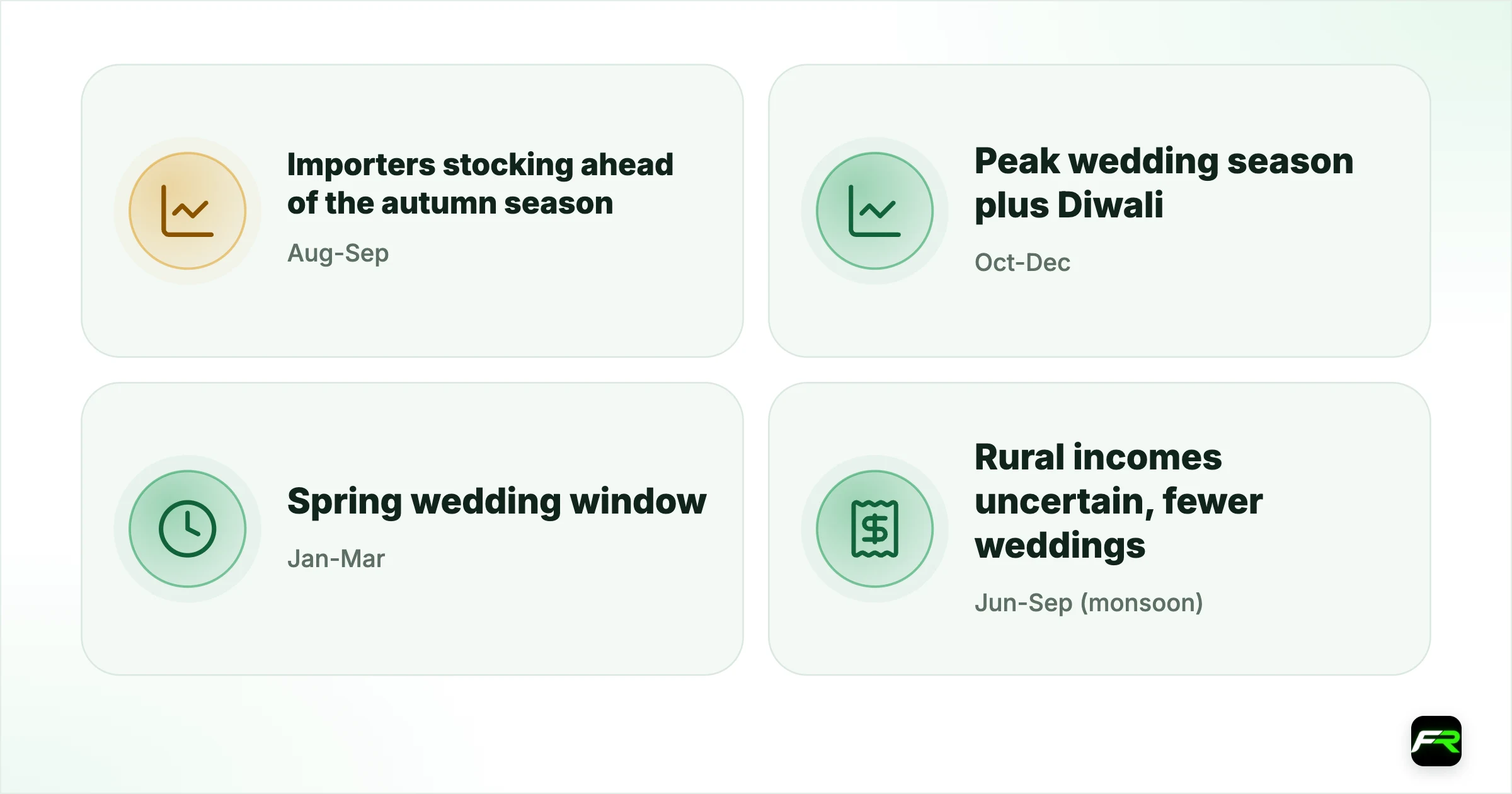
| Period | Activity | Gold market effect |
|---|---|---|
| Aug-Sep | Importers stocking ahead of the autumn season | Mild upward pressure on demand |
| Oct-Dec | Peak wedding season plus Diwali | Strongest concentrated Indian demand |
| Jan-Mar | Spring wedding window | Secondary demand peak |
| Jun-Sep (monsoon) | Rural incomes uncertain, fewer weddings | Seasonally weaker Indian demand |
How it shows up
Two effects. First, physical demand rises, which shows up in India’s gold imports and in the domestic premium over the world price. Second, on the trading side, volume in gold instruments tends to pick up in the autumn as Indian and other Asian participants become more active, and volatility can rise around large physical buying days. The price effect is a mild seasonal tailwind: long-run studies show gold tends to be firmer in the autumn, consistent with this demand, and softer in the northern-hemisphere summer.
How reliable is it
It is a real pattern but a weak one relative to the macro drivers. Indian household gold demand is price-sensitive: when the domestic price has already risen sharply, families buy less, defer purchases, or recycle old gold, and the seasonal support fades. In a year like 2026 with gold at records driven by central-bank buying and rate expectations, the wedding-season effect was a minor factor. In a year with a moderate gold price and good rural incomes after a strong monsoon, the seasonal demand is more visible.
Anil watches the Indian gold import figures and the domestic premium through September and October. A rising premium tells him wedding-season demand is genuinely strong and physical buyers are paying up for supply, which he treats as a mild bullish input. A discount tells him buyers have gone quiet because prices are too high, which cancels the seasonal signal regardless of the calendar.
Why the premium isn't always about demand
The domestic premium over the world price is the cleanest real-time read on wedding-season buying, but it moves for reasons that have nothing to do with weddings too. Import duty changes, gold-loan and jewellery-financing rules, and the rupee's own exchange rate all shift the landed cost of gold into India independently of physical demand. A rising premium during the wedding window is a genuine bullish signal; a rising premium caused by a duty change or a weaker rupee is not, so check what actually moved before reading it as a demand story.
How retail traders actually get exposure
Few retail forex traders hold physical gold or trade the Indian jewellery market directly. The practical routes are spot gold (XAU/USD) or gold CFDs through a forex broker, which track the world price rather than the India-specific premium, and USD/INR, which moves partly on the import bill when demand is strong. The World Gold Council's India data and the monthly import figures are the two things worth watching if you want the wedding-season effect to actually show up in a trade rather than staying a background narrative. The gold trading guide covers the mechanics of trading XAU/USD itself.
Trading implications
- Treat wedding-season demand as a secondary tailwind, not a standalone trade.
- It matters more in a year of moderate prices and strong rural incomes (good monsoon).
- Watch India’s monthly gold imports and the domestic premium as the real-time gauge of demand strength.
- The dollar, real US yields and central-bank flows will usually set the trend regardless of the season.
Weddings account for roughly half of India's annual gold demand on World Gold Council estimates, and November and December alone have historically driven demand for around 135 tonnes as an estimated 3 million weddings take place in that window, the scale behind the seasonal pattern described above.
The monsoon matters here. About half of India’s gold demand has historically come from rural areas, where incomes depend on the harvest. A good monsoon supports rural buying power and strengthens the autumn wedding-season demand; a poor one weakens it.
Frequently asked
When is Indian wedding season?
The larger window runs roughly October to December, overlapping Diwali. A second window runs through the spring, roughly January to March and into April or May, depending on the year’s auspicious dates.
Does gold always rise during Indian wedding season?
There is a mild historical tendency for firmer autumn gold prices consistent with the demand, but it is easily overwhelmed by macro factors, and Indian demand itself weakens when prices are already high.
How much of world gold demand comes from India?
India has historically been one of the two largest consumer markets for gold (with China), together accounting for roughly half of global jewellery, bar and coin demand, though central-bank buying is now a large share of total demand.
Why does the monsoon matter for gold?
A large share of Indian gold demand comes from rural areas, where incomes depend on the harvest. A good monsoon boosts rural buying power and the autumn wedding-season demand; a poor one weakens it.
Should I trade gold on the wedding-season calendar?
Only as one input. The trend is set by the dollar, real yields and central-bank flows. Use India’s monthly gold imports and the domestic premium as the real-time demand gauge rather than the calendar alone.
Related reading
The team behind this guide
Researched, checked and approved by five forex specialists
Every guide is written, fact-checked and edited before it goes live, and updated when the facts change. Spotted an error? Tell us.