IC Markets





































China's Record Gold Buying and What It Means for Gold Prices
Central banks led by China have kept buying gold, a major support for 2026 prices. Why they buy, and what it means for gold traders.
 WriterAbir KhanWriterWrites the guides · checks every figure against primary sources View profileAbout Abir →
 Market analysisTanbir Habib RiyadForex & Crypto AnalystForex and crypto analyst · technical and fundamental analysis View profileAbout Tanbir →
 Fact-checking & riskJannatul FerdaushFact-Checker & Risk AnalystFact-checks every figure · risk analysis · Applied Statistics, University of Dhaka View profileAbout Jannatul →
 Trading reviewJowel RanaCo-Founder & Forex TraderCo-founder · forex trader · reviews guides from a trader's view View profileAbout Jowel →
 Final approvalRanjan NiskrityFounder, Owner & Forex TraderFounder and owner · forex trader · signs off every guide View profileAbout Ranjan →
Key takeaways
- Central banks, led by China, India, Turkey and Poland, have been buying gold well above the pre-2022 pace.
- Reserve managers rarely sell into rallies, which creates a persistent bid and shallower pullbacks.
- Official buying is the slow layer of demand; Indian wedding and festival buying add seasonal bursts on top.
- The World Gold Council's quarterly data is the best check on whether that support is fading.
A large part of gold's rise through 2026 has come from a buyer that does not care about the price the way a speculator does: central banks. The People's Bank of China, along with the central banks of India, Turkey, Poland and several others, has been adding gold to official reserves at a pace well above the historical norm. This is structural demand, and it changes the character of the gold market.
Why central banks are buying
- Reserve diversification. Many emerging-market central banks hold large dollar reserves and want to reduce their concentration in a single currency and in US Treasuries.
- Sanctions risk. The freezing of Russian central-bank assets held abroad made other governments wary of holding reserves that another country could block. Physical gold held domestically cannot be frozen the same way.
- Long-term store of value. Gold has no counterparty and no default risk, which appeals to reserve managers thinking in decades.
- Domestic policy. China in particular has encouraged gold accumulation as part of a broader strategy around the yuan and financial resilience.
Why it supports the price differently
A speculator buying gold futures will sell when the price rises enough or when the macro picture changes. A central bank buying for reserves generally does not sell on a rally; it accumulates over years regardless of short-term price. That creates a persistent bid under the market and reduces the depth of pullbacks. When gold dips, official buyers often step in, which is part of why the 2026 uptrend has had shallow corrections compared with past gold bull markets.
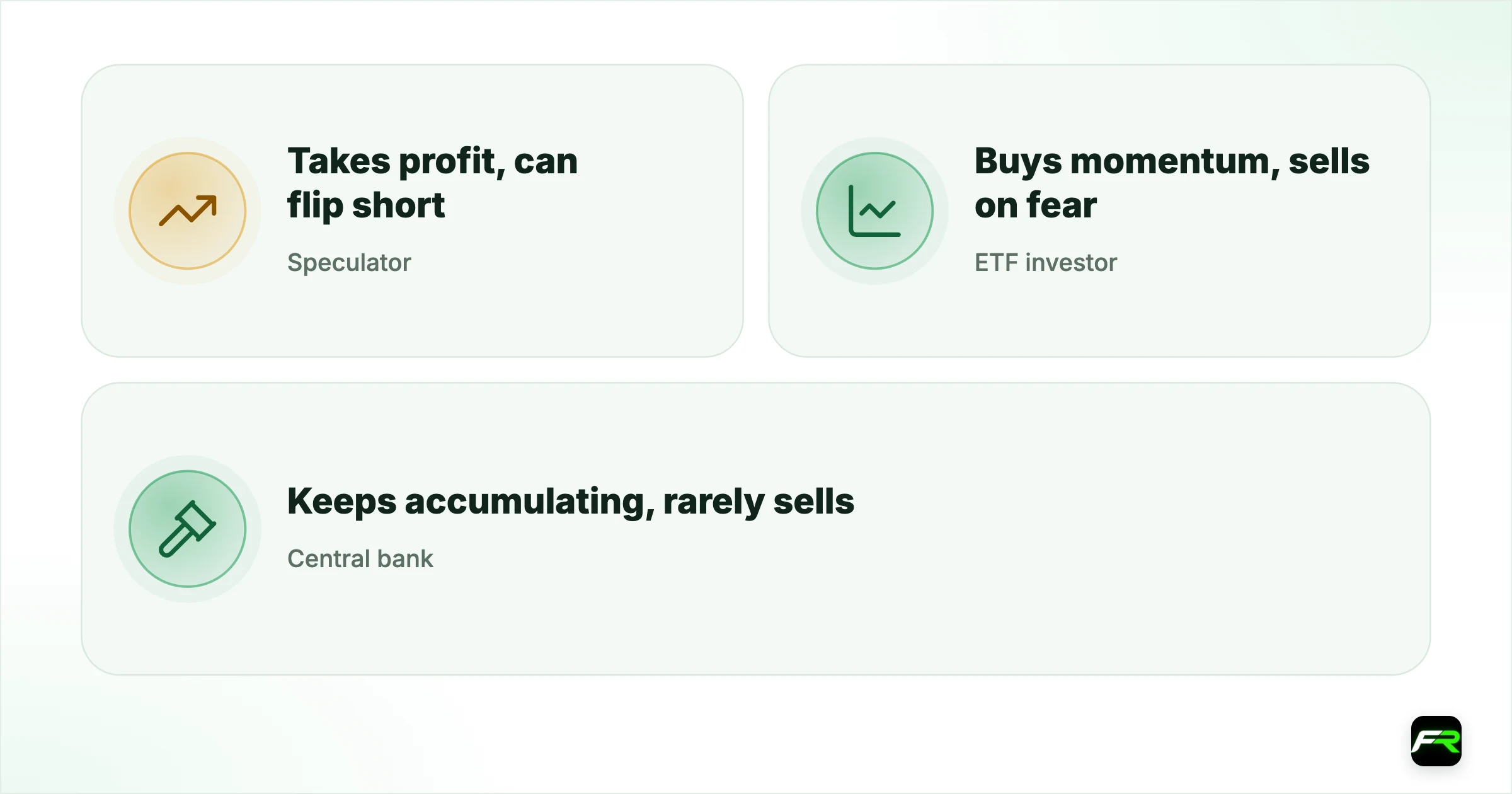
| Buyer type | Behaviour on a rally | Effect on price |
|---|---|---|
| Speculator (futures, CFDs) | Takes profit, can flip short | Adds volatility both ways |
| ETF investor | Buys momentum, sells on fear | Amplifies trends |
| Central bank (reserves) | Keeps accumulating, rarely sells | Persistent bid, shallower dips |
What it means for a trader
The structural bid does not mean gold only goes up. It means the balance of risk in a strong macro environment is tilted toward buyers, and that dip-buying strategies have had a tailwind. It also means a gold trader should watch the World Gold Council's quarterly Gold Demand Trends reports on central-bank demand and any official Chinese reserve data, because a slowdown in that buying would remove a support the market has come to rely on.
Anan, who caught a large part of gold's rally, said the central-bank buying story was what gave him the confidence to hold through the scary days. Every time gold pulled back and the headlines turned bearish, the pullback was shallow and quickly bought. He treated the structural demand as a reason to give trend trades more room, while still keeping every position sized to a one per cent risk.
How this fits with gold's seasonal demand
Central-bank buying is the slow, structural layer of gold demand. On top of it sit two seasonal layers driven by households rather than governments: the Indian wedding season, covered in gold volume and the Indian wedding season, and the festival buying around Diwali and Chinese New Year, covered in why gold prices spike around Diwali and Chinese New Year. Together the three explain most of Asia's influence on the gold price: official buyers set the floor, and seasonal consumer demand adds bursts on top of it.
The risk to the thesis
If central-bank buying slows sharply, either because gold has become too expensive for reserve managers to keep adding at pace, or because the diversification is judged complete, the market loses its most reliable buyer. Combined with a shift toward higher real US yields, that could produce a deeper correction than the 2026 uptrend has seen so far. The structural bid is a support, not a guarantee, and it can fade.
Central-bank gold data is reported with a lag and some countries under-report or report irregularly, so the exact pace of buying is always an estimate. Treat the trend as more reliable than any single quarter's figure.
Frequently asked
How much gold are central banks buying?
Central-bank net purchases have run well above the pre-2022 average for several years, with China, India, Turkey and Poland among the largest buyers. The World Gold Council publishes quarterly estimates.
Why does central-bank buying matter more than ETF buying?
Central banks buy for long-term reserves and rarely sell on a rally, creating a persistent bid. ETF and speculative flows are momentum-driven and reverse quickly, adding volatility rather than steady support.
Will China keep buying gold?
The stated rationale (reserve diversification, sanctions resilience) is long-term, so continued accumulation is likely, but the pace can slow if prices are judged too high or the diversification goal is met. Watch official reserve updates.
Does central-bank buying mean gold can't fall?
No. It provides a support that has made 2026's pullbacks shallow, but a shift to higher real yields plus a slowdown in official buying could still produce a meaningful correction.
Where can I check central-bank gold buying data myself?
The World Gold Council publishes central-bank demand every quarter in its Gold Demand Trends report and keeps a table of official gold reserves by country on gold.org. For China specifically, the People's Bank of China's official reserve assets, including gold holdings, are published monthly through the State Administration of Foreign Exchange (safe.gov.cn).
What is the sanctions angle?
After Russian central-bank assets held abroad were frozen in 2022, other governments became wary of holding reserves another country could block. Physical gold held domestically is not exposed to that risk, which increased its appeal as a reserve asset.
Related reading
The team behind this guide
Researched, checked and approved by five forex specialists
Every guide is written, fact-checked and edited before it goes live, and updated when the facts change. Spotted an error? Tell us.