IC Markets





































How Session Volatility Changes What You Should Risk Per Trade
Tokyo, London and New York move at very different speeds. How to adjust position size and stop distance by session.
 WriterAbir KhanWriterWrites the guides · checks every figure against primary sources View profileAbout Abir →
 Market analysisTanbir Habib RiyadForex & Crypto AnalystForex and crypto analyst · technical and fundamental analysis View profileAbout Tanbir →
 Fact-checking & riskJannatul FerdaushFact-Checker & Risk AnalystFact-checks every figure · risk analysis · Applied Statistics, University of Dhaka View profileAbout Jannatul →
 Trading reviewJowel RanaCo-Founder & Forex TraderCo-founder · forex trader · reviews guides from a trader's view View profileAbout Jowel →
 Final approvalRanjan NiskrityFounder, Owner & Forex TraderFounder and owner · forex trader · signs off every guide View profileAbout Ranjan →
A fixed risk rule of one per cent per trade is correct, but a fixed stop distance is not. The same pair moves two or three times as fast during the London and New York overlap as it does in the middle of the Tokyo session, so a 15-pip stop that survives comfortably at 07:00 GMT gets clipped on ordinary noise at 13:00 GMT. If you keep the stop the same and let the position size stay the same, you are effectively risking more during the volatile hours because the stop is more likely to be hit by noise.
The fix is not to change your risk percentage. It is to widen the stop during volatile sessions and let that shrink the position size, so a noise-driven stop-out is less likely and the dollar risk stays at one per cent either way.
How each session behaves
| Session (GMT) | Character | Typical EUR/USD 5-min range | Stop guidance |
|---|---|---|---|
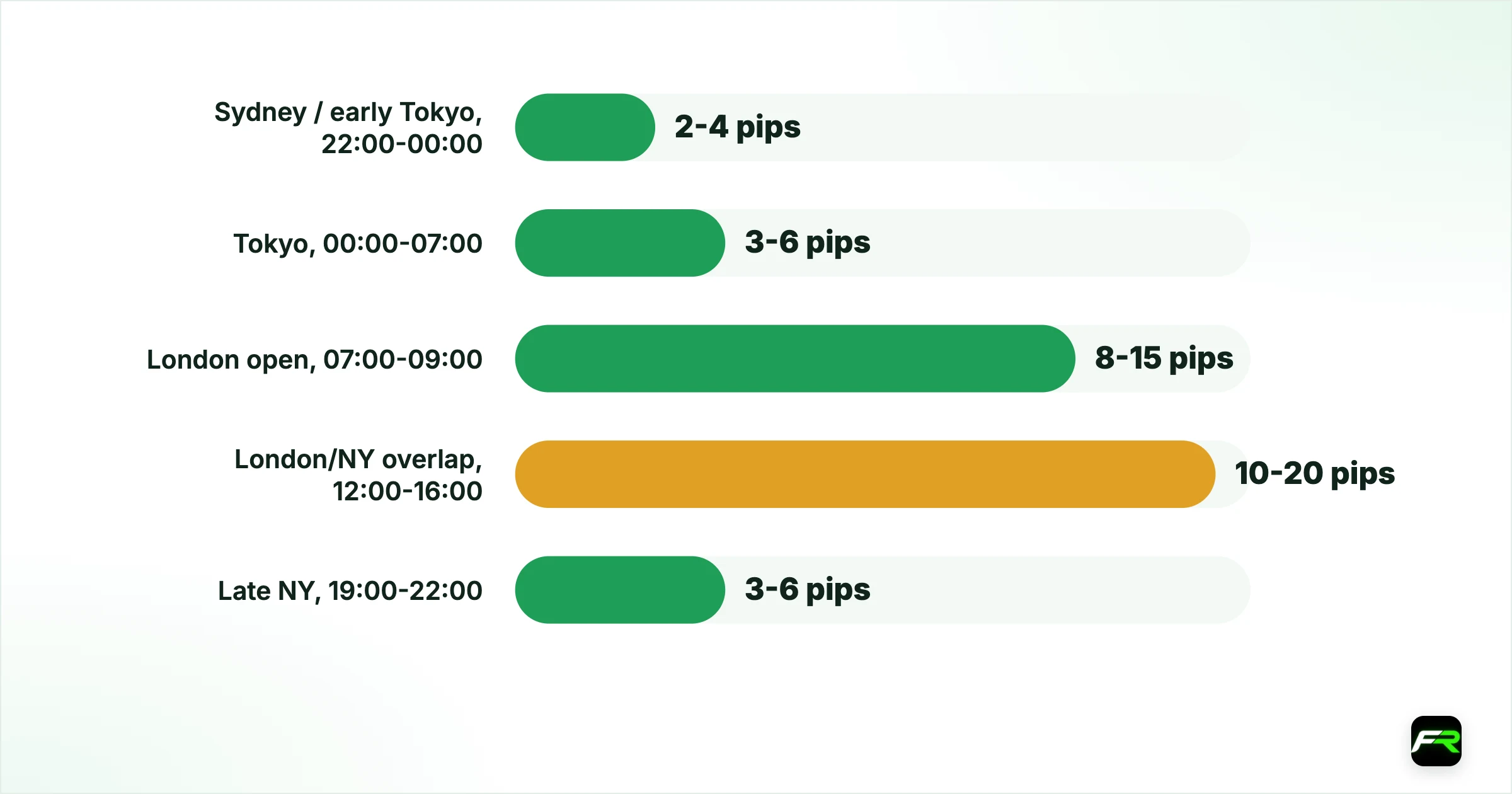
| Sydney/early Tokyo, 22:00-00:00 | Thin, drifting | 2-4 pips | Tight stops, small ranges |
| Tokyo, 00:00-07:00 | Range-bound, moderate | 3-6 pips | Range-edge stops, ~15-25 pips |
| London open, 07:00-09:00 | Fast, directional | 8-15 pips | Wider stops, ~25-40 pips |
| London/NY overlap, 12:00-16:00 | Highest volume, largest moves | 10-20 pips | Widest stops, ~30-50 pips |
| Late NY, 19:00-22:00 | Fading | 3-6 pips | Tighten again |
Working an example
You have a $3,000 account, one per cent risk is $30. In the Tokyo session you trade EUR/USD with a 20-pip range stop. At $30 risk over 20 pips you need $1.50 per pip, which is 0.15 lots. Later the same day you want to trade the London-NY overlap, where a sensible stop for the same setup is 40 pips because price is moving faster. At $30 risk over 40 pips you need $0.75 per pip, which is 0.075 lots, half the Tokyo position. Same dollar risk, half the size, because the stop had to be twice as wide to sit outside the noise.
If you had instead kept the 0.15-lot position and the 20-pip stop into the overlap, you would be stopped out on random moves far more often, and each stop-out would still cost $30, so your effective loss rate would climb without your risk rule ever changing on paper.
Priya trades before work (Tokyo session) and sometimes in the evening (London-NY overlap for India). She kept losing evening trades that would have worked if given room, then realised she was using her morning stop distances in a much faster market. She now has two stop presets: 20 pips for the morning, 40 for the evening, with the position size auto-adjusting so the risk stays at 1.5 per cent. Her evening win rate went from about 35 per cent to 46 per cent without changing anything about her entries.
Gold and JPY pairs are the extreme case
Gold can move $10 to $20 in a quiet Asian hour and $40 to $80 during the New York session on a data day. USD/JPY and AUD/JPY do something similar around the Tokyo fix (roughly 00:55 GMT) and around any Bank of Japan communication. For these instruments the session adjustment is not optional. A gold stop that works in the Asian session can be a rounding error during New York, and a position sized for the calm hours becomes dangerously large when volatility triples.
The rule to take away
- Keep your risk percentage constant across all sessions.
- Set the stop distance by what the market is actually doing right now, not by a fixed number.
- Let the position size fall out of those two: wider stop in volatile sessions means smaller position.
- If you cannot watch a fast session, either size for its volatility or trade the calm hours instead.
An ATR (Average True Range) reading on your trading timeframe is a quick proxy for current volatility. If ATR has doubled from this morning, your stop probably needs to be roughly twice as wide, and your position roughly half the size, to keep the dollar risk the same.
Volatility expansion and contraction
Traders sometimes describe this same pattern as volatility expansion and contraction rather than by session name, and it is worth knowing both terms because they describe the same thing from a different angle. Volatility expansion is ATR or range widening, which is what happens every day as Tokyo hands off to London and the ranges in the table above grow. Volatility contraction is the reverse, the ranges tightening back down as New York fades into Sydney. The session guidance above is really a scheduled, predictable version of expansion and contraction: you do not need to guess whether volatility is about to expand, because the calendar already tells you when London opens.
Frequently asked
Should I just always use a wide stop to be safe?
No. A wide stop in a calm session means either an oversized position (if you keep the pip risk) or a tiny position that barely moves the account. Match the stop to current volatility so it is outside the noise but not needlessly far.
What is ATR and how do I use it for stops?
Average True Range measures the average size of recent bars. A common approach is to place the stop 1.5 to 2 times the current ATR away from entry, which keeps it outside normal noise and adjusts automatically as volatility changes.
Which session is best for a beginner in Asia?
The Tokyo session, because it is slower and more range-bound, which gives more time to think and a simpler market to learn on. See our guide to the best trading hours for Asian traders.
Does spread also change by session?
Yes. Spreads are widest in the thin hours (late New York into Sydney) and around news, and tightest during the London-NY overlap when liquidity is deepest. Factor spread into your stop and target, especially in quiet hours.
How do I trade the London-NY overlap if I have a day job in Asia?
For most of Asia the overlap is evening, roughly 20:00 to 24:00 local. It is tradable after work, but it is fast, so size for the volatility, keep a hard stop, and avoid it around major US data if you cannot watch closely.
Related reading
The team behind this guide
Researched, checked and approved by five forex specialists
Every guide is written, fact-checked and edited before it goes live, and updated when the facts change. Spotted an error? Tell us.