IC Markets






































Negative Balance Protection: The Feature That Keeps a Bad Trade From Turning Into Debt
Negative balance protection means you can't lose more than your deposit. What it covers, which regulators require it, and why it matters.
 WriterAbir KhanWriterWrites the guides · checks every figure against primary sources View profileAbout Abir →

 Market analysisTanbir Habib RiyadForex & Crypto AnalystForex and crypto analyst · technical and fundamental analysis View profileAbout Tanbir →

 Fact-checking & riskJannatul FerdaushFact-Checker & Risk AnalystFact-checks every figure · risk analysis · Applied Statistics, University of Dhaka View profileAbout Jannatul →

 Trading reviewJowel RanaCo-Founder & Forex TraderCo-founder · forex trader · reviews guides from a trader's view View profileAbout Jowel →

 Final approvalRanjan NiskrityFounder, Owner & Forex TraderFounder and owner · forex trader · signs off every guide View profileAbout Ranjan →

Key takeaways
- Negative balance protection resets your account to zero if a fast move pushes losses past your deposit, so you never owe the broker.
- It is mandatory for retail clients under the FCA, ESMA rules (including CySEC brokers) and ASIC, but not everywhere offshore.
- It applies per entity: a broker's EU company may offer it while its offshore company does not.
- It caps the loss at your deposit; it doesn't replace stops, position sizing or protection against broker insolvency.
Negative balance protection (NBP) is a policy that resets your account to zero if a trade goes so badly that the loss exceeds your deposit. Without it, a violent market move that blows through your margin can leave you owing the broker money. With it, the worst case is that your account balance is zero. For a retail trader, it is one of the few broker features that is a genuine safety line and not a marketing line.
How an account goes negative
Normally, a broker closes your positions automatically when your margin level drops too low (the margin call and stop-out process). But in a fast market, particularly around news, a central-bank surprise, or a gap over the weekend, price can jump so far so quickly that the stop-out executes at a much worse level than intended, or cannot execute at all until price has moved well past your margin. The realised loss can then exceed your balance. This is rare but real. The 2015 Swiss franc move and several yen intervention spikes have produced negative balances for traders without NBP.
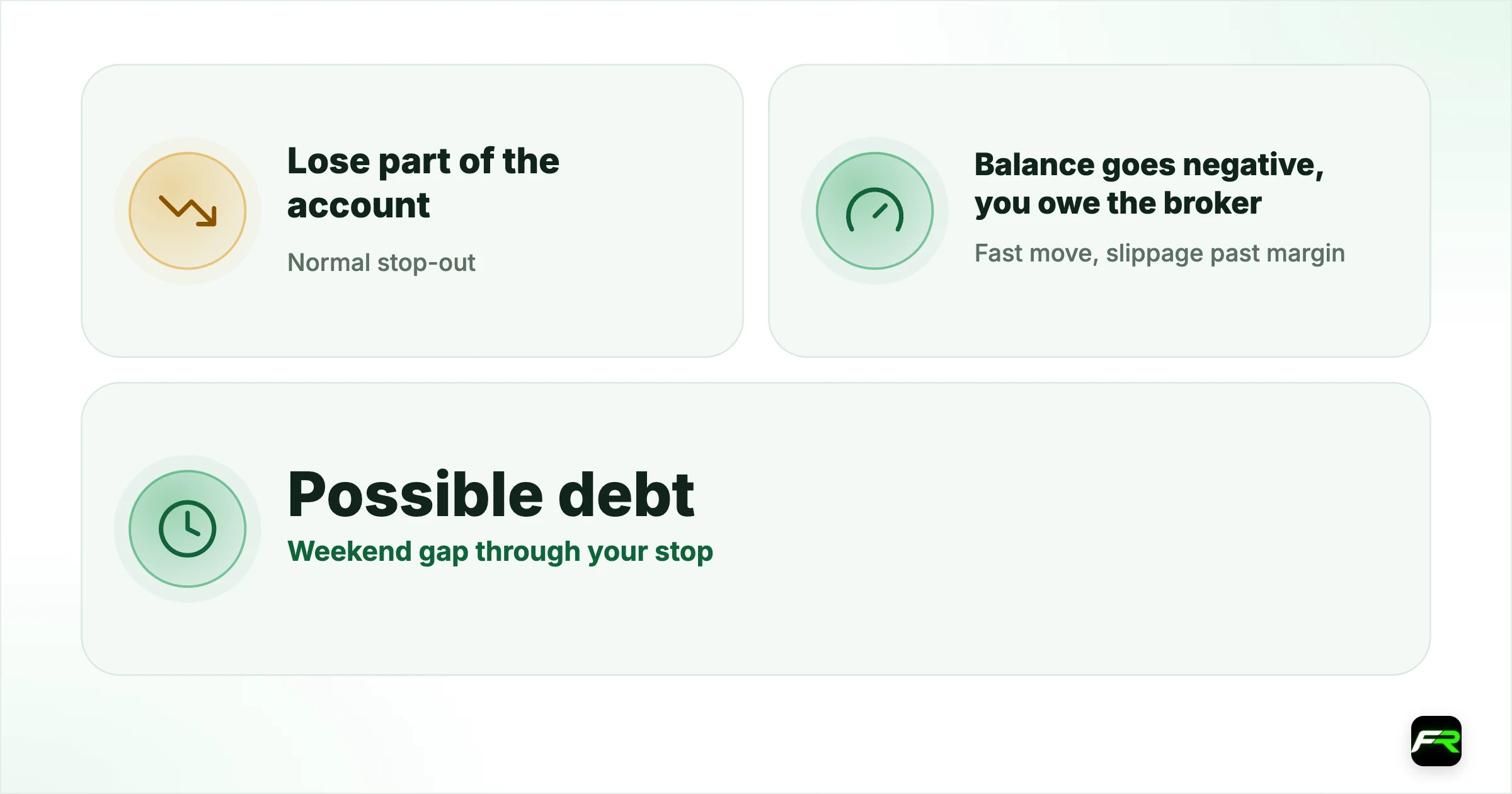
| Scenario | Without NBP | With NBP |
|---|---|---|
| Normal stop-out | Lose part of the account | Same |
| Fast move, slippage past margin | Balance goes negative, you owe the broker | Balance reset to zero |
| Weekend gap through your stop | Possible debt | Loss capped at deposit |
Which regulators require it
NBP is mandatory for retail clients under several tier-one regulators, including the FCA in the UK under its PS19/18 CFD rules, ESMA's product intervention measures across the EU (covered in ESMA's own FAQ on the restrictions, which apply to CySEC brokers as EU entities), and ASIC in Australia under its CFD product intervention order, in force since March 2021. It is not universally required by offshore entities, though many offer it voluntarily because it is cheap for them (negative balances are rare) and good for marketing. The key is to confirm it applies to the specific entity you are onboarded to, since a broker's EU entity may have it while its Seychelles entity does not.
Our broker reviews this year flag NBP as a distinct line item rather than folding it into a general safety score, because a handful of traders each year genuinely benefit from it during volatility spikes, and because its absence is a real, if low-probability, downside. Traders on Exness, IC Markets and others confirm NBP applied during the yen intervention episodes; the loss was capped at the deposit rather than turning into a demand for more money.
What NBP does not do
- It does not stop you losing your whole deposit. It only stops the loss going beyond it.
- It does not compensate you for slippage on a normal stop-out; that is just a bad fill, not a negative balance.
- It does not protect against broker insolvency; that is what segregated client funds and compensation schemes are for.
- It is not a reason to size positions carelessly. A wiped account is a wiped account whether it stops at zero or at minus $500.
How to check
Look in the client agreement or the entity's regulatory page for a clause stating that retail client accounts cannot go into negative balance, or that the broker will write off any negative balance arising from trading. If the broker has multiple entities, confirm which one you will be onboarded to (usually shown at signup) and check that entity's terms specifically. If you cannot find a clear statement, ask support in writing and keep the reply.
NBP is a backstop for a rare event, not a substitute for a stop loss and correct position sizing. If your risk process is sound, you should never come close to needing it.
What to do if a broker disputes an NBP claim
If a broker asks you to cover a negative balance despite NBP applying to your account, the first step is to check exactly which entity you are registered with, since this is the single most common source of a genuine dispute. A broker group can have an FCA-regulated entity with mandatory NBP and a separate offshore entity, often onboarding clients outside the UK, EU or Australia, where NBP is voluntary or absent. If your account terms and your onboarding confirmation show you are with the regulated entity, put that in writing to the broker's compliance or complaints team, quoting the specific clause and referencing the regulator's own rule rather than just the broker's marketing page.
- Get the broker's written response in writing, not just a phone call, and keep the account statement showing the negative balance and any reset.
- If the broker is regulated by the FCA, escalate an unresolved dispute to the Financial Ombudsman Service. ESMA-area brokers have an equivalent national ombudsman or the relevant national competent authority. ASIC-regulated brokers can be referred to the Australian Financial Complaints Authority (AFCA).
- If the entity turns out to be an unregulated or offshore one where NBP was never actually mandated, and the broker's own terms did not promise it either, the leverage to force a write-off is much weaker; this is exactly why confirming NBP applies to your specific entity before depositing matters more than reading a general policy page.
- Keep every communication in writing from the point a negative balance first appears. A dispute resolved months later depends heavily on there being a clear paper trail from the actual event.
A regulator's ombudsman scheme exists specifically for disputes like this and does not require a lawyer to use. It is normally free for the client and is the correct first escalation path before considering anything more drastic.
Sources and where to check it yourself
- ESMA: CFD restrictions for retail clients (2018): the EU measures that made negative balance protection mandatory
- FCA policy statement PS19/18: the UK's permanent CFD rules, including negative balance protection
Frequently asked
Can I really end up owing my broker money?
Without negative balance protection, yes, in a fast enough market move where the stop-out fills far past your margin. With NBP, the broker absorbs that and resets your balance to zero.
Is negative balance protection standard now?
It is mandatory for retail clients under the FCA, ESMA/CySEC and ASIC. Many offshore brokers offer it voluntarily, but it is not guaranteed, so check the specific entity's terms.
Does NBP mean I can't lose my deposit?
No. You can still lose 100% of your deposit through normal trading. NBP only prevents losses beyond that.
Does it cover every account type?
It typically applies to retail clients. Professional clients often waive it as part of accessing higher leverage. Confirm your account classification.
Should I choose a broker just for NBP?
It should be on your checklist but not the deciding factor. A verifiable licence, fair pricing and a clean withdrawal record matter more day to day. NBP is a low-probability backstop.
Related reading
The team behind this guide
Researched, checked and approved by five forex specialists
Every guide is written, fact-checked and edited before it goes live, and updated when the facts change. Spotted an error? Tell us.