IC Markets





































Why Gold Costs More in India Than Anywhere Else
India's gold price usually runs above the world price, mostly because of import duty and taxes. How the premium works and what it signals.
 WriterAbir KhanWriterWrites the guides · checks every figure against primary sources View profileAbout Abir →
 Market analysisTanbir Habib RiyadForex & Crypto AnalystForex and crypto analyst · technical and fundamental analysis View profileAbout Tanbir →
 Fact-checking & riskJannatul FerdaushFact-Checker & Risk AnalystFact-checks every figure · risk analysis · Applied Statistics, University of Dhaka View profileAbout Jannatul →
 Trading reviewJowel RanaCo-Founder & Forex TraderCo-founder · forex trader · reviews guides from a trader's view View profileAbout Jowel →
 Final approvalRanjan NiskrityFounder, Owner & Forex TraderFounder and owner · forex trader · signs off every guide View profileAbout Ranjan →
Key takeaways
- India imports nearly all its gold, so the local price is the world price plus import duty, a cess, GST and dealer margins.
- The duty is policy-set; the part a trader should watch is the wholesale premium or discount to the world price.
- A persistent discount means Indian physical demand, a pillar of global demand, has gone quiet.
- Duty cuts lower the local price and lift official imports; duty rises push buying into the grey market.
If you compare the price of gold in Mumbai with the international price on any given day, the Indian price is usually higher after converting for the rupee. India produces almost no gold of its own and imports nearly all of it, so the domestic price starts from the world price and then adds a stack of costs. Understanding that stack is useful both for anyone buying physical gold in India and for a trader reading Indian demand signals.
What makes up the extra cost
| Component | Approximate effect on the Indian price |
|---|---|
| Import duty (customs) | The largest single component; see the exact current rates below |
| Agriculture infrastructure and development cess | Bundled into the customs duty figure below, not a separate add-on |
| GST on the final product | Applied to the gold plus making charges at retail; see the exact current rates below |
| Local dealer and jeweller margins | Making charges, wastage, retail markup, not fixed by policy |
| Demand-supply swings | The wholesale price gap widens in strong demand, can flip to a discount in weak demand |
Add these together and the retail price of gold jewellery in India can sit well above the pure metal value implied by the world price and the exchange rate. The duty and cess portion is policy-set and changes when the government adjusts it, which it does periodically to manage imports and the trade deficit.
The actual numbers: current duty, cess and GST rates
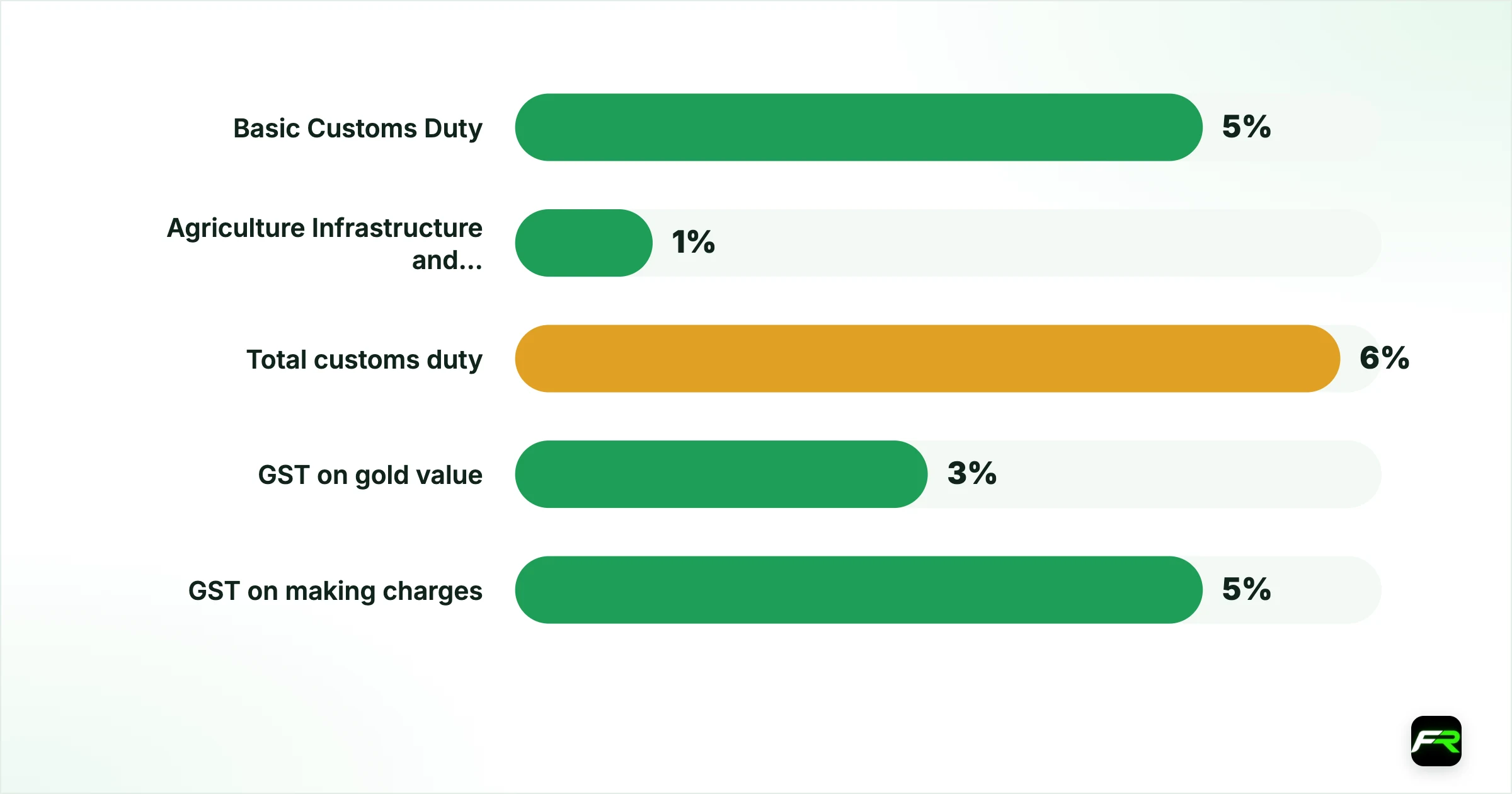
The duty stack was cut sharply in the July 2024 Union Budget, and it is worth stating the real figures rather than just the components, since the size of each piece is what actually determines how much more expensive Indian gold is. Total customs duty on imported gold currently runs at 6 per cent of the assessed value: a 5 per cent Basic Customs Duty (BCD) plus a 1 per cent Agriculture Infrastructure and Development Cess (AIDC), down from a combined 15 per cent before the cut. On top of that, GST applies twice, separately: 3 per cent on the value of the gold itself, and a further 5 per cent GST specifically on the jeweller's making or fabrication charge, which is billed as a separate line item from the metal value on a retail invoice.
| Levy | Rate | Applied to |
|---|---|---|
| Basic Customs Duty (BCD) | 5% | Assessed value of imported gold |
| Agriculture Infrastructure and Development Cess (AIDC) | 1% | Assessed value of imported gold |
| Total customs duty | 6% | Assessed value of imported gold (BCD + AIDC combined) |
| GST on gold value | 3% | The metal value at retail |
| GST on making charges | 5% | The jeweller's fabrication charge, billed separately |
These figures are set by the central government and change by notification, most recently the 2024 cut from a combined 15 per cent to 6 per cent on customs duty. They are worth checking directly against the Central Board of Indirect Taxes and Customs (CBIC), the government body that publishes the actual notifications, rather than relying on a figure that may already be a budget cycle out of date by the time you read it.
Premium vs discount
The interesting number for a trader is not the fixed duty but the variable part: whether Indian dealers are paying above or below the world price for wholesale gold. In strong demand periods (festivals, weddings, a fear-driven rush), dealers pay a premium over the world price to secure supply. In weak demand periods, particularly when the domestic price has spiked and households pull back, that can flip to a discount, where Indian gold trades below the world price and some even flows back out. A persistent discount is a signal that Indian physical demand, one of the pillars of global gold demand, is soft.
Anil watches the Indian wholesale gold price gap as a demand gauge. When he was considering a gold trade during Diwali season one year, the domestic market was at a steep discount, which told him Indian buyers had gone quiet because prices were too high. He took that as a reason to be cautious on the long side, and gold did drift lower through the festival that year.
How duty changes move things
When India cuts import duty on gold, the domestic price drops immediately relative to the world price, smuggling incentives fall, official imports rise, and demand often picks up. This is exactly what followed the 2024 cut: official imports and reported demand both rose as the incentive to smuggle gold in to avoid the higher duty shrank. When duty is raised, the reverse happens and a grey market for gold expands. These changes are announced in the budget or by CBIC notification, and they matter for anyone modelling Indian demand. They do not move the world price much on their own, but a sustained pickup in official Indian imports adds real demand over time.
For an Indian resident, gold can be traded on recognised exchanges as futures and options through a SEBI-registered broker, or bought without holding physical metal through two distinct instruments. Sovereign gold bonds are a government-issued security tied to the gold price, paying a small fixed annual interest on top of any price gain, with a multi-year term. Gold ETFs are exchange-traded funds that hold physical gold or gold-backed assets and trade like a stock intraday, with no interest but no lock-in either. Trading gold CFDs through an offshore broker is a separate legal question under FEMA.
Sources and where to check it yourself
- World Gold Council: Gold Demand Trends: quarterly Indian jewellery, bar and coin demand
- Central Board of Indirect Taxes and Customs: current customs duty notifications, including gold
Frequently asked
Why is gold more expensive in India?
India imports nearly all its gold, and the domestic price is the world price plus a 6% total customs duty (5% BCD plus 1% AIDC), 3% GST on the metal, 5% GST on making charges, and dealer and jeweller margins. Strong local demand can widen the wholesale gap further on top of that.
What is the Indian gold premium or discount?
The gap between the wholesale price Indian dealers pay and the world price, on top of the fixed duty and tax stack. A premium means strong local demand; a discount means weak demand, which is a soft signal for global gold.
Does the Indian gold price gap affect the world gold price?
Not directly day to day. But sustained changes in Indian official demand, driven by duty changes and household buying, add or remove a meaningful chunk of global physical demand over time.
How can an Indian resident trade gold legally?
Through exchange-traded gold futures and options via a SEBI-registered broker, or via sovereign gold bonds, gold ETFs, or physical gold. Offshore gold CFD trading is a grey area under FEMA.
What is the difference between a sovereign gold bond and a gold ETF?
A sovereign gold bond is a government-issued security with a multi-year term that pays a small fixed annual interest on top of the gold price. A gold ETF is an exchange-traded fund backed by gold that trades like a stock during market hours, with no interest but no lock-in period either.
Does a duty cut make gold cheaper for everyone?
It makes gold cheaper in India relative to the world price and tends to lift official Indian imports and demand. The world price is set globally and moves on the dollar, real yields and central-bank flows, not on Indian duty alone.
Related reading
The team behind this guide
Researched, checked and approved by five forex specialists
Every guide is written, fact-checked and edited before it goes live, and updated when the facts change. Spotted an error? Tell us.