IC Markets





































How the Middle East Oil Shock Is Reaching Asian Currencies
An oil price jump shifts the Fed's path, widens Asian importers' trade deficits and moves USD/JPY, USD/INR and the rupiah. The full chain.
 WriterAbir KhanWriterWrites the guides · checks every figure against primary sources View profileAbout Abir →
 Market analysisTanbir Habib RiyadForex & Crypto AnalystForex and crypto analyst · technical and fundamental analysis View profileAbout Tanbir →
 Fact-checking & riskJannatul FerdaushFact-Checker & Risk AnalystFact-checks every figure · risk analysis · Applied Statistics, University of Dhaka View profileAbout Jannatul →
 Trading reviewJowel RanaCo-Founder & Forex TraderCo-founder · forex trader · reviews guides from a trader's view View profileAbout Jowel →
 Final approvalRanjan NiskrityFounder, Owner & Forex TraderFounder and owner · forex trader · signs off every guide View profileAbout Ranjan →
Key takeaways
- Most large Asian economies import oil in dollars, so an oil spike widens their trade deficits and weakens their currencies.
- India (USD/INR) and Indonesia (USD/IDR) feel it most; Malaysia, a net energy exporter, can benefit.
- The bigger effect often runs through the Fed: oil-driven US inflation keeps rates higher and lifts the dollar across Asia.
- A very sharp, fear-driven spike can still send money into the safe-haven yen, against the trade-balance logic.
Most of Asia's large economies are net oil importers. Japan, India, Indonesia, Thailand, the Philippines and South Korea all buy far more oil than they produce, and they pay for it in dollars. So when the oil price jumps on a Middle East supply scare, the effect flows straight into their currencies and into the broader macro picture that drives all Asian FX.
The trade-balance channel
A higher oil price means an oil importer's import bill rises immediately. That widens the trade deficit, which means the country needs more dollars to pay for the same volume of oil, which puts downward pressure on the local currency. The effect is largest for economies where oil is a big share of imports and where the currency is already sensitive to the trade balance, which describes India (USD/INR) and Indonesia (USD/IDR) well. India alone imported roughly 4.5 million barrels a day of crude in 2023, a record, according to the US Energy Information Administration's country analysis of India, which is the scale behind why oil moves the rupee as directly as it does.
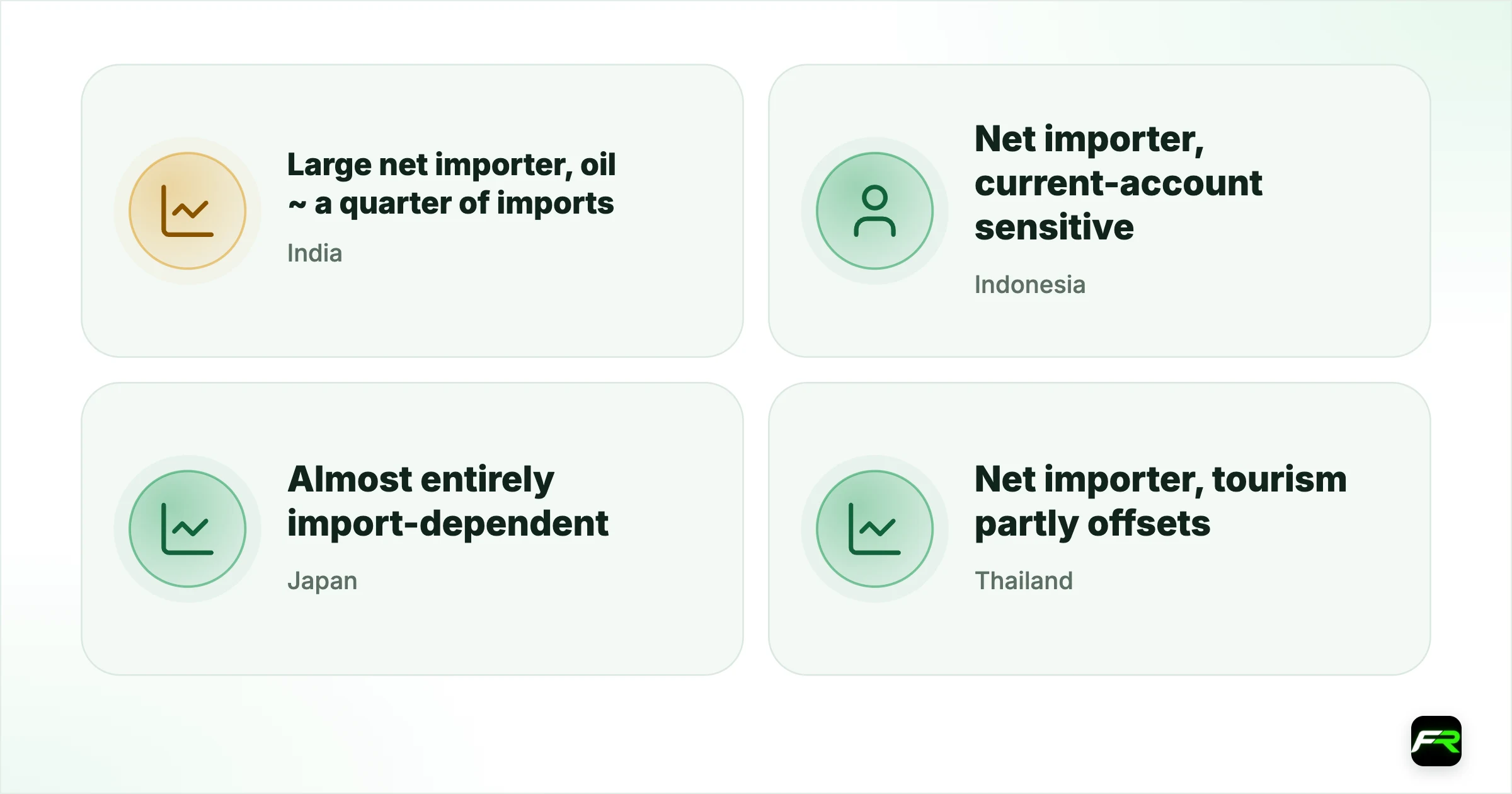
| Economy | Oil position | Currency effect of an oil spike |
|---|---|---|
| India | Large net importer, oil ~ a quarter of imports | Rupee weakens, USD/INR up |
| Indonesia | Net importer, current-account sensitive | Rupiah slides, USD/IDR up |
| Japan | Almost entirely import-dependent | Yen softens on the trade hit, though rate-gap dominates |
| Thailand | Net importer, tourism partly offsets | Baht slips modestly |
The Fed channel
The second, often larger, effect runs through the United States. A sustained oil price rise adds to US inflation, which can push the Federal Reserve to keep rates higher for longer or slow its cutting. Higher-for-longer US rates strengthen the dollar against everything, so an oil shock strengthens the dollar versus the yen, rupee and rupiah on top of the direct trade-balance hit. The Fed transmission guide covers this pathway.
The exceptions
Not every Asian currency loses ground on an oil spike. Malaysia is a net energy exporter, so a higher oil price can support the ringgit through improved export revenue and government finances. And a very sharp oil spike that triggers global risk-off can send money into the safe-haven yen despite Japan's import dependence, which is why USD/JPY sometimes falls on the worst oil headlines even though the trade-balance logic points up.
Rina watched USD/IDR climb steadily during an oil price spike with no Indonesian news to explain it. Once she connected the two, oil became a standing item on her watchlist for the rupiah. She now checks the oil price alongside US yields as the two external variables most likely to move USD/IDR on a day with a quiet domestic calendar.
What to watch
- Brent crude as the benchmark: a move of $10 or more over a short period is a shock worth acting on. The EIA's daily Brent spot price series is a free, authoritative reference for the actual level and the size of a recent move.
- Whether the spike is supply-driven (bad for importers) or demand-driven (a stronger global economy, more mixed).
- US inflation expectations and Fed commentary in the days after: the Fed channel is often the bigger currency effect.
- For India and Indonesia specifically, any government response such as fuel subsidy adjustments, which affect the fiscal and current-account picture.
The relationship between oil and any single currency is not mechanical. In a given week the dollar's broad direction, central-bank meetings and risk sentiment can all outweigh the oil effect. Treat oil as one input, not a trade on its own.
How swap costs change during an oil-driven volatility spike
Anyone holding USD/INR or USD/IDR through an oil shock is not only exposed to the spot move covered above, they are also exposed to a shift in the swap they pay or earn for holding the position overnight. Swap tracks the interest-rate differential between the two currencies, and both the RBI and Bank Indonesia have a history of leaning on rates, or on verbal signalling about rates, specifically to defend the currency during exactly this kind of external shock. A rate response, or even strong expectations of one, moves the swap on the pair within days, on top of whatever the spot price is doing.
The direction is not fixed. If the central bank responds to an oil-driven currency slide by holding or raising rates to defend the rupee or rupiah, the interest-rate gap against the dollar can widen in the local currency's favour, which typically makes holding short USD/INR or short USD/IDR (long the local currency) more expensive in swap terms and holding long USD/INR or long USD/IDR relatively cheaper, since swap tracks which side is paying the higher rate. A trader who was already long USD/INR going into the shock for the trade-balance reasons covered above may find the swap on that position has shifted noticeably by the time the position is a week old, separate from whatever the exchange rate itself has done. The overnight swap guide covers how to check a broker's actual swap rates rather than assume last month's numbers still apply once a shock has changed the rate outlook.
Sources and where to check it yourself
- US EIA: Brent crude spot price history: the daily Brent benchmark the article uses to judge a shock
- RBI reference rate archive: to line up rupee moves against oil moves
Frequently asked
Which Asian currencies are most exposed to an oil spike?
The rupee and the rupiah, because India and Indonesia are large net oil importers with currencies that are sensitive to the trade balance and to foreign capital flows. The Japanese yen is also exposed through the trade channel, though its rate-gap driver often dominates.
Does an oil spike always weaken the yen?
Not always. The trade-balance logic points to yen weakness, but a severe oil shock that causes global risk-off can drive safe-haven flows into the yen, sometimes strengthening it despite Japan's import dependence.
How does oil affect the Fed?
A sustained oil price rise feeds into US inflation, which can lead the Fed to keep rates higher for longer. That strengthens the dollar against Asian currencies on top of the direct trade effect.
Is any Asian currency helped by higher oil?
Malaysia is a net energy exporter, so a higher oil price can support the ringgit and Malaysian government finances. Most of the region's large economies are hurt by it.
Should I trade an oil shock through Asian FX?
The link is real but noisy. If you do, focus on USD/INR or USD/IDR where the effect is clearest, size small, and watch US inflation expectations, which often drive the larger currency move.
Related reading
The team behind this guide
Researched, checked and approved by five forex specialists
Every guide is written, fact-checked and edited before it goes live, and updated when the facts change. Spotted an error? Tell us.