IC Markets





























Requote vs Slippage vs Off Quotes: What Is the Difference?
Three things can happen when price moves between your click and the fill: a requote, slippage or off quotes. Which one you meet depends on your account's execution type. Here is how each works and which costs more.
 WriterAbir KhanWriterWrites the guides · checks every figure against primary sources View profileAbout Abir →
 Market analysisTanbir Habib RiyadForex & Crypto AnalystForex and crypto analyst · technical and fundamental analysis View profileAbout Tanbir →
 Fact-checking & riskJannatul FerdaushFact-Checker & Risk AnalystFact-checks every figure · risk analysis · Applied Statistics, University of Dhaka View profileAbout Jannatul →
 Trading reviewJowel RanaCo-Founder & Forex TraderCo-founder · forex trader · reviews guides from a trader's view View profileAbout Jowel →
 Final approvalRanjan NiskrityFounder, Owner & Forex TraderFounder and owner · forex trader · signs off every guide View profileAbout Ranjan →
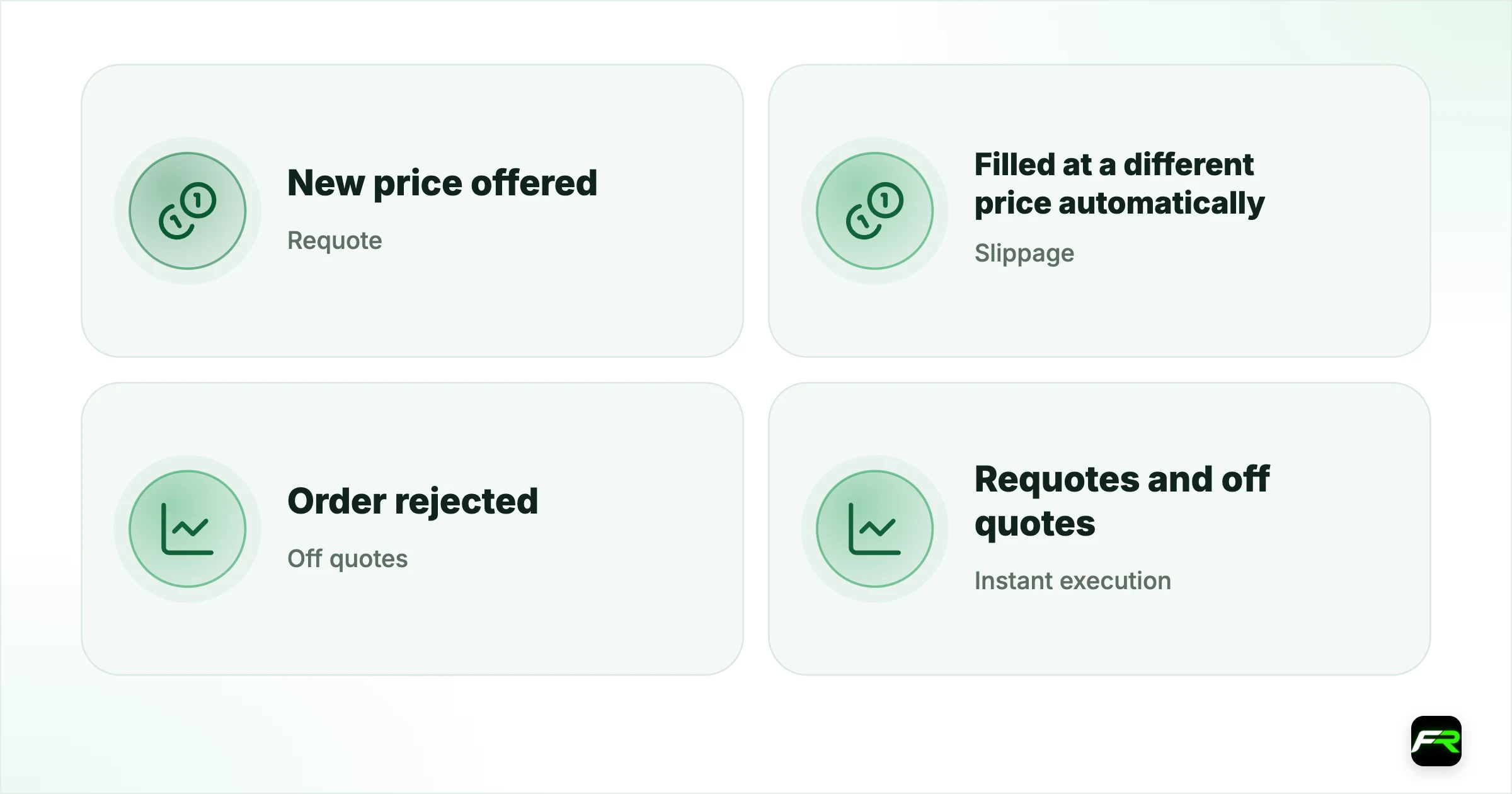
Requotes, slippage and off quotes are three answers to the same problem: the price moved between the moment you clicked and the moment your order reached the broker's server. A requote offers you a new price to accept. Slippage fills you at the new price without asking. Off quotes rejects the order because no acceptable price was available.
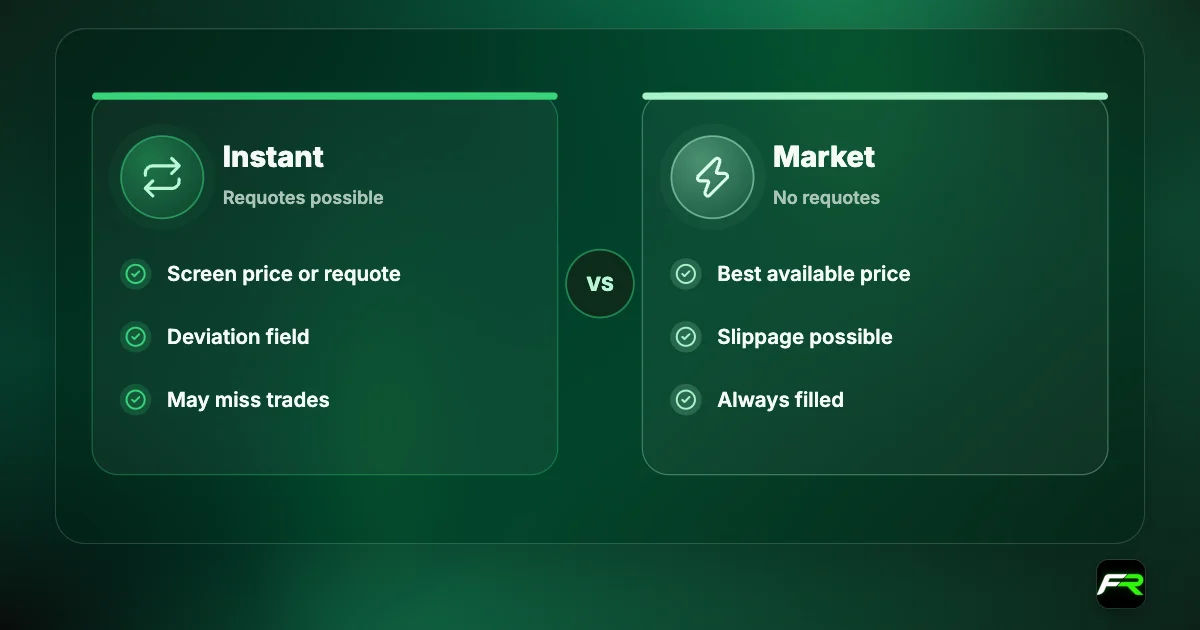
Which one you see depends mostly on your account's execution type. Instant-execution accounts produce requotes and off quotes; market-execution accounts produce slippage. Telling them apart helps you choose an account and read your fills correctly.
| Requote | New price offered; you accept or decline |
|---|---|
| Slippage | Filled at a different price automatically |
| Off quotes | Order rejected; no fill |
| Instant execution | Requotes and off quotes |
| Market execution | Slippage, positive or negative |
Side by side
| Requote | Slippage | Off quotes | |
|---|---|---|---|
| What happens | Server offers a new price | Order fills at the next available price | Rejected outright |
| Do you get filled? | Only if you accept | Yes | No |
| Price certainty | High: you see the price first | Lower: fill can differ | Not applicable |
| Fill certainty | Lower | High | None |
| MT4 code | 138 | No error, shown in fill price | 136 |
| MT5 code | 10004 | No error, shown in fill price | 10021 (no quotes) |
| Account type | Instant execution | Market execution | Instant execution |
Requotes
On instant execution, the terminal sends the price you see and asks to be filled at exactly that price. If the market has moved, the server comes back with a new price. You have a few seconds to accept. Requotes protect you from surprise fills but can cost entries in fast markets. Our guide to requotes in MT4 covers the settings that reduce them.
Slippage
On market execution, the terminal asks to be filled at the best available price, whatever it is when the order arrives. If price moved against you, you get a worse fill: negative slippage. When it moved in your favour, a regulated broker should pass on the better price: positive slippage. Stop losses and take profits on any account type can slip too, because they become market orders when triggered.
You see slippage in the fill price in the Trade or History tab, compared with the price you clicked or the stop level. It is not shown as an error, which is why many traders do not notice it until they compare fills over a few weeks.
Off quotes
Off quotes is the rejection path on instant execution: no price within your allowed deviation existed. Nothing fills, nothing is charged. It is common during news and around the rollover. Our guide to the off quotes error explains the deviation setting that controls it.
Which costs more?
A requote or off quotes costs nothing directly, but a missed entry has a cost if the trade would have won. Slippage costs money on each affected fill, but you always get in or out. For stop losses, slippage is usually the better outcome: an exit at a slightly worse price beats no exit in a falling market. Entries are different, and preferences vary by strategy.
Two traders in Lagos buy EUR/USD the second US inflation data is released. One has an instant-execution account with deviation off and is requoted three times, finally entering 1.5 pips above the original price after 20 seconds. The other has a market-execution account and is filled within a second at 0.8 pips above the click. Both paid for the fast market; the second paid less and was in the trade sooner.
Is slippage a sign of a bad broker?
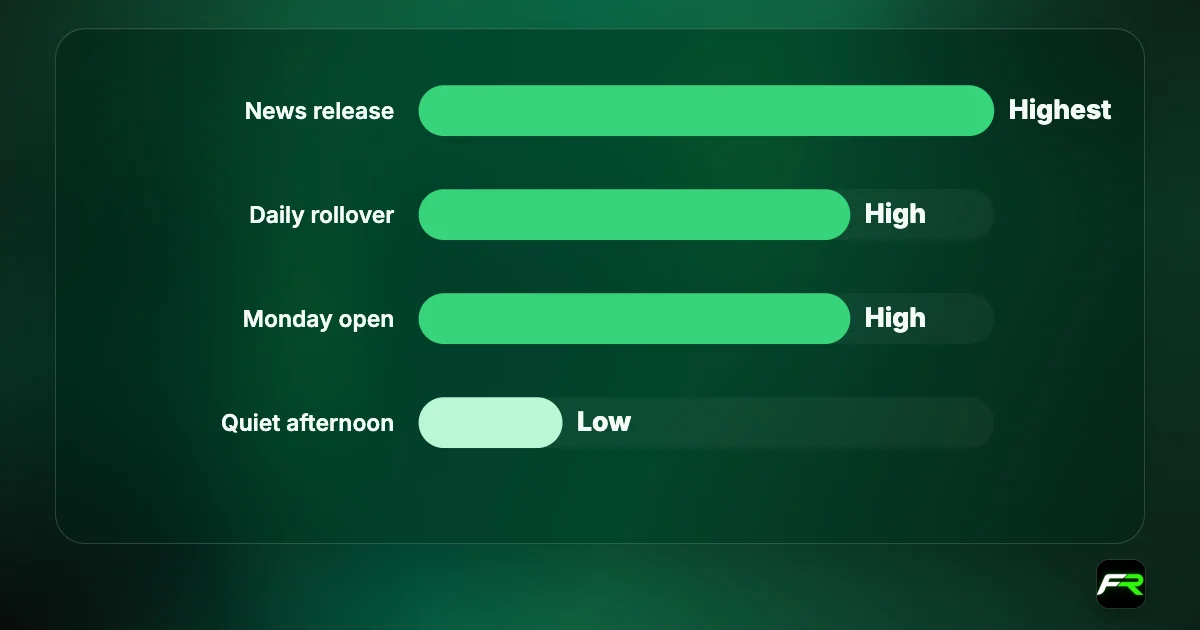
Some slippage is normal in any market, especially at news, rollover and Monday opens. Warning signs are slippage that is almost always negative, even on calm days, or fills that never improve when price moves in your favour. Regulated brokers must have an order execution policy and many publish slippage statistics. Keep a log of fills and compare; our guide to spreads at rollover explains predictable busy times.
Slippage on stop losses and take profits
Stop losses slip because they become market orders once triggered, so in a fast move the fill is the next available price. Take profits are limit orders, so they fill at your level or better and do not slip against you. That difference explains why a winning trade often closes exactly on target while a losing one can close a little beyond the stop. Over many trades, the extra cost on stops is a real part of your results and worth tracking.
How to reduce all three
- Avoid entries in the first minutes after high-impact news and around the 17:00 New York rollover.
- On instant execution, set a sensible maximum deviation.
- Use limit orders for entries where possible; they fill at your price or better, or not at all.
- Keep a stable, low-latency connection, or use a VPS near the broker's server.
- Trade liquid pairs during their main sessions.
Limit orders avoid negative slippage
A buy limit or sell limit order fills only at your price or better. It cannot slip against you. The trade-off is that it may not fill at all if price does not come back to your level. Traders who want to avoid negative slippage on entries often place limit orders a little away from the market instead of clicking at market.
Execution types by account
Most modern ECN, raw and standard accounts use market execution. Some older or fixed-spread accounts use instant execution. The order window shows which you have: a deviation field means instant execution. Our broker guides describe each model, for example XM execution and Exness execution.
Compare ten of your recent fills with the prices you clicked. If the average difference is under half a pip on major pairs outside news, your execution is normal.
Stop losses can slip on every account type. In a gap or a fast move, the fill can be far from the stop level, so size positions for that possibility.
Frequently asked
What is the difference between requote and slippage?
A requote asks you to accept a new price before filling; slippage fills you at the new price automatically. Requotes happen on instant execution, slippage on market execution. With requotes you may miss trades; with slippage you always get filled.
Is positive slippage real?
Yes. If price moves in your favour between the click and the fill, a market-execution order can fill at a better price. Regulated brokers should pass on positive slippage as well as negative. If yours never does, ask about its execution policy.
What is off quotes in forex?
Off quotes is a rejection on instant-execution accounts when no acceptable price exists within your allowed deviation. Nothing fills and nothing is charged. It is common during news and at the rollover.
Can a stop loss slip?
Yes. A stop loss becomes a market order when triggered, so it fills at the next available price. In fast markets or gaps, that can be worse than your stop level. Guaranteed stops, where offered, avoid this for a fee.
Which execution type is better?
Market execution suits traders who need to be filled, especially for exits and around news. Instant execution suits traders who prefer to miss a trade rather than accept a different price. Most active traders choose market execution.
How do I avoid slippage on entries?
Use limit orders, which fill only at your price or better, and avoid entering in the first minutes after major news or around the rollover. A fast, stable connection also helps reduce the delay between click and fill.
Official sources: MQL5: trade server return codes · MQL4: error codes
Related reading
The team behind this guide
Researched, checked and approved by five forex specialists
Every guide is written, fact-checked and edited before it goes live, and updated when the facts change. Spotted an error? Tell us.