IC Markets
































How to Open a Forex Account in South Africa, Step by Step
From choosing a broker to your first funded trade: verification documents, account-type choice, the test deposit and withdrawal, and the settings to get right before you start.
 WriterAbir KhanWriterWrites the guides · checks every figure against primary sources View profileAbout Abir →
 Market analysisTanbir Habib RiyadForex & Crypto AnalystForex and crypto analyst · technical and fundamental analysis View profileAbout Tanbir →
 Fact-checking & riskJannatul FerdaushFact-Checker & Risk AnalystFact-checks every figure · risk analysis · Applied Statistics, University of Dhaka View profileAbout Jannatul →
 Trading reviewJowel RanaCo-Founder & Forex TraderCo-founder · forex trader · reviews guides from a trader's view View profileAbout Jowel →
 Final approvalRanjan NiskrityFounder, Owner & Forex TraderFounder and owner · forex trader · signs off every guide View profileAbout Ranjan →
Opening a forex account in South Africa takes about 20 minutes of form-filling and a day or two for verification. The process is not hard, but the choices you make while doing it, account type, leverage, base currency, matter for how your trading goes. This is the step-by-step, in the order you will actually do it.
Step 1: Choose the broker
Before you touch a sign-up form, settle the broker choice against the checklist: local FSCA licence verified on fsca.co.za, true ZAR account, low minimum deposit, good demo, local funding, clean withdrawal record, MT4 or MT5. The beginners broker guide covers this. Do not pick on leverage or bonus.
Step 2: Register and verify
You will provide your name, ID number, address, contact details, and answer questions about your trading experience and financial situation. Then you upload verification documents:
- Proof of identity: your green ID book, smart ID card, or passport.
- Proof of address: a utility bill, bank statement or municipal account, usually less than three months old, showing your name and address.
- Sometimes proof of payment method: a photo of your bank card (middle digits covered) or a bank confirmation letter.
Verification usually takes a few hours to two working days. Complete it fully now, not later when you want to withdraw, because an incomplete verification is the most common cause of a stuck first withdrawal.
FICA: why brokers ask, and what they accept
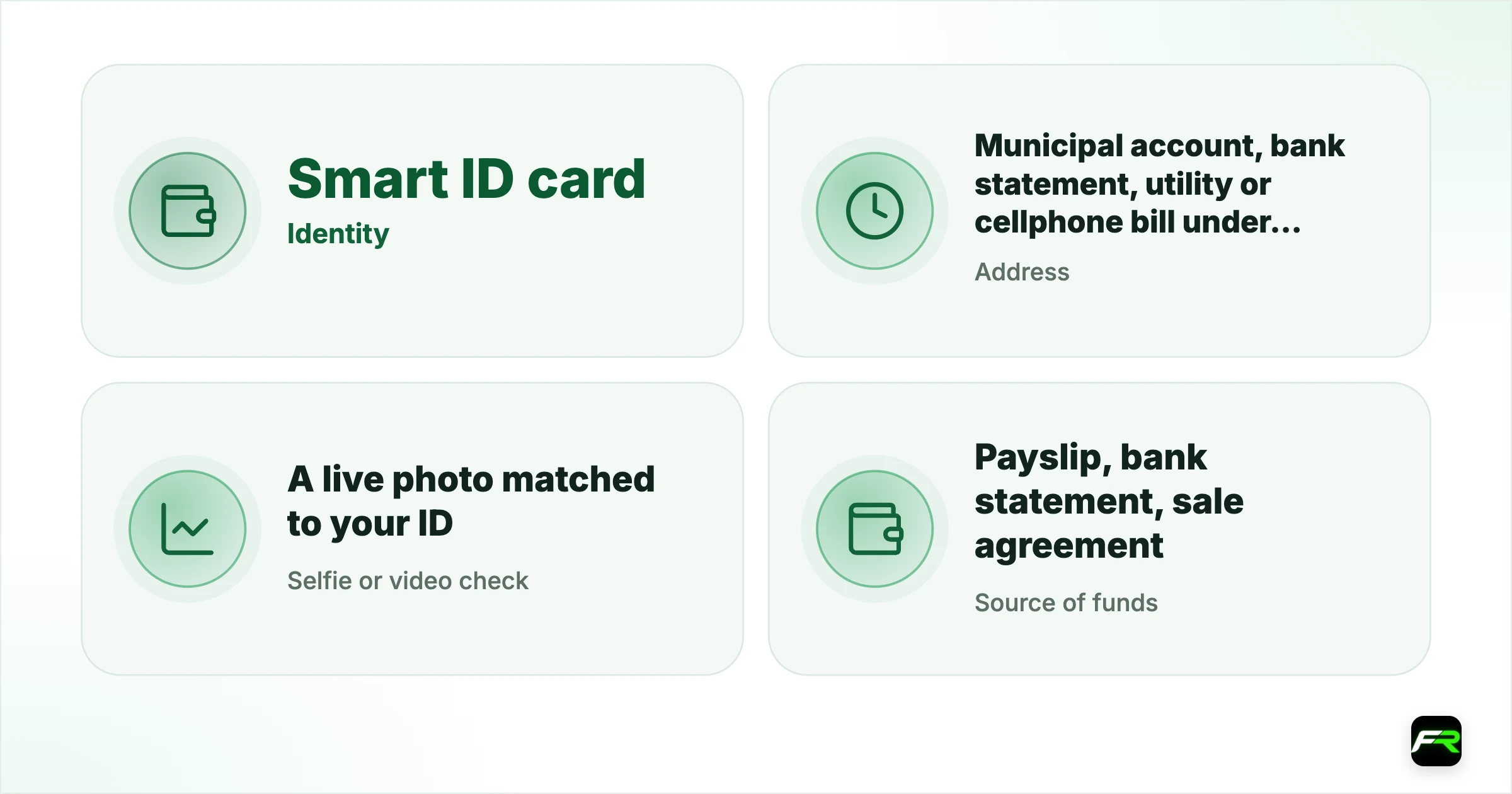
The document requests come from the Financial Intelligence Centre Act, usually shortened to FICA, which requires financial firms to identify their clients and understand where their money comes from. A locally licensed broker has to do this; skipping it would put its licence at risk. Here is what typically satisfies each requirement:
| Requirement | Usually accepted | Common reasons for rejection |
|---|---|---|
| Identity | Smart ID card (both sides), green ID book, passport | Glare, cut-off edges, expired passport |
| Address | Municipal account, bank statement, utility or cellphone bill under three months old | Old document, P.O. box only, someone else's name |
| Selfie or video check | A live photo matched to your ID | Poor light, glasses or a hat |
| Source of funds (larger deposits) | Payslip, bank statement, sale agreement | Screenshots without your name or dates |
If you live in a shared or informal home without a bill in your name, ask the broker which alternatives it accepts. Many take a bank-stamped statement or a letter from your bank confirming your address.
Upload clear colour photos on a flat, dark surface in daylight. Most first-time rejections are photo quality, not the document itself.
Step 3: Choose the account type
| Choice | Recommendation for a beginner |
|---|---|
| Base currency | ZAR, so your balance and results are in rand |
| Account type | Standard or a low-commission raw account, based on your spread comparison |
| Leverage | Low: around 1:100. You can raise it later |
| Platform | MT4 or MT5 |
| Bonus | Decline it; bonuses lock withdrawals |
Step 4: The test deposit and withdrawal
- Deposit a small amount, R200 to R500, by Ozow or local EFT.
- Place one tiny trade and close it, so there is a small realised result.
- Request a withdrawal of most of the balance back to your bank.
- Confirm it arrives, and note how long the broker took to approve it.
- Only after that round trip works, fund the account properly.
This is the single best habit when opening an account. It proves the money moves both ways before you have real profit at stake, and it gets the first-withdrawal review out of the way early.
Step 5: Set up before you trade
- Set leverage to your chosen level in the account settings.
- Work out your 1 per cent risk in rand and know your position size for a typical stop distance.
- Turn on two-factor authentication for the account.
- Install the platform on your computer and phone, and log in to both.
- Open the demo alongside the live account and keep using it.
Naledi opened her account, uploaded her smart ID and a recent municipal bill, and was verified the next morning. She deposited R300, traded 0.01 lots on EUR/USD, closed for a tiny profit, and withdrew R280, which reached her Capitec account the following day. Then she funded R2,000 properly. The whole process, including the test cycle, took three days, and she never had a verification or withdrawal problem afterward.
Take a screenshot of the FSCA register entry for your broker's entity on the day you open the account, and check the entity name matches your client agreement. It is a two-minute habit that matters if there is ever a dispute.
Common sign-up problems and fixes
| Problem | Usual cause | Fix |
|---|---|---|
| Proof of address rejected | Document too old, or name and address do not match your ID | Use a municipal bill or bank statement under 3 months old in your exact name |
| ID upload rejected | Blurry photo, glare, or edges cut off | Retake in good light, all four corners visible, no flash glare |
| Account stuck 'pending verification' | One document still under review, or a mismatch flagged | Message support with your reference; ask exactly what is outstanding |
| Cannot select ZAR base currency | Some account types are USD only | Choose the account type that offers ZAR, or ask support to switch it before you fund |
After the account is open
Do not rush to trade. Spend the first week on the demo version of your live account, place your test deposit and withdrawal, set your leverage and two-factor authentication, and write down your trading plan: which pairs, which hours, how you size a trade, your daily loss limit. The account being open is not a signal to start; your process being ready is. Our case studies show what happens when people skip this step.
The account-opening choices people rush, base currency, leverage, whether to take the bonus, are exactly the ones that shape the first year. Pick ZAR, pick low leverage, skip the bonus, and do a test withdrawal before you fund properly. Twenty minutes of care here saves a lot of trouble later.
For the rules and brokers that apply where you live, see our guide to the best forex brokers in South Africa.
Frequently asked
What documents do I need to open a forex account in South Africa?
Proof of identity (green ID book, smart ID card or passport), proof of address less than about three months old (utility bill, bank statement or municipal account), and sometimes proof of your payment method such as a masked photo of your bank card.
How long does verification take?
Usually a few hours to two working days. Complete it fully when you open the account, because an incomplete verification is the most common cause of a delayed first withdrawal.
What account settings should a beginner choose?
ZAR base currency, a standard or low-commission raw account based on a spread comparison, low leverage around 1:100, MT4 or MT5, and no deposit bonus.
Should I do a test withdrawal?
Yes. Deposit a small amount, place and close one tiny trade, and withdraw most of the balance before funding properly. It proves the money moves both ways and clears the first-withdrawal review early.
How much do I need to open an account?
The main FSCA brokers allow deposits from around R70 to R500. A more realistic starting amount once you are ready to trade live is R500 to R2,000.
Why does a forex broker need my proof of address?
The Financial Intelligence Centre Act requires licensed firms to verify who their clients are and where they live, as part of anti-money-laundering controls. A recent municipal account, bank statement or utility bill in your name is usually enough.
Related reading
The team behind this guide
Researched, checked and approved by five forex specialists
Every guide is written, fact-checked and edited before it goes live, and updated when the facts change. Spotted an error? Tell us.