IC Markets




































Best Forex Trading Hours in South Africa (SAST)
South African time lines up well with the London and New York sessions. Here are the hours to trade the major pairs and USD/ZAR, and the hours to leave alone.
 WriterAbir KhanWriterWrites the guides · checks every figure against primary sources View profileAbout Abir →
 Market analysisTanbir Habib RiyadForex & Crypto AnalystForex and crypto analyst · technical and fundamental analysis View profileAbout Tanbir →
 Fact-checking & riskJannatul FerdaushFact-Checker & Risk AnalystFact-checks every figure · risk analysis · Applied Statistics, University of Dhaka View profileAbout Jannatul →
 Trading reviewJowel RanaCo-Founder & Forex TraderCo-founder · forex trader · reviews guides from a trader's view View profileAbout Jowel →
 Final approvalRanjan NiskrityFounder, Owner & Forex TraderFounder and owner · forex trader · signs off every guide View profileAbout Ranjan →
One of the quiet advantages of trading from South Africa is the time zone. South African Standard Time sits two hours ahead of London in the northern-hemisphere winter and one hour ahead in summer, which puts the most active part of the trading day in your afternoon and early evening. This guide covers which hours to trade and which to skip, in SAST.
The sessions in SAST
| Session | Approx SAST | Character |
|---|---|---|
| Sydney | 23:00-08:00 | Thin, low volatility |
| Tokyo | 01:00-10:00 | Moderate; best for JPY and AUD pairs |
| London | 09:00-18:00 | High liquidity, the main event for EUR and GBP |
| New York | 14:00-23:00 | High liquidity; US data early in the session |
| London to New York overlap | 14:00-18:00 | The most active window of the day |
Times shift by an hour when South Africa stays on standard time and the northern hemisphere moves to daylight saving. The pattern holds: your afternoon is the busy part of the global day.
The best window for most traders
For a South African trading the major pairs, the sweet spot is roughly 14:00 to 18:00 SAST, the London to New York overlap. Liquidity is highest, spreads are tightest, and the day's biggest moves and US data releases land here. If you have a day job, this window runs from mid-afternoon into the early evening, which is more workable than the overnight sessions traders in other time zones are stuck with.
Trading after work
If you can only trade from about 18:00, you still catch the back half of the New York session, which is active until New York closes around 23:00 SAST. US afternoon moves, follow-through from the data, and trend continuation all happen here. After roughly 22:00 the market thins out, spreads widen, and it is a poor time for a beginner to trade. The stretch from midnight to the London open is the worst: thin, choppy and expensive.
USD/ZAR specifically
USD/ZAR is most liquid from the local open through the London session and the overlap, roughly 09:00 to 18:00 SAST. The SARB releases data and decisions in the local afternoon. Outside those hours the rand pair's spread widens noticeably, more than the major pairs do, so evening rand trading costs more. The USD/ZAR guide covers this.
| SAST | Trade? | Why |
|---|---|---|
| 09:00-14:00 | Yes, moderate | London session, good for EUR/GBP and USD/ZAR |
| 14:00-18:00 | Best | London to New York overlap, tightest spreads, biggest moves |
| 18:00-22:00 | Workable | New York session continues; fine after work |
| 22:00-00:00 | Caution | Thinning liquidity, wider spreads |
| 00:00-09:00 | Avoid | Thin, choppy, expensive; Tokyo only for JPY pairs |
Thandi worked until 17:00 and used to trade at 21:00 because that was when she had time, then wondered why her results were poor. Her spreads were wider than the numbers she had backtested on, and the moves were smaller. She shifted to trading the last 45 minutes of her lunch break and the 17:00 to 18:30 window, both inside the overlap, and traded less often. Her average trade quality improved immediately.
Match your trading to the overlap where you can, even if it means fewer, shorter sessions. Trading the thin hours because they fit your schedule is a common reason South African beginners underperform their own backtests.
Which pairs suit which hours
| Pair | Best hours (SAST) | Why |
|---|---|---|
| EUR/USD, GBP/USD | 10:00-18:00 | London and New York liquidity |
| USD/ZAR | 09:00-18:00 | Local open plus London; SARB data in the SA afternoon |
| USD/JPY, AUD/USD | 02:00-10:00 and 15:00-18:00 | Tokyo session and the overlap |
| EUR/GBP | 10:00-16:00 | European hours; quiet outside them |
If your available time is the evening, EUR/USD and GBP/USD still work until New York closes around 23:00 SAST. Yen pairs are the exception that favour an early-morning South African trader, since the Tokyo session runs roughly 01:00 to 10:00 SAST.
Major release times in SAST, through the year
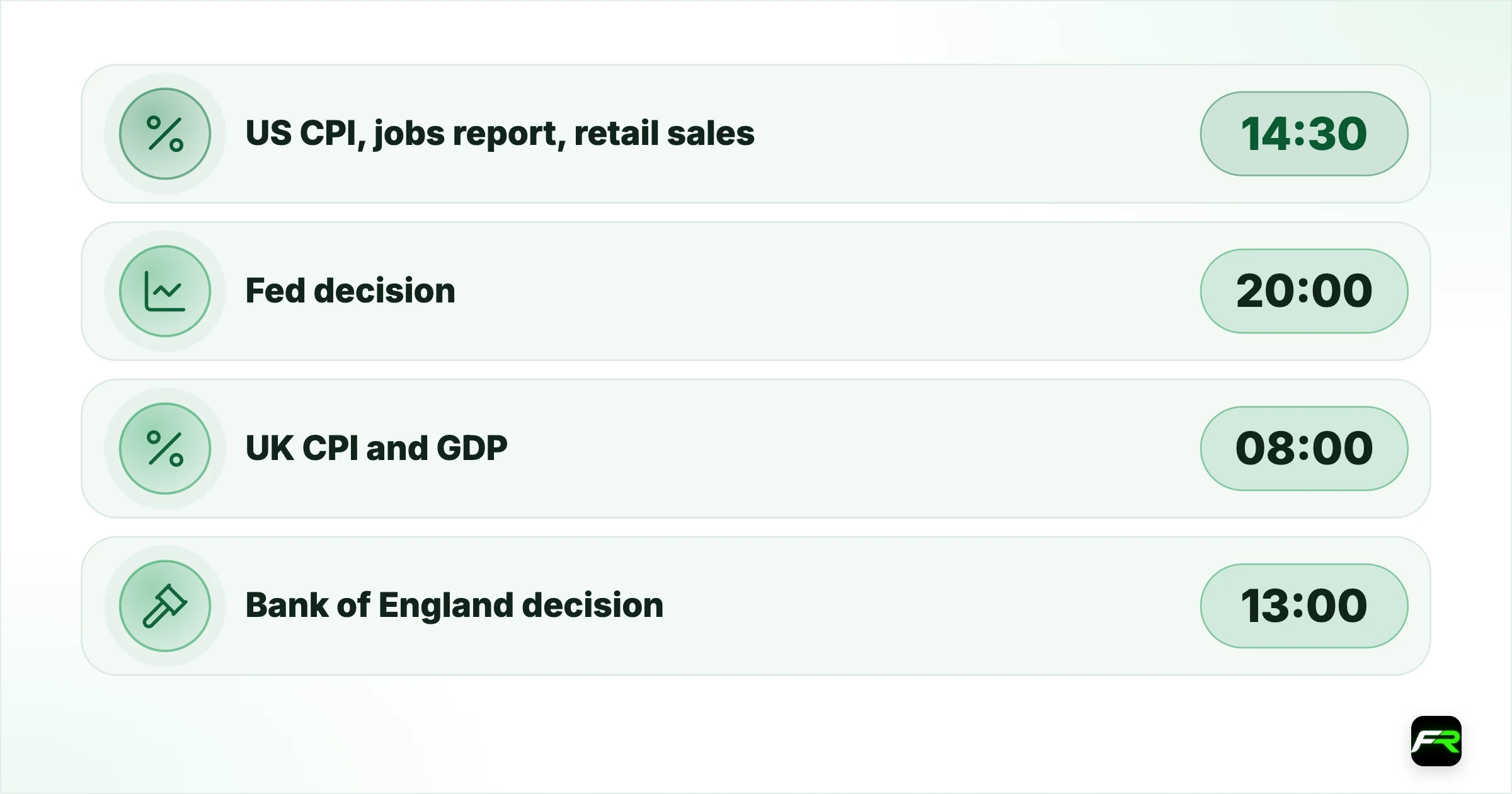
South Africa does not change its clocks, but the US, UK and euro area do, so their scheduled releases shift by an hour in SAST twice a year. The US switches on different dates from Europe, which creates a few weeks each March and late October when the gap is unusual.
| Release | Northern summer (SAST) | Northern winter (SAST) |
|---|---|---|
| US CPI, jobs report, retail sales (08:30 New York) | 14:30 | 15:30 |
| Fed decision (14:00 New York) | 20:00 | 21:00 |
| UK CPI and GDP (07:00 London) | 08:00 | 09:00 |
| Bank of England decision (12:00 London) | 13:00 | 14:00 |
| ECB decision (14:15 Frankfurt) | 14:15 | 15:15 |
| SA CPI (Stats SA) | 10:00 | 10:00 |
For 2026 the US returns to standard time on 1 November, so US releases move to 15:30 SAST from then until March. If you set calendar alerts once at the start of the year, check them again at both clock changes.
Building a weekly trading timetable
Fixed hours beat trading whenever you have a moment free. A simple timetable that many part-time South African traders use:
- Sunday evening: mark the week's high-impact releases and the levels on your two or three pairs.
- Tuesday to Thursday: trade the overlap or the early evening, with a firm stop time.
- Monday and Friday: manage existing trades, review, and take new trades only if the setup is exceptional.
- Release days: be flat 15 minutes before a high-impact number on the pair you trade.
Days of the week matter too
Monday mornings are often slow and directionless while the market finds its footing after the weekend. Tuesday to Thursday carry most of the meaningful moves and most of the scheduled data. Friday afternoons thin out as the week's positions are closed, and holding into the weekend means gap risk when the market reopens Sunday evening. Many part-time South African traders concentrate on Tuesday to Thursday and are flat by Friday evening.
South Africans have a genuinely good trading time zone. The best hours of the global day are your afternoon and early evening, not the middle of your night. Use that. If you can only trade late, trade the New York session until about 22:00 and then stop, rather than pushing into the dead hours.
Frequently asked
What are the best forex trading hours in South Africa?
Roughly 14:00 to 18:00 SAST, the London to New York overlap, when liquidity is highest, spreads are tightest and the biggest moves and US data releases occur. The wider 09:00 to 22:00 window is workable.
Can I trade forex after work in South Africa?
Yes. From about 18:00 you catch the second half of the New York session, which stays active until New York closes around 23:00 SAST. After 22:00 the market thins and spreads widen, so it is a poor time for beginners.
What hours should I avoid?
Roughly midnight to 09:00 SAST. Liquidity is thin, price action is choppy, and spreads are wide. The Tokyo session in this window is only really useful for yen and Australian dollar pairs.
When is USD/ZAR most active?
From the local open through the London session and the overlap, about 09:00 to 18:00 SAST. The SARB releases data and decisions in the local afternoon. Rand-pair spreads widen more than major-pair spreads outside these hours.
Does daylight saving affect these times?
Yes, by about an hour. South Africa does not change its clocks, but London and New York do, so the sessions shift an hour when the northern hemisphere is on daylight saving. The overall pattern stays the same.
What time is US data released in South Africa?
US releases at 08:30 New York time, such as CPI and the jobs report, come out at 14:30 SAST during the northern summer and 15:30 SAST from early November to mid-March. Fed decisions arrive at 20:00 SAST in summer and 21:00 in winter.
Related reading
The team behind this guide
Researched, checked and approved by five forex specialists
Every guide is written, fact-checked and edited before it goes live, and updated when the facts change. Spotted an error? Tell us.