IC Markets
































Forex Scams in South Africa: The Red Flags
The deepfake advert, the account manager, the profit split, the withdrawal fee. The specific patterns behind most South African forex losses, and the checks that stop them.
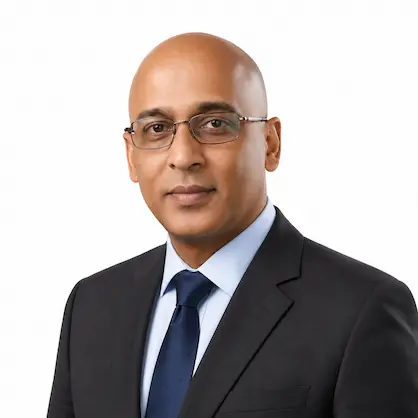
 WriterAbir KhanWriterWrites the guides · checks every figure against primary sources View profileAbout Abir →
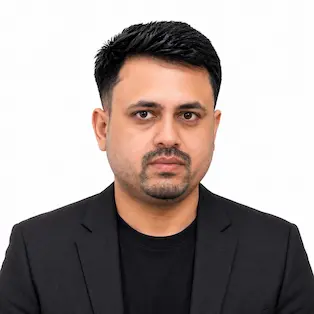
 Market analysisTanbir Habib RiyadForex & Crypto AnalystForex and crypto analyst · technical and fundamental analysis View profileAbout Tanbir →
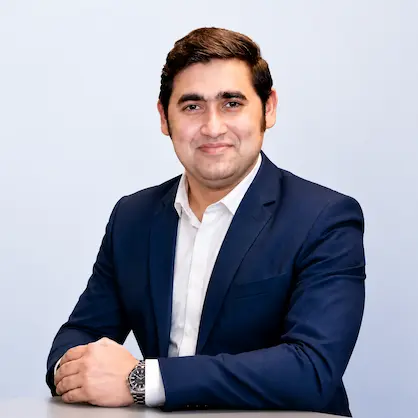
 Fact-checking & riskJannatul FerdaushFact-Checker & Risk AnalystFact-checks every figure · risk analysis · Applied Statistics, University of Dhaka View profileAbout Jannatul →
 Trading reviewJowel RanaCo-Founder & Forex TraderCo-founder · forex trader · reviews guides from a trader's view View profileAbout Jowel →
 Final approvalRanjan NiskrityFounder, Owner & Forex TraderFounder and owner · forex trader · signs off every guide View profileAbout Ranjan →
A large share of the money South Africans lose to forex is not lost trading. It is taken by scams built around forex as the story. The FSCA issues public warnings at a rate of more than two a week, and in December 2025 fined one platform, Banxso, more than R2 billion. Those scams follow a small number of patterns. Learn them and you screen out most of the risk before you ever place a trade.
Pattern 1: the celebrity advert
A video or article shows a well-known South African businessperson, or a global figure like Elon Musk, endorsing an automated trading system that turns a small deposit into a large monthly income. The videos are AI-generated deepfakes. Clicking through leads to a sign-up form and, within an hour, a phone call from an "account manager". No real public figure endorses a retail trading bot. The endorsement is the scam.
Pattern 2: the account manager
Someone offers to trade your account for you, or tells you exactly what to deposit and when. A regulated broker does not do this. A person who manages your money for a fee or a profit share needs an FSCA discretionary licence, which almost none of them hold. If a human is directing your deposits or trading your account, you are not with a broker, you are with a scam.
Pattern 3: the profit split and guaranteed return
A fixed monthly percentage, a guaranteed return, or a profit-split arrangement where you put in capital and someone trades it. Real trading has losing months. Anything promising a fixed positive return is either a Ponzi paying early joiners with later joiners' money, or a straightforward theft. The Fast Profit Income scheme the FSCA warned against in 2026 promised up to 200 per cent.
Pattern 4: the withdrawal fee
Your account shows a profit. When you try to withdraw, you are told to first pay a "release fee", a "tax", an "insurance", or to top up your deposit to a certain level. Every one of these is a lie designed to extract more money. No legitimate broker ever requires a payment from you to release your own withdrawal. The moment you hear this, stop sending money.
Pattern 5: the recruitment scheme
A "mentor" sells a course or signals, and encourages successful students to become sub-mentors, build their own groups, and recruit. The money flows from new joiners' fees, not from trading, and the Dubai photos and withdrawal screenshots are affiliate earnings or props. This is a pyramid with forex as the theme.
| Red flag | What it means |
|---|---|
| Celebrity endorsement of a trading product | Deepfake advert; the platform is a scam |
| Someone trades your account or directs your deposits | Unlicensed money management; illegal and unsafe |
| Guaranteed or fixed monthly return | Ponzi or theft; real trading has losing months |
| Any fee to release a withdrawal | Definitive scam signal; stop paying |
| Pressure and urgency | "Deposit now, the offer ends" is manipulation |
| Payment to a personal account | Real brokers only take payment to a company, via their platform |
| Not on the FSCA register, or on the warning list | Do not deposit |
Where to report, and what each body can do
Victims often report to one place and assume it covers everything. Each body has a different job, so report to all that apply, as soon as possible.
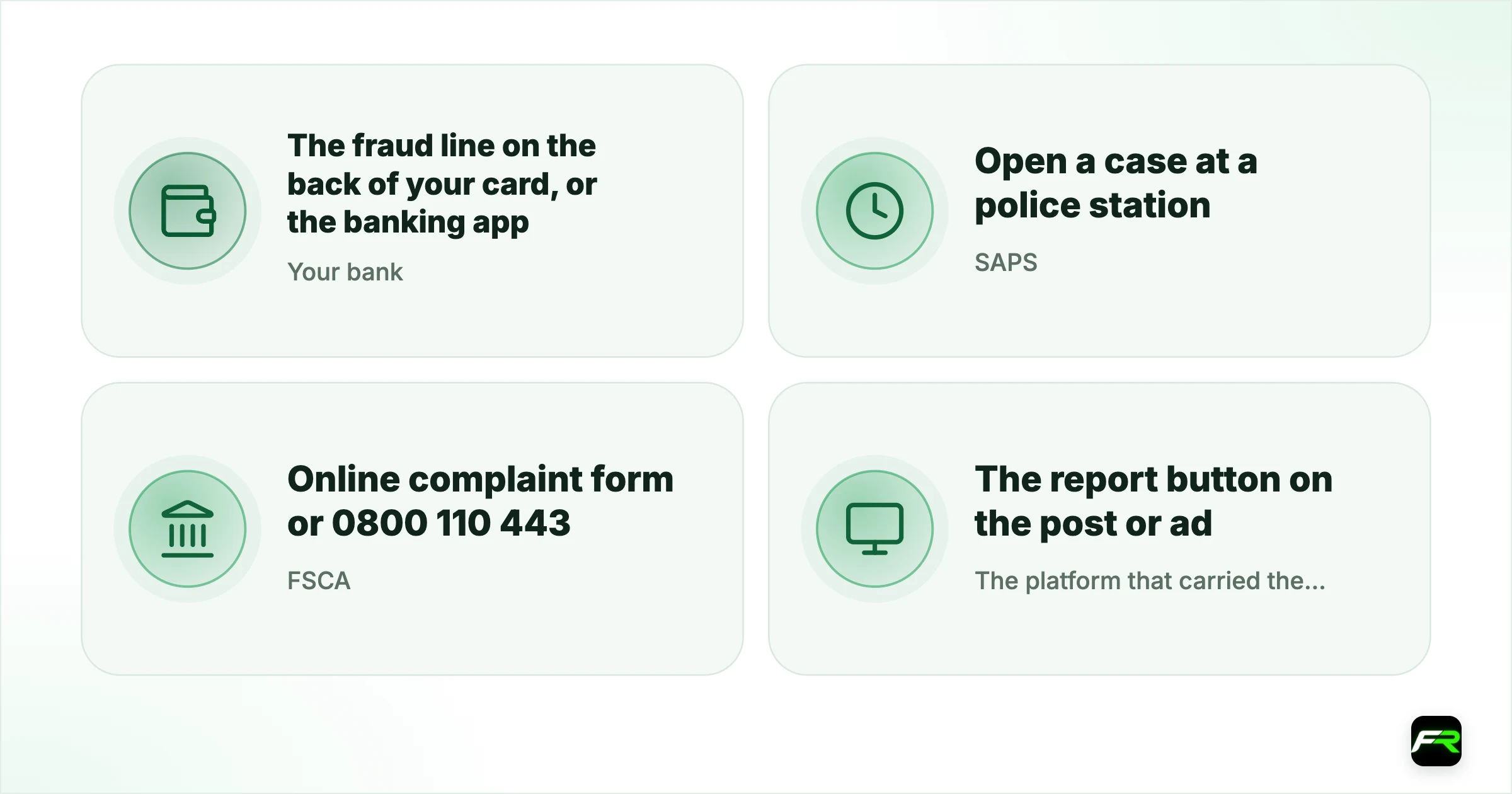
| Report to | How | What it can do |
|---|---|---|
| Your bank | The fraud line on the back of your card, or the banking app | Try to stop or recall recent payments |
| SAPS | Open a case at a police station; keep the case number | Criminal investigation; the case number supports bank and insurance claims |
| FSCA | Online complaint form or 0800 110 443 | Investigate unlicensed providers and publish warnings |
| The platform that carried the advert | The report button on the post or ad | Remove the advert and the account |
Reporting to the FSCA matters even when your money is gone. Its warnings are built partly from public complaints, and a warning published quickly can stop the next person from depositing.
Recovery scams: the second hit
Soon after a loss, many victims are contacted by someone offering to get the money back: a "lawyer", a "blockchain investigator" or even someone claiming to be from the FSCA. They ask for an upfront fee, then another. This is a second scam, often run by the same people, using the list of victims from the first.
The FSCA and SAPS do not charge to investigate, and they do not cold-call victims offering recovery for a fee. Anyone who does is a scammer.
The checks that stop all of this
- Search the platform on the FSCA register at fsca.co.za. Confirm an active licence covering derivatives, in the entity you would trade with.
- Run the same name through the FSCA warning list.
- Confirm you fund a company account through the broker's own platform, never a person.
- Reject any offer where someone trades for you or guarantees a return.
- Never pay a fee to withdraw. Never.
- Slow down. Urgency is a manipulation tactic; a real broker will still be there next week.
Thandeka deposited R25,000 after a deepfake billionaire video, was told by an "account manager" to add R120,000 to unlock an automated system, saw fake gains, then paid a "release fee" and a "tax" trying to withdraw before the manager vanished. Every step was a known pattern: the celebrity advert, the account manager, the withdrawal fee. A three-minute FSCA check at the start would have shown the platform's licence was suspended.
If you have already sent money to something matching these patterns, stop sending more immediately, do not pay any 'fee' to recover it, gather all records and screenshots, and report it to the FSCA and the South African Police Service. Paying more to 'unlock' a withdrawal only deepens the loss.
Almost every South African forex loss story I hear is one of five patterns, and all five are defeated by the same habits: check the FSCA register and warning list, never let anyone trade your money, never pay to withdraw, and never trust a celebrity advert. The trading is hard. Not getting scammed is not hard, it just requires doing the checks.
Frequently asked
What are the most common forex scams in South Africa?
Deepfake celebrity adverts for automated trading, account managers who trade your money or direct your deposits, guaranteed-return and profit-split schemes, withdrawal-fee demands, and mentorship pyramids that pay from recruitment rather than trading.
Is being asked to pay a fee to withdraw ever legitimate?
No, never. Any request to pay a release fee, tax, insurance or deposit top-up to unlock your own withdrawal is a scam. Stop sending money immediately and treat the account as lost.
Are the celebrity endorsements of trading apps real?
No. Videos showing public figures endorsing retail trading bots are AI-generated deepfakes. No legitimate businessperson endorses an automated trading system that promises a monthly income from a small deposit.
How do I check if a forex platform is a scam?
Search it on the FSCA register at fsca.co.za for an active licence covering derivatives, search the same name on the FSCA warning list, and confirm you would fund a company account through the broker's own platform rather than paying a person.
What should I do if I have been scammed?
Stop sending money, do not pay any fee to recover funds, save all records and screenshots, and report it to the FSCA and the South African Police Service. If a licensed broker is involved, also escalate to the FSCA and the Ombud.
Can someone recover money I lost to a forex scam for a fee?
Be very wary. Offers to recover scam losses for an upfront fee are a common second scam aimed at recent victims. The FSCA and SAPS do not charge to investigate. Report to your bank, SAPS and the FSCA, and do not pay anyone promising recovery.
Related reading
The team behind this guide
Researched, checked and approved by five forex specialists
Every guide is written, fact-checked and edited before it goes live, and updated when the facts change. Spotted an error? Tell us.