IC Markets





































Trading USD/ZAR: A Beginner's Guide
The pair every South African trader knows, and one of the most volatile a beginner can meet. How it is quoted, what moves it, when to trade it, and why to size it small.
 WriterAbir KhanWriterWrites the guides · checks every figure against primary sources View profileAbout Abir →
 Market analysisTanbir Habib RiyadForex & Crypto AnalystForex and crypto analyst · technical and fundamental analysis View profileAbout Tanbir →
 Fact-checking & riskJannatul FerdaushFact-Checker & Risk AnalystFact-checks every figure · risk analysis · Applied Statistics, University of Dhaka View profileAbout Jannatul →
 Trading reviewJowel RanaCo-Founder & Forex TraderCo-founder · forex trader · reviews guides from a trader's view View profileAbout Jowel →
 Final approvalRanjan NiskrityFounder, Owner & Forex TraderFounder and owner · forex trader · signs off every guide View profileAbout Ranjan →
USD/ZAR is the US dollar against the South African rand, and it is where most South African traders start because it is the exchange rate they already follow. It is a reasonable pair to trade, but not a gentle one: it moves more than the major pairs, its spread is wider, and it can gap hard around a SARB decision. This guide covers the basics you need before you place a trade in it.
How the pair is quoted
A USD/ZAR price of 18.5000 means one US dollar buys 18.50 rand. A rise to 18.6000 means the dollar has strengthened and the rand has weakened; a fall to 18.4000 means the rand has strengthened. Buying USD/ZAR is a bet the rand will weaken, and selling it is a bet the rand will strengthen. A pip is the fourth decimal, 0.0001, though the pair is often discussed in whole-cent moves, and those cents are large: a one-cent move from 18.50 to 18.51 is a normal few-minutes fluctuation.
What moves it
- Global risk sentiment. The rand is a risk-on, risk-off currency. On a good day for world markets it strengthens; on a fearful day it sells off hard.
- The US Federal Reserve. US inflation data and Fed decisions move the dollar side and are the biggest scheduled risk for a USD/ZAR position.
- The SARB. The domestic rate decision is the local high-volatility event, capable of a 1.5 per cent move in minutes.
- Commodities. Gold and platinum group metals prices; South Africa is a major exporter.
- Politics and fiscal news. The Budget, ratings reviews, coalition stability.
The full drivers guide covers each in detail.
When to trade it
USD/ZAR is most liquid, with the tightest spread, during the London session and the London to New York overlap, roughly 10:00 to 18:00 South African time. It is thin and wide in the late evening and overnight. If you trade after work, check the spread at that hour before committing. Avoid holding a large position through the SARB announcement unless trading that event is your specific plan.
| Time (SAST) | Condition | Notes |
|---|---|---|
| 08:00-10:00 | Local open, moderate | SA data often released around now |
| 10:00-15:00 | London session, liquid | Tightest spreads begin |
| 15:00-18:00 | London to New York overlap | Most liquid, most movement |
| 18:00-22:00 | New York only, thinning | Wider spread, US data can still hit |
| 22:00-08:00 | Thin | Wide spread, avoid for beginners |
Pip value and margin on USD/ZAR, worked
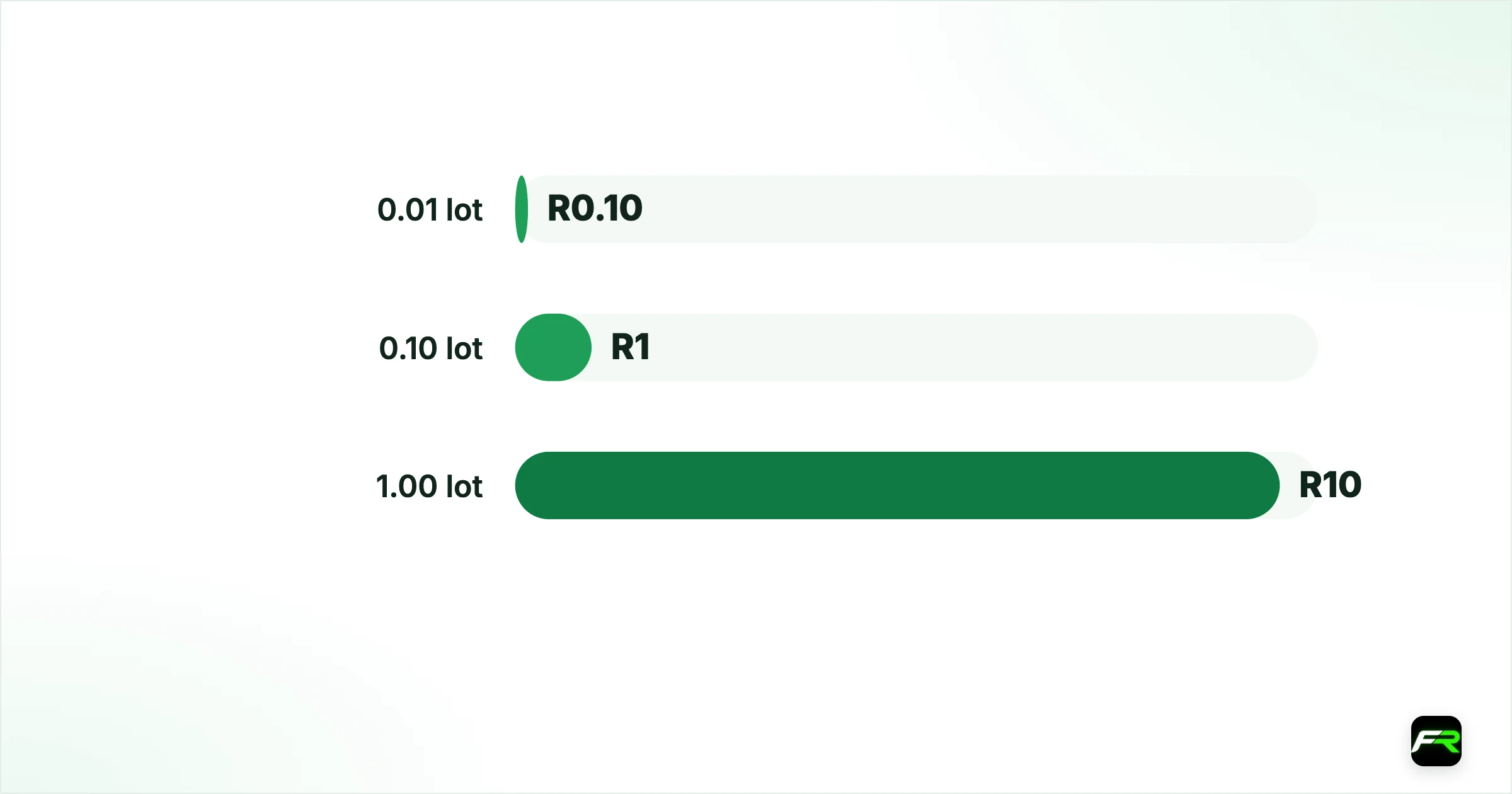
Because USD/ZAR is quoted in rand, the pip value on a rand account is fixed and easy to remember. The margin you put up is not: it depends on the exchange rate and your leverage. With USD/ZAR at 18.50 and leverage set at 1:100:
| Trade size | Notional | Value of 1 pip | Value of a 10-cent move | Margin at 1:100 |
|---|---|---|---|---|
| 0.01 lot (micro) | $1,000 | R0.10 | R100 | About R185 |
| 0.10 lot (mini) | $10,000 | R1 | R1,000 | About R1,850 |
| 1.00 lot (standard) | $100,000 | R10 | R10,000 | About R18,500 |
The fourth column is the one to absorb. A 10-cent move, say from 18.50 to 18.60, is an ordinary few hours for this pair. On a single standard lot it is R10,000, which is why a beginner's account should almost always be trading micro lots on USD/ZAR.
Your first USD/ZAR trade, step by step
- Check the calendar for the next 24 hours: no SARB decision, US CPI or jobs report due while you plan to hold.
- Mark the level that would prove your idea wrong. That is your stop, measured in cents, then converted to pips.
- Divide 1 per cent of your account by the stop in pips to get the rand per pip you can afford, then the lot size.
- Place the order with the stop and a target attached, during the London session or the overlap.
- Write the trade in your journal before you look at the result.
Mpho has a R6,000 account. His idea is that USD/ZAR will rise from 18.50, and it is wrong if the price falls to 18.38, a 12-cent or 1,200-pip stop. One per cent is R60, so he can afford R0.05 a pip, half a micro lot. His broker's smallest size is 0.01, so he either takes 0.01 lots and accepts a R120 risk, or waits for a setup with a tighter stop. He waits.
Sizing it: small
Because USD/ZAR can move one to two per cent in a day, a position that would be sensible on EUR/USD is too big on USD/ZAR. Work out your position size from your stop distance and a fixed 1 per cent account risk, and expect the stop distance on USD/ZAR to be wider than on a major pair, which means a smaller position. The position-sizing guide has the calculation for a rand account.
Bongani traded USD/ZAR with the same lot size he used on EUR/USD, because the number looked the same in the platform. His first week included a 1.6 per cent rand move on a risk-off day, which on his oversized position was a 20 per cent account hit in an afternoon. Once he sized from his stop and 1 per cent risk, the same kind of move cost him the planned 1 per cent, and he could keep trading.
USD/ZAR is a volatile, event-sensitive pair with a wide spread and a meaningful overnight swap. It is tradeable, but it punishes oversized positions and careless timing more than the major pairs do. Size small and respect the SARB calendar.
USD/ZAR is the natural first pair for a South African, and that is fine as long as you respect what it is: a high-volatility emerging-market cross, not a calm major. Trade it in the liquid hours, keep positions small, and stay out of it around the SARB decision until you know what you are doing.
Frequently asked
What does USD/ZAR mean?
The US dollar against the South African rand. A price of 18.50 means one dollar buys 18.50 rand. Buying the pair bets the rand will weaken; selling it bets the rand will strengthen.
Is USD/ZAR good for beginners?
It is a reasonable pair to learn on because you already follow it, but it is more volatile than the major pairs, has a wider spread, and can gap around the SARB decision. Size positions small and trade it in the liquid hours.
When is the best time to trade USD/ZAR?
During the London session and the London to New York overlap, roughly 10:00 to 18:00 South African time, when liquidity is highest and the spread is tightest. Avoid the thin late-evening and overnight hours.
How much does USD/ZAR move in a day?
Commonly one to two per cent, and it has done 1.5 per cent or more within minutes of a SARB rate decision. That is why positions should be smaller than you would use on a major pair.
Should I hold USD/ZAR overnight?
You can, but there is an overnight swap charge that is larger than on major pairs, and you carry the risk of an offshore move while you sleep. For a beginner, closing positions before the thin overnight session is safer.
What is a pip worth on USD/ZAR?
On a rand account, a pip (0.0001) is worth R10 per standard lot, R1 per mini lot and R0.10 per micro lot. A 10-cent move in the rate is 1,000 pips, so it changes a micro lot by R100 and a standard lot by R10,000.
Related reading
The team behind this guide
Researched, checked and approved by five forex specialists
Every guide is written, fact-checked and edited before it goes live, and updated when the facts change. Spotted an error? Tell us.