IC Markets





































Swap-Free (Islamic) Forex Accounts in South Africa
Swap-free accounts remove overnight interest to comply with the riba prohibition. How they work, hidden fees to check, and SA brokers offering them.
 WriterAbir KhanWriterWrites the guides · checks every figure against primary sources View profileAbout Abir →
 Market analysisTanbir Habib RiyadForex & Crypto AnalystForex and crypto analyst · technical and fundamental analysis View profileAbout Tanbir →
 Fact-checking & riskJannatul FerdaushFact-Checker & Risk AnalystFact-checks every figure · risk analysis · Applied Statistics, University of Dhaka View profileAbout Jannatul →
 Trading reviewJowel RanaCo-Founder & Forex TraderCo-founder · forex trader · reviews guides from a trader's view View profileAbout Jowel →
 Final approvalRanjan NiskrityFounder, Owner & Forex TraderFounder and owner · forex trader · signs off every guide View profileAbout Ranjan →
South Africa has a large Muslim trading community, and swap-free accounts exist to make forex trading workable within the prohibition on riba, interest. A standard account charges or pays interest, called swap, on any position held past the daily rollover. A swap-free account removes that. This guide covers how they work, the fees that sometimes replace the swap, and how to choose one.
What swap is, and why it is an issue
When you hold a forex position overnight, you are effectively borrowing one currency to hold another, and the interest-rate difference between them is applied to your account as a credit or a charge. That interest is riba, which makes a standard account a problem for observant Muslim traders. A swap-free account switches this off, so a position can be held for days or weeks without any interest component.
How brokers replace the swap
Brokers do not offer swap-free accounts out of generosity, and how they recover the cost is the thing to check. Common approaches:
- A flat administration fee per lot for positions held beyond a certain number of nights. This is transparent if disclosed clearly.
- A slightly wider spread on the swap-free account than the standard one.
- A grace period of a few nights swap-free, then a fee. Fine for short-term traders, costly for position traders.
- Excluding certain instruments from swap-free treatment, often exotic pairs including some rand crosses.
| Model | Good for | Watch for |
|---|---|---|
| Genuinely fee-free, all pairs | Any holding period | Rare; confirm it is not time-limited |
| Free for X nights, then admin fee | Short-term and swing traders | The per-lot fee size and when it starts |
| Wider spread instead of swap | Traders who hold long | Compare the total cost against a standard account plus swap |
| Swap-free except exotics | Major-pair traders | Whether USD/ZAR is included |
What to check before opening one
- Read the swap-free terms in full: the grace period, the administration fee per lot, and which instruments are covered.
- Confirm USD/ZAR and any other pairs you trade are included in the swap-free treatment.
- Compare the all-in cost (spread plus any admin fee) against the standard account plus swap for your typical holding period.
- Check the broker does not require a religious declaration or documentation that you are uncomfortable providing, though some do ask.
- Confirm the account is still on the locally FSCA-licensed entity.
Yusuf opened a swap-free account and assumed it was cost-free. It gave three nights swap-free, then charged an administration fee per lot that, on his multi-week position trades, added up to more than the swap on a standard account would have. He moved to a broker whose swap-free account used a slightly wider spread with no time limit, which suited his holding period better. The lesson was to compare the actual cost for how he trades, not just to see the word "free".
"Swap-free" does not mean cost-free. Every swap-free account recovers the cost somehow. Read the specific terms and work out what it costs you for your holding period before assuming it is cheaper or the same as a standard account.
Working out the cost for your holding period
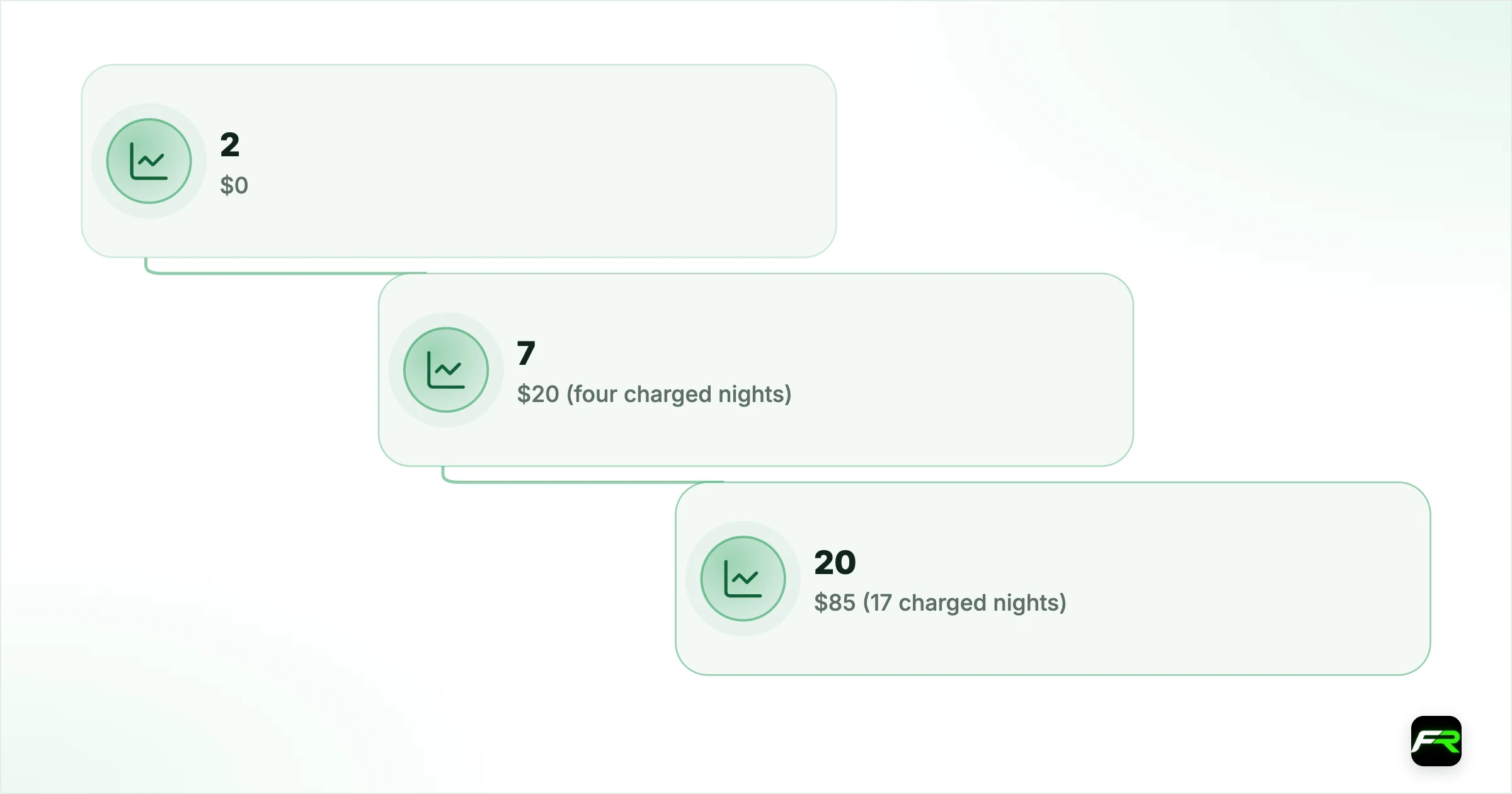
The right swap-free account depends on how long you hold trades. Compare two common fee models with illustrative figures for one standard lot of EUR/USD: an account that is free for three nights and then charges a $5 administration fee per lot per night, and an account with no time limit that widens the spread by 0.5 pips, worth $5 per lot once.
| Nights held | Admin-fee model | Wider-spread model |
|---|---|---|
| 2 | $0 | $5 |
| 7 | $20 (four charged nights) | $5 |
| 20 | $85 (17 charged nights) | $5 |
A short-term trader is better off with the grace-period account, while anyone holding for more than about four nights would pay less on the wider spread. Use your broker's real figures, which you will find in its swap-free terms, and your own typical holding time. The numbers above are for illustration only.
Gold, indices and the rand pairs
Swap-free treatment often differs by instrument. Some brokers extend it to gold and silver but not to index or energy CFDs; others exclude exotic currency pairs, which can include USD/ZAR. If you trade gold or the rand, check those symbols specifically in the swap-free terms and in your platform's specification window after the account is set up. A statement showing a swap line on a single instrument is the quickest way to find a gap.
Whether a particular account structure is acceptable for you is a religious question. Many traders ask a scholar they trust to look at the broker's terms, especially the fee model.
Swap-free abuse and account closure
Brokers watch swap-free accounts for what they consider abuse: holding very large positions for weeks purely to avoid financing costs a normal account would pay, or opening hedged positions across accounts to game the structure. If a broker decides an account is being used this way, it can convert it back to a standard account, claw back swap that would have been charged, or close it. For an ordinary observant trader holding normal positions for normal reasons this does not arise, but read the swap-free terms so you know where the broker draws the line.
Confirming it before you rely on it
- Open the account as swap-free from the start, rather than converting later, where the broker allows it.
- Place a small test position and hold it over two or three rollovers, then check the account statement for any swap or administration line.
- Confirm in that statement that USD/ZAR specifically shows no swap.
- Keep a copy of the swap-free terms as they were when you opened the account.
Availability in South Africa
Most of the large FSCA-linked brokers, including Exness, HFM and XM, offer a swap-free option, either as an account type or a setting you request. Terms differ significantly between them, so the choice comes down to the fee model and which pairs are covered rather than whether the option exists. The FSCA broker guide covers the shortlist.
The swap-free account is a genuine and useful product, but the terms vary more than almost any other account feature. Two brokers both say "Islamic account" and one is fee-free with a wide instrument list while the other charges a steep per-lot fee after two nights and excludes the rand pairs. Read the specific terms every time.
Frequently asked
What is a swap-free forex account?
An account that removes the overnight interest, called swap, on positions held past the daily rollover. This makes trades workable within the Islamic prohibition on riba, interest. Positions can be held for days or weeks with no interest component.
Are swap-free accounts really free?
No. Brokers recover the cost through a flat administration fee per lot after a grace period, a wider spread, or by excluding some instruments. Read the specific terms and compare the all-in cost for your holding period.
Which South African brokers offer swap-free accounts?
Most large FSCA-linked brokers, including Exness, HFM and XM, offer a swap-free option. The terms, especially the fee model and which pairs are covered, differ significantly, so compare those rather than just availability.
Is USD/ZAR included in swap-free treatment?
Not always. Some brokers exclude exotic pairs, which can include rand crosses, from swap-free treatment. Confirm the pairs you trade are covered before opening the account.
Do I need to prove I am Muslim to open one?
Some brokers ask for a declaration or documentation, others simply offer it as an account type or setting. Check the broker's requirement if that matters to you.
Is gold included in swap-free accounts?
Often, but not always. Some brokers apply swap-free treatment to metals such as gold, while excluding indices, energies or exotic pairs. Check the instrument list in the swap-free terms and confirm on your first statement that no swap line appears for gold.
Related reading
The team behind this guide
Researched, checked and approved by five forex specialists
Every guide is written, fact-checked and edited before it goes live, and updated when the facts change. Spotted an error? Tell us.