IC Markets
































The Rand, Eskom and Load Shedding: What Actually Moves USD/ZAR
Eskom ran all of 2026 without load shedding, helping the rand, but tariffs and debt remain risks. What power did to the currency and what to watch.
 WriterAbir KhanWriterWrites the guides · checks every figure against primary sources View profileAbout Abir →
 Market analysisTanbir Habib RiyadForex & Crypto AnalystForex and crypto analyst · technical and fundamental analysis View profileAbout Tanbir →
 Fact-checking & riskJannatul FerdaushFact-Checker & Risk AnalystFact-checks every figure · risk analysis · Applied Statistics, University of Dhaka View profileAbout Jannatul →
 Trading reviewJowel RanaCo-Founder & Forex TraderCo-founder · forex trader · reviews guides from a trader's view View profileAbout Jowel →
 Final approvalRanjan NiskrityFounder, Owner & Forex TraderFounder and owner · forex trader · signs off every guide View profileAbout Ranjan →
For most of the last decade, load shedding was a permanent line item in any rand forecast. That changed. Eskom took South Africa through the entire 2026 winter with no load shedding at all, the first clear year since 2018, after more than a year without a single stage. The currency market noticed, and the rand has traded better than its reputation would suggest. For a South African trader the questions now are different: what did load shedding actually do to USD/ZAR when it was at its worst, is the recovery real, and what should you watch instead.
The mechanism, when load shedding was severe
Load shedding never moved the rand the way traders expected. People assumed the currency would drop the moment Eskom announced a higher stage. It rarely did. The effect ran through a slow chain: unreliable power means lower output from mines and factories, which means weaker GDP growth, which means lower expected returns on South African assets, which means less foreign capital buying rand-denominated bonds and equities, which means a softer currency. Every link in that chain moves over weeks and months, not in an afternoon. During the worst load-shedding stretches the rand carried a persistent risk premium. It did not gap on each announcement.
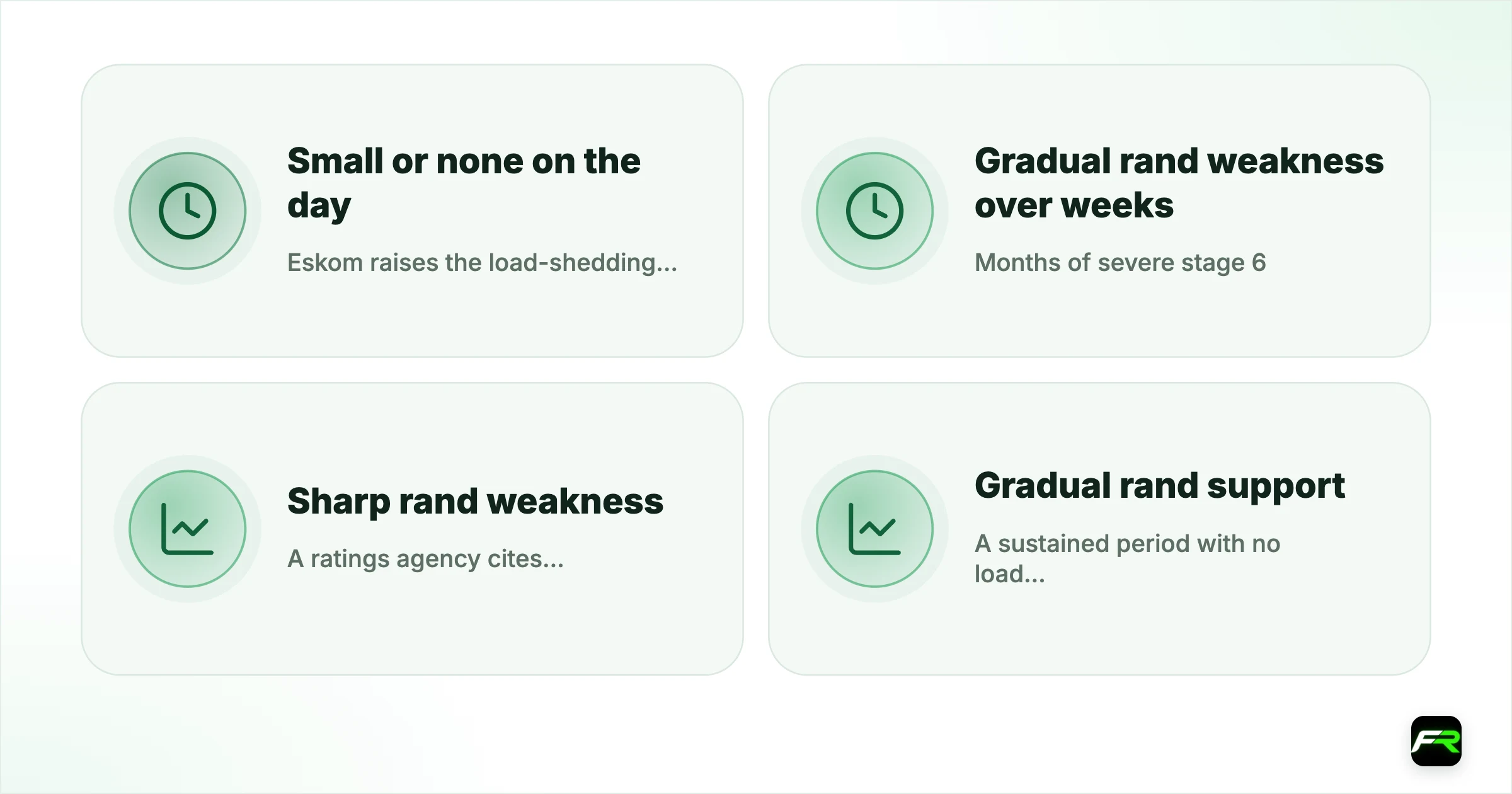
| Event | Typical USD/ZAR reaction | Why |
|---|---|---|
| Eskom raises the load-shedding stage | Small or none on the day | Already expected, priced as a slow growth drag |
| Months of severe stage 6 | Gradual rand weakness over weeks | Growth downgrades, investor confidence falls |
| A ratings agency cites electricity in a downgrade | Sharp rand weakness | Forced selling by mandate-constrained funds |
| A sustained period with no load shedding | Gradual rand support | Growth outlook improves, risk premium eases |
| A US Fed decision or global risk-off day | Large, fast USD/ZAR move | The rand is a liquid EM proxy; global factors dominate short term |
Is the recovery real?
Partly. Eskom's energy availability improved to its best level since 2020, unplanned outages fell, and the utility saved billions of rand in diesel by running its plants better rather than leaning on emergency generators. That is genuine operational progress and it removed a real drag on the rand.
The caveats matter, though. Electricity tariffs have risen more than 18 per cent over two years, which feeds inflation and squeezes households and businesses. Eskom's debt load and the age of its coal fleet are not fixed. Grid capacity for new generation is constrained in parts of the country. And the political will to keep reforms going can waver. The market is treating the improvement as real but reversible, so the rand gets support from it without pricing in a permanent fix.
Do not build a trade around "load shedding is over so the rand only goes up". The power situation is one slow-moving input among many, and a single risk-off week driven by the US can outweigh a year of Eskom progress in a few sessions.
What actually moves USD/ZAR now
On any given day, USD/ZAR is far more likely to move on offshore factors than on anything domestic. The rand is one of the most liquid emerging-market currencies and gets used as a proxy for EM risk generally, so a US inflation print, a Fed decision, a China growth scare or a broad risk-off session moves it more than a local headline.
- The Fed and US data. US CPI and FOMC days are the biggest scheduled risk for a USD/ZAR position, regardless of what is happening in South Africa.
- The interest-rate gap. The SARB repo rate is 7.25 per cent against a US federal funds target range of 3.75 to 4 per cent. That spread in the rand's favour attracts carry flows and has supported the currency.
- The SARB decision. The domestic high-volatility event. The rand can move 1.5 per cent or more within minutes of the statement.
- Commodities. South Africa exports gold, platinum group metals, coal and iron ore, so the rand tends to track them.
- Politics and fiscal news. Budget statements, coalition stability and credit-rating reviews reprice sovereign risk and move the rand on their own.
The full rand drivers guide covers each of these, and the SARB decision guide covers trading the announcement.
USD/ZAR, GBP/ZAR or EUR/ZAR?
South African traders often start with a rand pair because it feels familiar. USD/ZAR is the sensible choice of the three: it is the most liquid, has the tightest spreads, and is the one every analyst and news feed covers. GBP/ZAR and EUR/ZAR are thinner, with wider spreads and larger swap costs to hold overnight, and they move on two sets of news at once, the rand's and the pound's or euro's. That is more to track, not less risk.
Many experienced South African traders eventually trade less rand and more of the major pairs like EUR/USD, because the spreads are tighter and the news flow is cleaner. There is nothing wrong with trading USD/ZAR, but you are taking on a volatile pair with event risk clustered around the SARB and the Fed. Size accordingly, and do not hold large rand positions through a SARB decision unless that is the trade you intend.
| Pair | Liquidity and spread | Best for |
|---|---|---|
| USD/ZAR | Most liquid rand pair, tightest spread | Trading the rand directly, following SARB and Fed |
| GBP/ZAR | Thinner, wider spread, higher swap | Traders who also follow UK data closely |
| EUR/ZAR | Thinner, wider spread, higher swap | Traders who also follow euro-area data closely |
| EUR/USD and other majors | Deepest liquidity, tightest spreads | Lower-cost trading once you are past the rand-familiarity stage |
Trading around it from South Africa
- Treat SARB decision days, the Budget, and US CPI and FOMC dates as your high-volatility calendar. Load-shedding announcements, if they return, are not in that category.
- Watch ratings-agency review dates. A downgrade or a negative outlook change can produce a real, fast move.
- Use the power situation as background for your directional lean on swing trades, not as an entry trigger.
- Keep position size normal. The rand can strengthen sharply on a risk-on week even during bad domestic news, because the global driver outweighs the local one in the short run.
- Have a connection backup. Load shedding is suspended, not abolished, and load reduction, storms and fibre cuts still happen.
During the stage 6 period, Nomsa shorted the rand the afternoon Eskom raised the stage, expecting a quick payout. The pair barely moved and drifted against her for two sessions. A week later a ratings agency published a note citing electricity constraints and USD/ZAR jumped, but she had already closed at a loss. Her lesson was that the tradeable event was the ratings note, not the Eskom announcement, and the two were a week apart. She now trades the rand around the SARB decision and US data, and treats Eskom news as slow context.
South African traders spent years trying to trade load shedding as a news event, and it was never that. It was a slow structural negative that was already in the price. Now that it has eased, the temptation is to treat that as a one-way positive for the rand. That is wrong; all it did was remove a drag. The rand still lives and dies by the Fed, the SARB and global risk appetite, and that is where a trader should be looking.
The bottom line
Load shedding hurt the rand through growth and confidence, slowly, not through same-day headlines. Its suspension in 2026 has helped, but tariffs, debt and an ageing grid mean the market sees the improvement as real and reversible rather than permanent. For a trader, the currency's daily behaviour is still set offshore, by the Fed and global risk sentiment, and domestically by the SARB decision and the Budget. Trade those. Keep Eskom as context and keep a connection backup regardless.
Trading USD/ZAR on margin carries a high risk of loss, and the rand can move several per cent in a day on offshore news. This is general market commentary, not a trade recommendation.
Frequently asked
Is there still load shedding in South Africa?
Eskom ran the whole of 2026 with no load shedding, the first clear year since 2018, after more than a year without a stage. Localised load reduction, storm damage and fibre outages still happen, so a connection backup is still worth having, but scheduled national load shedding has been suspended.
Does load shedding make the rand weaker?
When it was severe, yes, but slowly. It lowered growth expectations and investor confidence, which reduced foreign capital inflows and left the rand carrying a risk premium. It did not usually move the currency on the day a stage was announced.
Has the rand got stronger now that load shedding has stopped?
The improvement removed a real drag and has been supportive, alongside a wide interest-rate gap in the rand's favour. But the rand's day-to-day direction is still set by the Fed, global risk sentiment and the SARB, so the power situation is one slow input among several, not a one-way positive.
What moves USD/ZAR the most on a given day?
Offshore factors: US inflation data, Fed decisions, China growth news and global risk sentiment. The rand is a liquid emerging-market proxy, so global drivers outweigh domestic ones in the short term. The main domestic event is the SARB rate decision.
Should I trade the rand on Eskom news?
Generally no. Eskom developments are slow-moving structural inputs that the market prices gradually. The tradeable events are SARB decisions, the Budget, ratings reviews and US data releases.
Could load shedding come back?
It is possible. Eskom's debt, the age of its coal fleet and grid constraints are not resolved, and the operational gains could reverse. The market treats the recovery as real but reversible, which is why the rand gets support from it without pricing in a permanent fix.
Related reading
The team behind this guide
Researched, checked and approved by five forex specialists
Every guide is written, fact-checked and edited before it goes live, and updated when the facts change. Spotted an error? Tell us.