IC Markets


































Best Forex Broker in South Africa for Beginners
For a first account, the priorities are a local FSCA licence, a true ZAR account, a low minimum deposit, a good demo, and a clean withdrawal record. Not the highest leverage or the biggest bonus.
 WriterAbir KhanWriterWrites the guides · checks every figure against primary sources View profileAbout Abir →
 Market analysisTanbir Habib RiyadForex & Crypto AnalystForex and crypto analyst · technical and fundamental analysis View profileAbout Tanbir →
 Fact-checking & riskJannatul FerdaushFact-Checker & Risk AnalystFact-checks every figure · risk analysis · Applied Statistics, University of Dhaka View profileAbout Jannatul →
 Trading reviewJowel RanaCo-Founder & Forex TraderCo-founder · forex trader · reviews guides from a trader's view View profileAbout Jowel →
 Final approvalRanjan NiskrityFounder, Owner & Forex TraderFounder and owner · forex trader · signs off every guide View profileAbout Ranjan →
A beginner needs a broker that is safe, cheap to start with, easy to fund locally, and honest about withdrawals. The things that get marketed hardest, huge leverage, big deposit bonuses, "zero spread", award shelves, are either irrelevant or actively bad for a new trader. This guide sets out the checklist for a first account and how to apply it.
The beginner checklist
- Local FSCA licence. Confirm the ODP authorisation on fsca.co.za and that the entity matches your account agreement.
- True ZAR base account. So your balance, risk and results are in rand and your tax records are simple.
- Low minimum deposit. R70 to R500 is enough to start. You should not need to risk much to learn.
- A proper demo account. Unlimited time, realistic conditions, the same platform as the live account.
- Local funding. EFT, Ozow, and card from the main South African banks.
- A clean withdrawal record. Read recent reviews focused specifically on getting money out.
- MT4 or MT5. The standard platforms, so any course or tutorial you follow will match.
| Priority | Why it matters for a beginner | What to ignore |
|---|---|---|
| FSCA licence | Local recourse if something goes wrong | Offshore licence with high leverage |
| ZAR account | Clean numbers, simple tax | USD account you have to mentally convert |
| Low minimum deposit | Learn without risking much | "Premium" accounts with high minimums |
| Good demo | Practise for months at no cost | Pressure to fund immediately |
| Withdrawal record | You can actually get your money | Deposit bonus that locks withdrawals |
Leverage: less is better when you start
A beginner does not need 1:1000 leverage, and a broker leading with it is usually an offshore entity with lighter oversight. Lower leverage, 1:30 to 1:200, makes it harder to accidentally take a position far too big for your account, which is one of the most common ways a first deposit disappears. You can always increase it later. The leverage guide covers this.
Bonuses: skip them
A deposit bonus almost always comes with a trading-volume requirement before you can withdraw anything, including your own deposit. That pushes a new trader to overtrade to "unlock" the bonus, which is exactly the wrong behaviour. A tight spread and fast withdrawals are worth far more than bonus credit you may never be able to take out.
Aphiwe almost signed up with an offshore broker for the 100 per cent deposit bonus and 1:2000 leverage. A friend who trades talked her through the withdrawal condition on the bonus and what 1:2000 does to a R1,000 account. She opened a locally licensed ZAR account instead, deposited R500, and spent three months on the demo alongside the small live account. A year later she is slightly up and still trading, which she credits mostly to not starting with the bonus broker.
Open the demo before you deposit anywhere. Spend real time on it. A broker that makes the demo hard to access, or nags you to fund within days, is telling you what it prioritises.
Regulated-account outcomes are public
Brokers operating under strict regulation are required to publish the share of retail accounts that lose money, usually as a line on the website like "74 per cent of retail investor accounts lose money with this provider". Read that number. It is not marketing, it is a regulator-mandated disclosure, and it is the most honest figure a broker gives you. A beginner should treat it as the base rate they are trying to beat, and as a reminder to start small. A broker that shows no such disclosure is usually operating from a jurisdiction that does not require one, which is itself information about the broker.
Switching brokers later is normal
You do not have to pick the perfect broker on day one. Many South African traders open a locally licensed ZAR account to learn on, then later add or move to another for a tighter spread on a specific pair, a better platform, or stronger support. Your trading skills, your journal and your strategy all move with you. The only friction is withdrawing from one and funding the other, and doing a small test cycle on the new one. Choose a solid, safe first broker and treat the decision as reversible, because it is.
Your first 30 days with a new broker
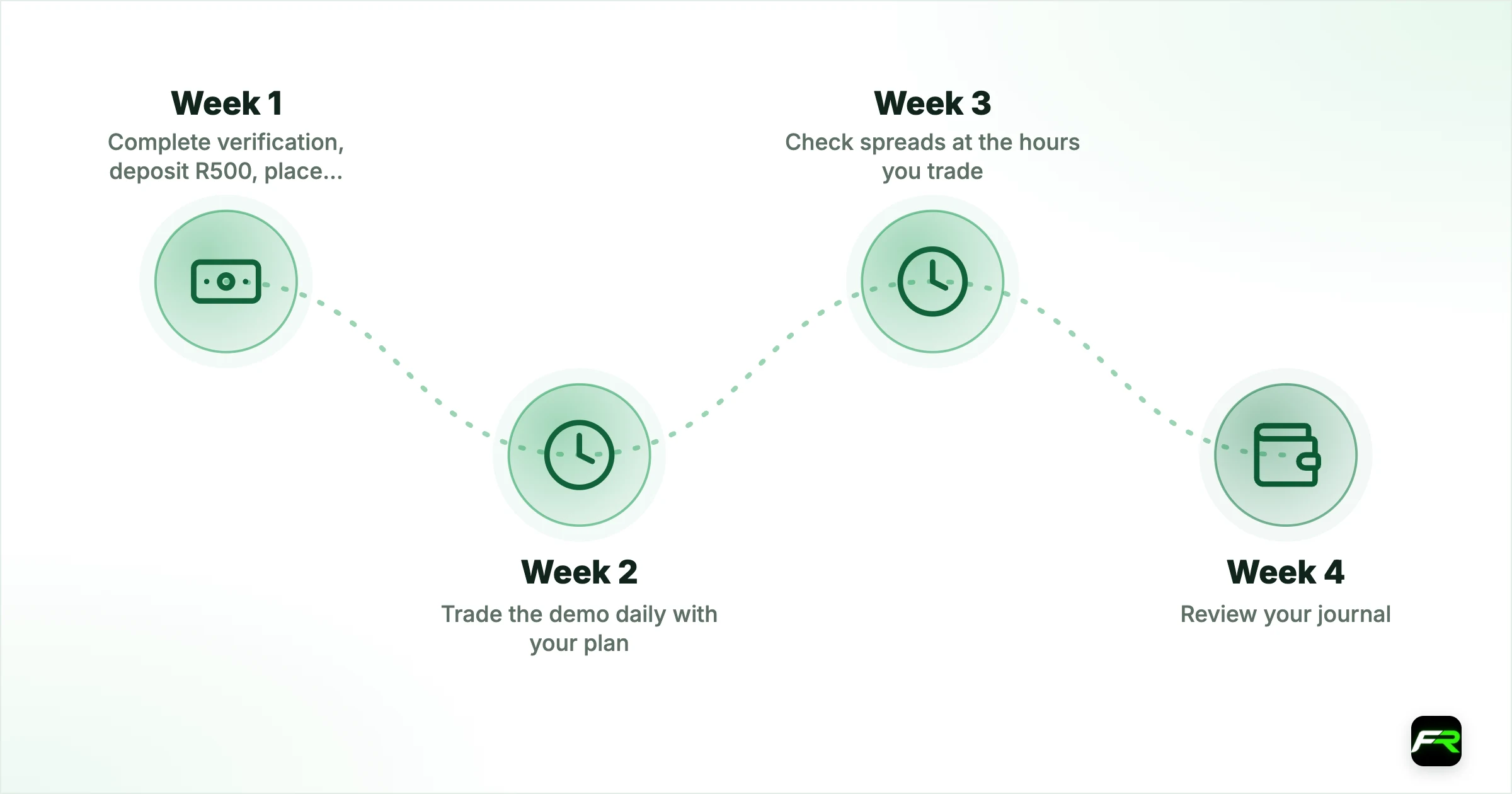
Opening the account is the easy part. The first month decides whether the broker suits you, and it is the cheapest time to find out it does not. A simple plan keeps you from depositing more than you should before you have tested the basics.
| Week | What to do | What you are testing |
|---|---|---|
| Week 1 | Complete verification, deposit R500, place one tiny trade, withdraw R300 | Funding, the platform and the withdrawal round trip |
| Week 2 | Trade the demo daily with your plan; keep the live account to one or two micro trades | Whether the demo and live fills look alike |
| Week 3 | Check spreads at the hours you trade; message support with a real question | Real costs and support quality |
| Week 4 | Review your journal; decide whether to add funds or move on | Your process, not your profit |
If any step fails, a withdrawal that drags, a spread far wider than advertised, support that cannot answer a plain question, you have lost very little. Move to the next broker on your shortlist and repeat the month. That is far cheaper than discovering the same problems with R20,000 on the account.
Mistakes we see in a first account
- Funding the full amount on day one instead of testing with R500.
- Accepting the default leverage, often the highest available, without lowering it.
- Trading the live account and the demo with different rules, so the demo teaches nothing.
- Signing up through a social media link that routes you to an offshore entity of the same brand.
- Skipping the journal because the account is small.
None of these is about choosing the wrong broker. They are habits, and they follow you from one platform to the next. Fixing them in the first month matters more than any feature comparison.
A sensible first-account setup
- Locally FSCA-licensed broker, ODP authorisation verified.
- ZAR base account, standard or raw depending on the spread comparison.
- Deposit R500 to R2,000, an amount you can lose without it mattering.
- Leverage set low, around 1:100.
- Risk 1 per cent per trade from the first trade.
- Demo running in parallel until your process is consistent.
The best beginner broker is a boring one: locally licensed, rand account, small minimum, good demo, pays withdrawals without drama. Everything a broker shouts about in its ads is either irrelevant to a beginner or a reason to be careful. Pick boring, start small, and put your effort into learning to trade rather than into the broker choice.
Frequently asked
What is the best forex broker for beginners in South Africa?
The one that is locally FSCA-licensed, offers a true ZAR account, has a low minimum deposit and a good demo, supports local funding, and has a clean withdrawal record. Exness, HFM and XM are commonly used starting points; verify the current licence yourself.
How much should a beginner deposit?
Enough to be real but not enough to hurt: R500 to R2,000 for most people. The main FSCA brokers allow much less, but a tiny account produces tiny results even when you trade well.
Should a beginner take a deposit bonus?
No. Deposit bonuses usually lock your withdrawals behind a trading-volume requirement, which pushes you to overtrade. A tight spread and reliable withdrawals are worth more.
What leverage should a beginner use?
Low, around 1:30 to 1:200. High leverage makes it easy to take a position far too large for your account. You can increase it later once you size trades properly.
Do I need MT4 or MT5?
One of them is worth having as a beginner, because almost every tutorial and course is built around them. MT5 is the newer version; either is fine to learn on.
How long should I test a broker before depositing more?
About a month is enough for most beginners. In that time you can complete verification, run a small deposit and withdrawal, compare demo and live conditions, check spreads at your trading hours and test support. Add money only once all of that has worked.
Related reading
The team behind this guide
Researched, checked and approved by five forex specialists
Every guide is written, fact-checked and edited before it goes live, and updated when the facts change. Spotted an error? Tell us.