IC Markets




































How to Check a Broker's FSCA Licence in Three Minutes
A step-by-step walk through the FSCA register: where to find the licence number, what to confirm, and the entity-substitution trick that catches South African traders out.
 WriterAbir KhanWriterWrites the guides · checks every figure against primary sources View profileAbout Abir →
 Market analysisTanbir Habib RiyadForex & Crypto AnalystForex and crypto analyst · technical and fundamental analysis View profileAbout Tanbir →
 Fact-checking & riskJannatul FerdaushFact-Checker & Risk AnalystFact-checks every figure · risk analysis · Applied Statistics, University of Dhaka View profileAbout Jannatul →
 Trading reviewJowel RanaCo-Founder & Forex TraderCo-founder · forex trader · reviews guides from a trader's view View profileAbout Jowel →
 Final approvalRanjan NiskrityFounder, Owner & Forex TraderFounder and owner · forex trader · signs off every guide View profileAbout Ranjan →
This is the single most useful check a South African trader can do before depositing, and it is free and takes about three minutes. The FSCA keeps a public register of every firm it authorises. If a broker is not on it, or the record does not say what the marketing says, you have your answer. Here is exactly how to do it.
Step 1: Find the legal entity name and licence number
Go to the broker's website and scroll to the footer, or open the "Legal", "Regulation" or "About" pages. You are looking for two things: the full registered company name (not the brand name) and an FSP or licence number, usually written as "FSP 12345" or "authorised financial services provider no. 12345". Write both down. If a broker makes this hard to find, that is itself a small red flag.
Step 2: Search the FSCA register
On fsca.co.za, open the register search, which the site links from the main navigation as the list of regulated entities. Search by the FSP number first, then by the company name to cross-check, and open the record.
Step 3: Confirm four things
- The entity exists and the number matches. The name on the register should be the same registered company name from the broker's legal page.
- The authorisation covers the right activity. For a broker that is your trade counterparty, look for derivative instruments or an ODP authorisation. An advice-only FSP is weaker.
- The status is active. Check it is not lapsed, suspended, provisionally withdrawn or withdrawn. The FSCA suspended and provisionally withdrew licences from CFD brokers during 2026, so this is not hypothetical.
- The entity matches your account agreement. When you open the account, the counterparty named in the client agreement should be the same entity you just checked, not an offshore sister company.
| What you see on the register | What it means |
|---|---|
| Active, covers derivatives, entity matches agreement | Locally licensed. Best case for protection. |
| Active, but advice or intermediary only | The local entity cannot be your counterparty. Check which entity holds the account. |
| Lapsed, suspended or withdrawn | Do not deposit. Existing clients should read FSCA notices on the firm. |
| Not found at all | Not FSCA authorised. If it is taking South African clients as counterparty, that is a problem. |
The entity-substitution trick
The most common way a South African trader gets a false sense of safety: the broker's local website shows a real FSCA licence for its South African entity, but the account you actually open is with a group company registered offshore. Nothing is hidden, it is in the client agreement, but few people read that far. If the entity that will hold your money is not the entity on the FSCA record, you are an offshore client for the purposes of protection and dispute resolution, whatever the homepage says.
Naledi checked her broker on the register, found an active licence covering derivatives, and deposited. Months later a withdrawal stalled and she went to complain to the FSCA, only to be told her account was with the group's offshore entity, which the FSCA does not supervise. The licence she had checked was real. It just was not the entity holding her money. She now checks the counterparty name in the agreement against the register before funding.
Screenshot the FSCA record on the day you open the account, showing the entity name, the authorisation and the active status. If there is a dispute later, you have a dated record of what you were told and what the register showed.
A worked check, from footer to register
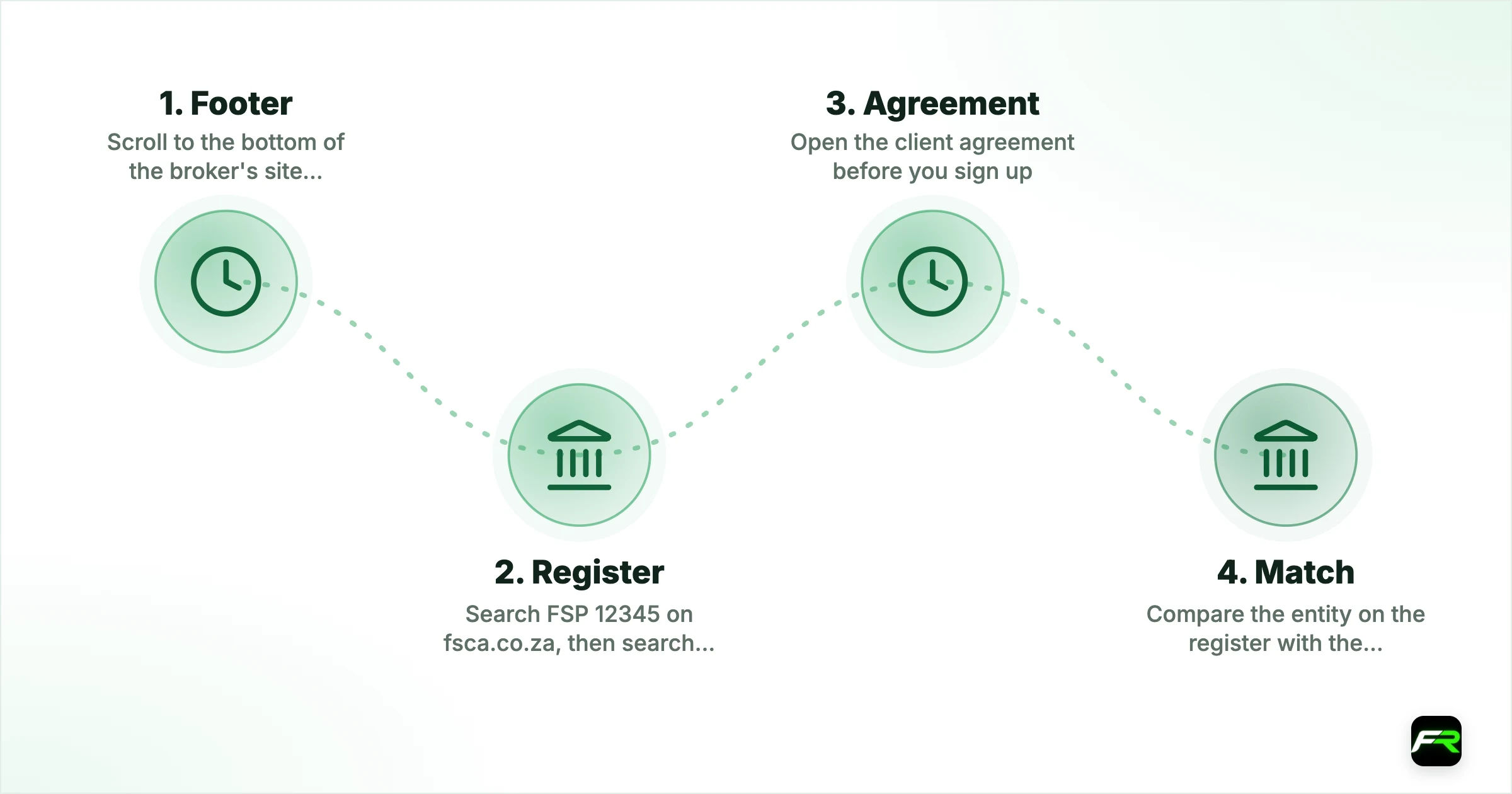
Here is how the routine runs in practice, using an imaginary broker called Example Markets. Nothing in it needs special knowledge, only a willingness to read the small print on two websites and compare names.
| Step | What you do | What you note down |
|---|---|---|
| 1. Footer | Scroll to the bottom of the broker's site and open its legal page | Example Markets (Pty) Ltd, FSP 12345 |
| 2. Register | Search FSP 12345 on fsca.co.za, then search the company name | Status: authorised; categories include derivative instruments |
| 3. Agreement | Open the client agreement before you sign up | Counterparty: Example Markets (Pty) Ltd |
| 4. Match | Compare the entity on the register with the one in the agreement | Same entity: local protection applies |
| 5. Warnings | Search the brand name on the FSCA warning list | No warning found |
If step four turns up a different name, for example Example Markets Global Ltd registered in another country, stop and decide whether you are comfortable as an offshore client. That is a legitimate choice for some traders, but it should be a choice, not a surprise discovered during a dispute.
Checking the people as well as the firm
The register record also lists the key individuals and, for many firms, the representatives allowed to deal with clients. Anyone calling you as an account manager on behalf of a licensed firm should appear as one of its representatives, or at least be reachable through the firm's published switchboard. Scammers often name a real licensed firm and then give you a WhatsApp number that has nothing to do with it.
When someone phones claiming to work for a licensed broker, hang up and call the number on the firm's own website. A genuine representative will not mind; an impersonator will not be on the other end.
Checking the warning list too
Alongside the register of authorised firms, the FSCA publishes warnings against entities it believes are operating without authorisation. Search the firm name there as well. A hit on the warning list is a clear stop. The warning list guide covers how to read it.
I tell every new South African trader to do two searches before their first deposit: the broker on the FSCA register, and the broker on the FSCA warning list. Together they take three minutes and they screen out most of the ways people lose money before they have placed a single trade. It is the highest-value habit in retail forex and almost nobody does it.
For the rules and brokers that apply where you live, see our guide to the best forex brokers in South Africa.
Frequently asked
Where is the FSCA register?
On the FSCA's official website, fsca.co.za, linked from the main navigation as the list of regulated entities and financial services providers. Do not use a link from the broker's own site; go to the regulator directly.
What should the licence cover for a forex broker?
Derivative instruments, or an Over-the-Counter Derivative Provider authorisation, because a retail forex trade is a derivative between you and the broker. An advice-only or intermediary FSP is a weaker position.
What if the broker is not on the register?
If a firm is taking South African clients as the counterparty to forex trades without FSCA authorisation, that is a serious problem. Do not deposit, and check whether it appears on the FSCA warning list.
Why does the entity name matter?
Groups often run a locally licensed South African entity and a separate offshore one. If your account agreement names the offshore entity, the FSCA does not supervise your account and a dispute has no local route, regardless of the licence shown on the website.
Can a licence be withdrawn after I open an account?
Yes. The FSCA suspended and provisionally withdrew CFD broker licences during 2026. Check FSCA notices periodically, keep withdrawals regular, and do not leave a large balance sitting with any single broker.
Can a scammer use a real broker's FSP number?
Yes, and it happens. Clone operations copy a licensed firm's name and number onto their own website. That is why you compare the website address, phone numbers and entity name with the FSCA record, and call the firm on the contact details the register or its official site gives.
Related reading
The team behind this guide
Researched, checked and approved by five forex specialists
Every guide is written, fact-checked and edited before it goes live, and updated when the facts change. Spotted an error? Tell us.