IC Markets



























SARB Exchange Control and Forex Trading, Explained
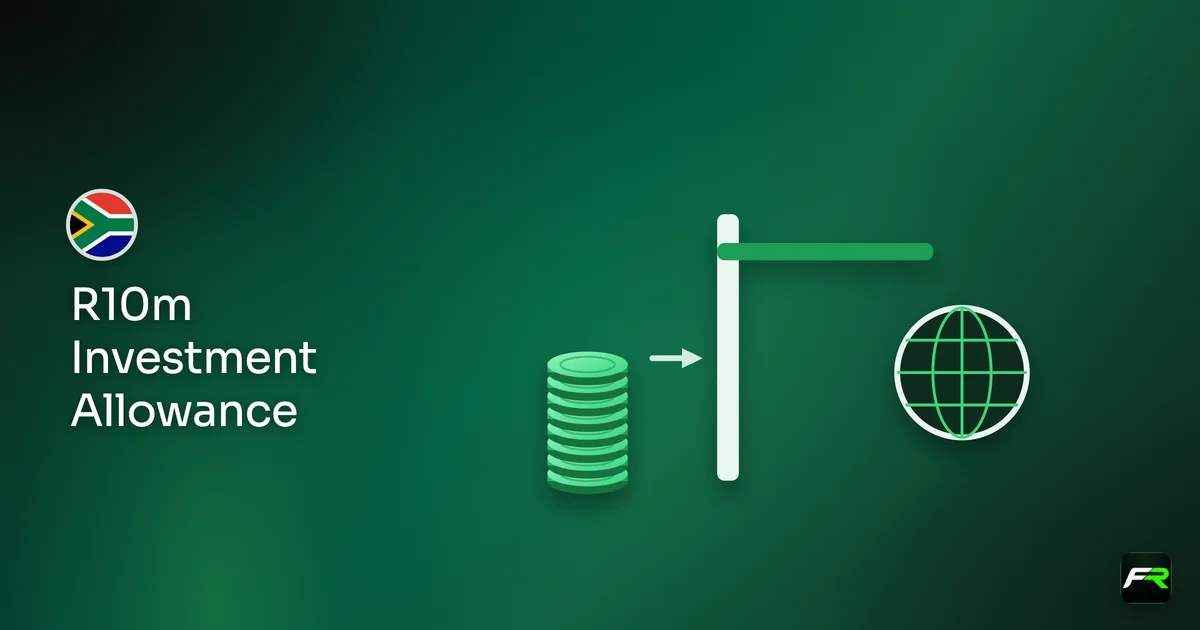
Sending rand to a foreign broker is governed by the Reserve Bank. How the R2 million and R10 million allowances apply, and when a ZAR account helps.
 WriterAbir KhanWriterWrites the guides · checks every figure against primary sources View profileAbout Abir →
 Market analysisTanbir Habib RiyadForex & Crypto AnalystForex and crypto analyst · technical and fundamental analysis View profileAbout Tanbir →
 Fact-checking & riskJannatul FerdaushFact-Checker & Risk AnalystFact-checks every figure · risk analysis · Applied Statistics, University of Dhaka View profileAbout Jannatul →
 Trading reviewJowel RanaCo-Founder & Forex TraderCo-founder · forex trader · reviews guides from a trader's view View profileAbout Jowel →
 Final approvalRanjan NiskrityFounder, Owner & Forex TraderFounder and owner · forex trader · signs off every guide View profileAbout Ranjan →
Exchange control is the set of Reserve Bank rules on moving money across South Africa's borders. It is separate from tax and separate from the FSCA. For a forex trader it matters in one specific situation: when you send rand from a South African bank to a broker account held offshore. This guide explains the allowances, how the transfer actually works, and why a broker with a local rand account changes the picture.
The two allowances
Every South African resident aged 18 or older has two annual allowances for moving money offshore, both resetting on 1 January:
- Single Discretionary Allowance (SDA): R2 million a year. The 2026 Budget doubled this from R1 million. It can be used for almost any legal purpose abroad, including funding an investment or trading account, with no tax clearance required. Your bank processes it against your ID.
- Foreign Investment Allowance (FIA): up to R10 million a year. This sits on top of the SDA and is specifically for offshore investment. It requires a SARS Tax Compliance Status PIN (formerly a tax clearance certificate), which confirms your tax affairs are in order.
For a retail trader funding an account with a few thousand or a few tens of thousands of rand, the SDA alone is far more than enough, and the allowances are almost never the binding constraint.
| Allowance | Annual limit | Tax clearance needed? | Typical use for a trader |
|---|---|---|---|
| Single Discretionary Allowance | R2 million | No | Funding a forex or trading account offshore |
| Foreign Investment Allowance | R10 million | Yes, SARS TCS PIN | Larger offshore investment, rarely relevant to retail forex |
How the transfer works
When you instruct your bank to send rand to a foreign broker, the bank converts it to the target currency, reports the transfer to the Reserve Bank under a balance-of-payments category, and debits it against your SDA. You will usually be asked the reason for the payment. "Investment" or "trading account funding" is a normal answer. The bank keeps the record. There is nothing to file with SARS or SARB yourself for an SDA transfer, but keep your own record of the rand amount, the date and the exchange rate, because you will need it for your tax return later.
When a local ZAR account sidesteps this
If your broker has a genuine South African entity with a local bank account, your deposit is a domestic rand transfer, not a cross-border one. It does not touch your SDA, there is no conversion at the point of deposit, and the money stays in the local banking system until you trade. This is one of the practical reasons to prefer a broker with a true ZAR account, and the tax on your profits is exactly the same either way. Our ZAR account guide covers which brokers offer this.
Lindiwe funded an offshore broker by international transfer, sending R30,000. Her bank converted it at its own rate, charged a SWIFT fee, and the broker's bank took a further cut, so about R28,900 landed. When she later switched to a broker with a local ZAR account, the same R30,000 deposit arrived in full by instant EFT and never used her discretionary allowance. She keeps a simple spreadsheet of every deposit and withdrawal with the date and rate, which made her first tax return straightforward.
Record every deposit and withdrawal in rand, with the date and the exchange rate used. SARS wants your profit calculated in rand, and reconstructing exchange rates a year later from a broker statement in US dollars is tedious and error-prone.
Which rule applies to your situation
Most questions about exchange control come down to one of a handful of situations. The table sets out how each is normally treated for a resident individual. Your bank applies the rules, so it is the place to confirm anything unusual.
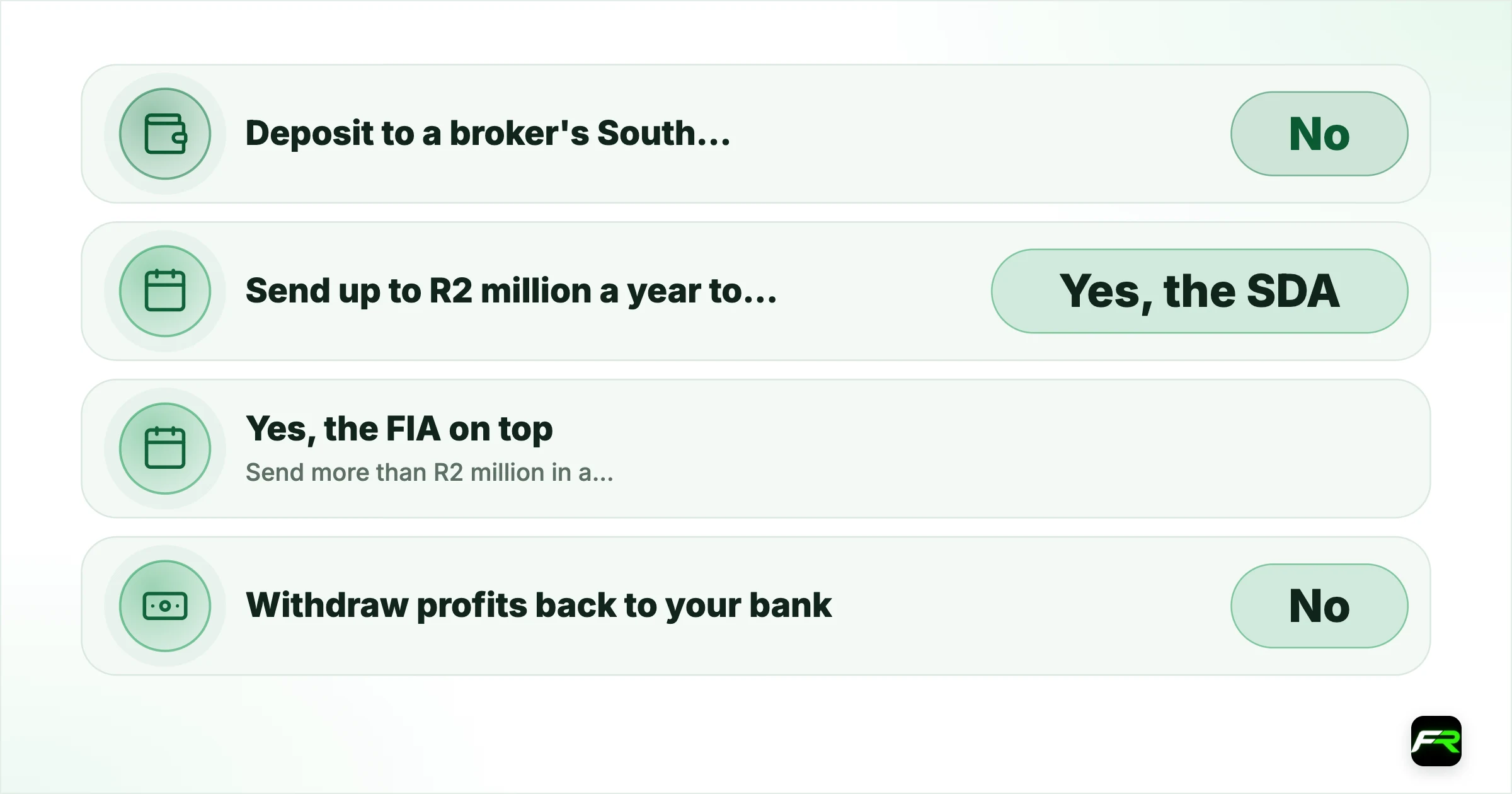
| Situation | Uses your allowance? | What you need |
|---|---|---|
| Deposit to a broker's South African entity in rand | No | Nothing beyond the broker's own checks |
| Send up to R2 million a year to an offshore broker | Yes, the SDA | Your ID; no SARS PIN |
| Send more than R2 million in a calendar year | Yes, the FIA on top | SARS Approval International Transfer (TCS PIN) |
| Withdraw profits back to your bank | No | Keep the record for SARS |
| Trade JSE currency futures | No | A JSE-authorised derivatives broker |
The Budget 2026 change made the first two rows simpler. SARS confirms that residents can now send up to R2 million each calendar year without a Tax Compliance Status PIN, so a married couple can move R4 million between them before anyone needs SARS approval.
Keeping a paper trail for every transfer
Exchange-control paperwork is the bank's job, but the record you keep is yours, and SARS will ask for it. For each offshore transfer save the bank's confirmation, which shows the rand amount, the rate and the reporting category, and match it to the deposit on your broker statement. Do the same in reverse for every withdrawal. A single spreadsheet with date, rand amount, foreign amount and rate covers both exchange control and tax.
Ask your bank for the transfer confirmation by email on the day. Pulling old international payment advices months later can take a branch visit.
What exchange control does not do
Exchange control does not make forex trading illegal, does not tax you (that is SARS), and does not cap how much you can trade once the money is with the broker. It only governs the border crossing, and it does not apply at all to a domestic ZAR deposit. Staying within your allowance also does not remove your tax obligation on the profits.
New traders worry about exchange control far more than they need to. For the amounts a retail trader moves, the R2 million discretionary allowance is enormous headroom, and a local ZAR account avoids the question entirely. The part people actually get wrong is not the SARB transfer, it is failing to keep the rand values and exchange rates they will need for SARS.
Frequently asked
How much can I send offshore to fund a forex account?
Up to R2 million a year under the Single Discretionary Allowance with no tax clearance, and up to a further R10 million under the Foreign Investment Allowance with a SARS Tax Compliance Status PIN. For most retail traders the R2 million allowance is far more than needed.
Do I need SARS clearance to fund a broker account?
Not for transfers within your R2 million Single Discretionary Allowance. You only need a SARS Tax Compliance Status PIN if you use the Foreign Investment Allowance on top of it, which is rare for retail forex.
Does exchange control apply to a local ZAR broker account?
No. Depositing rand to a broker's South African entity is a domestic transfer, so it does not use your discretionary allowance and there is no currency conversion at deposit.
What reason do I give my bank for the transfer?
Funding an investment or trading account is a normal, acceptable reason. The bank reports it to the Reserve Bank under a balance-of-payments category and debits it against your Single Discretionary Allowance.
Does staying within my allowance mean I do not owe tax?
No. Exchange control and tax are separate. SARS taxes your trading profit as income regardless of how the money crossed the border, and regular traders must register for provisional tax.
Can my spouse and I combine our allowances?
Each resident adult has their own R2 million Single Discretionary Allowance, so a couple can send up to R4 million a year in total. Transfers run against the allowance of whoever sends them, and each person should hold their own account with the broker.
Related reading
The team behind this guide
Researched, checked and approved by five forex specialists
Every guide is written, fact-checked and edited before it goes live, and updated when the facts change. Spotted an error? Tell us.