IC Markets

































5 South African Forex Case Studies Every Beginner Should Read
Five patterns that repeat in South African trading, from the deepfake-advert victim to the slow grinder who made it work, with the numbers.
 WriterAbir KhanWriterWrites the guides · checks every figure against primary sources View profileAbout Abir →
 Market analysisTanbir Habib RiyadForex & Crypto AnalystForex and crypto analyst · technical and fundamental analysis View profileAbout Tanbir →
 Fact-checking & riskJannatul FerdaushFact-Checker & Risk AnalystFact-checks every figure · risk analysis · Applied Statistics, University of Dhaka View profileAbout Jannatul →
 Trading reviewJowel RanaCo-Founder & Forex TraderCo-founder · forex trader · reviews guides from a trader's view View profileAbout Jowel →
 Final approvalRanjan NiskrityFounder, Owner & Forex TraderFounder and owner · forex trader · signs off every guide View profileAbout Ranjan →
Most South African trading stories fit one of a handful of patterns. The names and the amounts change, the mistake usually does not. These five case studies are drawn from patterns the FX Recap desk sees repeatedly, from FSCA enforcement records, and from what South African traders describe in forums and reviews. Read them before your first deposit. Four of the five lost money, and the reasons are ordinary and avoidable.
These are composite cases built from common, well-documented patterns and public regulatory findings. Names and specific figures are illustrative. The lessons are the point.
Case 1: The automated-trading advert
Thandeka, 44, from Polokwane, saw a Facebook video of a well-known South African billionaire endorsing an automated trading system that turned R4,700 into R300,000 a month. She clicked through, was called within an hour by a friendly "account manager", and deposited R25,000. The manager encouraged her to add R120,000 more to "unlock" the automated system. Her account showed large gains for two weeks. When she asked to withdraw, the platform demanded a "release fee" and then a "tax payment". She sent both. Then the manager stopped answering.
This is the Banxso pattern almost exactly. In December 2025 the FSCA fined that platform more than R2 billion, the largest penalty in South African regulatory history, after finding it misappropriated client funds and ran deepfake celebrity adverts funnelling people into high-risk CFD trades. A court placed it in liquidation and said its business model was illegal.
What Thandeka got wrong
- The celebrity endorsement was fake. No legitimate billionaire endorses a retail trading bot, and those videos are AI-generated.
- An "account manager" directed her deposits. A regulated broker does not phone you to tell you how much to add.
- The "release fee" and "tax" were the giveaway. No legitimate platform ever charges you to withdraw your own money.
- A three-minute FSCA register check was never done. It would have shown the licence was suspended.
If an advert shows a public figure endorsing a trading product, assume it is fake and move on. Verify any platform on fsca.co.za before you send a cent. If you are ever asked to pay a fee to release a withdrawal, you are in a scam and should stop sending money immediately.
Case 2: The over-leveraged first month
Sipho, 24, from Soweto, opened a live account with R5,000 and leverage of 1:1000. He read that USD/ZAR was volatile around the SARB rate decision, so he put on a large position the afternoon of the announcement. At 1:1000 it needed only about R200 of margin, yet it controlled roughly R200,000 of USD/ZAR, forty times his account. The rand moved 1.8 per cent against him within ten minutes of the statement. Because his position was so large relative to his account, that move was a 72 per cent drawdown. His stop, which he had set "wide so it wouldn't get hit", filled near the bottom. He had R1,400 left.
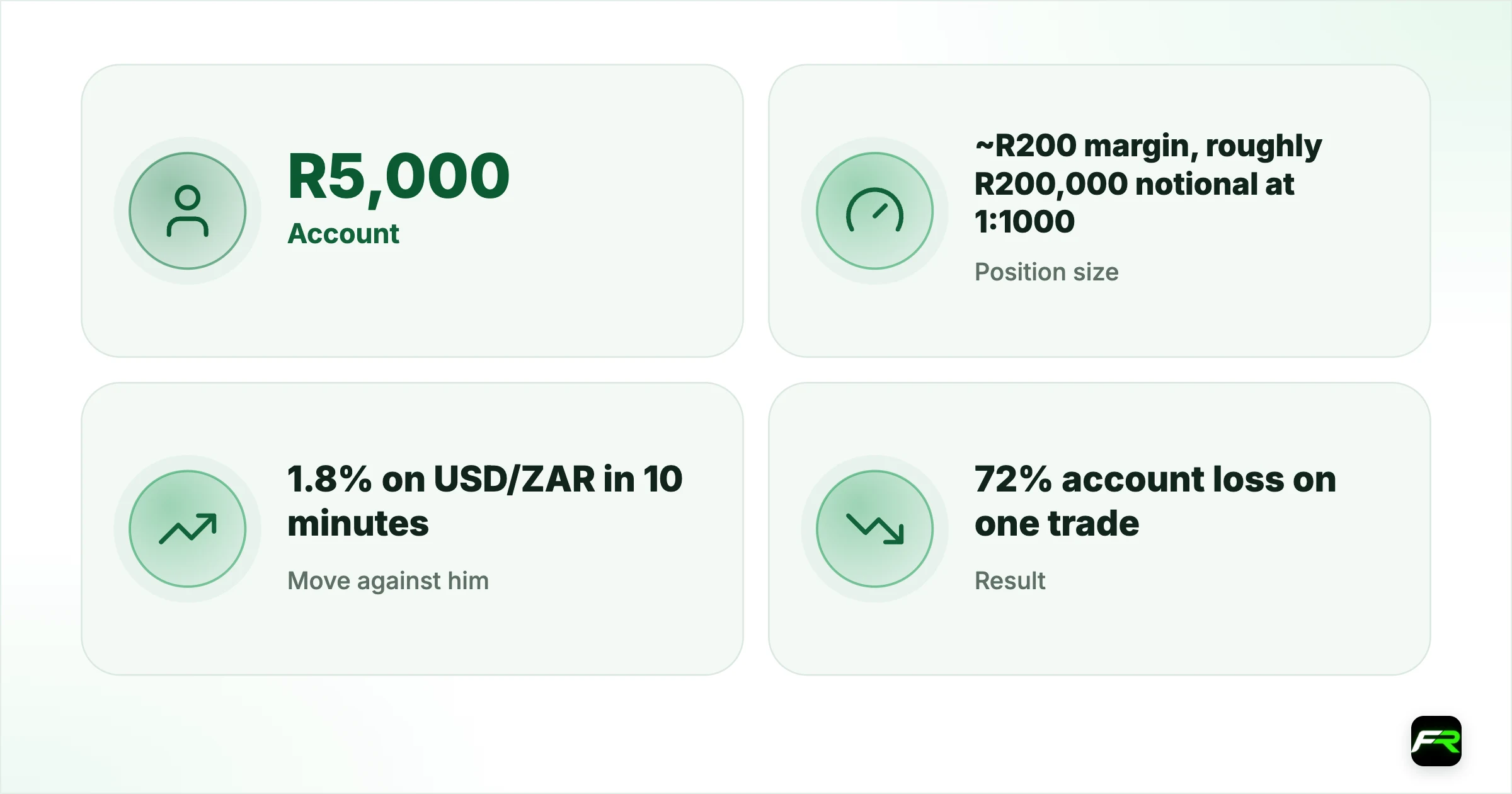
| Account | R5,000 |
|---|---|
| Position size | ~R200 margin, roughly R200,000 notional at 1:1000 |
| Move against him | 1.8% on USD/ZAR in 10 minutes |
| Result | 72% account loss on one trade |
| The fix | Risk 1% (R50) per trade, not 40% of the account |
What Sipho got wrong
- Available leverage got confused with sensible position size. 1:1000 let him take a position 400 times too big for his account.
- A large position went into a scheduled high-impact event. The SARB decision is exactly when the rand gaps.
- The stop was set wide to avoid being stopped out, which only means a bigger loss when it is hit.
Sized properly, Sipho would have risked about R50 on that trade, roughly 1 per cent of his account, and the same 1.8 per cent move would have cost him a few rand, not most of his money. The position-sizing guide shows the exact calculation on a rand account.
Case 3: The revenge spiral
Lerato, 30, from Bloemfontein, funded a R20,000 account and traded it carefully for two months, ending roughly flat. Then she took two losing trades in one morning, down about R1,200. Instead of stopping, she doubled her position size to "win it back before lunch". That trade lost too. By the end of the day she had taken nine trades, was down R6,800, and was trading purely to recover the last loss. Within three weeks the account was at R2,000. Her strategy had not failed; her discipline had.
What Lerato got wrong
- Position size went up after losses instead of down, or to zero.
- There was no daily loss limit, so a bad morning turned into a bad month.
- The goal became getting even, which is an emotion, not a trading plan.
Set a hard daily loss limit before you start, for example 3 per cent of the account, and close the platform when you hit it. The market is open tomorrow. Almost every blown South African account is lost this way, in a run of revenge trades, not in a single unlucky position.
Case 4: The signal group
Bongani, 27, from Durban, paid R2,500 a month to a WhatsApp signal group run by a local "mentor" whose Instagram was full of Dubai photos and withdrawal screenshots. He followed the signals for six months on a R15,000 account. Some weeks were green, more were red. After six months he was down about R4,000 on trading and had paid R15,000 in subscription fees. When he asked the mentor for a verified track record, he was removed from the group. The screenshots, it turned out, were affiliate earnings from people signing up to the mentor's broker link, not trading profits.
| What Bongani paid | Amount |
|---|---|
| Signal subscription, 6 months | R15,000 |
| Trading losses following the signals | ~R4,000 |
| Total cost | ~R19,000 |
| What the mentor actually earned from | Broker affiliate commissions on new sign-ups |
What Bongani got wrong
- The mentor had no verified, audited track record, and was paid anyway.
- Dubai photos and withdrawal screenshots got read as proof. Neither is.
- One question was never asked before subscribing: how does the mentor actually make money? The answer was affiliate commissions, so the incentive was sign-ups, not his success.
The signal-group guide and the mentorship guide cover how to tell a real educator from a recruiter.
Case 5: The slow grinder
Ayanda, 33, from Cape Town, is the case that worked, and it is the least dramatic. She spent four months on a demo account before funding anything, going live only once she had 50 demo trades logged with a consistent process. Her first live deposit was R8,000, risking 1 per cent per trade on two setups she knew well on USD/ZAR and EUR/USD, with a written journal for every trade. Returns over 18 months averaged about 2 per cent a month, with two losing months. She treats it as a side income of a few thousand rand a month, not a salary, and registered as a provisional taxpayer once the profits became regular.
| Demo period | 4 months, 50+ logged trades before going live |
|---|---|
| Starting capital (live) | R8,000 |
| Risk per trade | 1% (R80) |
| Average return | ~2% per month over 18 months |
| Losing months | 2 of 18 |
| Mindset | Second income, not a salary |
| Tax | Registered for provisional tax when profits became regular |
What Ayanda got right
- The demo period ran until her process was consistent, not until she was bored.
- Risk per trade stayed tiny and fixed, so no single trade or bad week could hurt her.
- She traded a small number of familiar setups instead of chasing every move.
- Her expectations were realistic. Two per cent a month is a good retail result that compounds well over years, not the 30 per cent a month the adverts promise.
- SARS was dealt with early, rather than hoped past.
The uncomfortable truth in these five stories is that the boring trader is the one still standing. Thandeka, Sipho, Lerato and Bongani all wanted the result fast. Ayanda accepted that it would be slow and small, and that is exactly why it worked. If your plan depends on a big return this month, you have already made the mistake the other four made.
The common threads
Across the four traders who lost money, the same few things show up. None of them is about picking the wrong currency pair.
- They wanted it fast. Every loss story has an unrealistic timeline behind it.
- Risk per trade was too high, losses were left to run, or size went up after losing.
- Marketing got trusted: a celebrity advert, Dubai photos, withdrawal screenshots, a friendly account manager.
- They paid to lose money, through withdrawal "fees", signal subscriptions, or leverage that turned a normal move into a wipeout.
- Two free checks were skipped: the FSCA register, and a few months on demo.
Regulated broker disclosures in South Africa and elsewhere consistently show that most retail forex accounts lose money. Starting small, sizing every trade at around 1 per cent risk, and practising on demo first does not guarantee a profit. It just keeps you in the game long enough to find out whether you can trade.
Frequently asked
How much money do most South African beginners lose?
Most lose their entire first deposit. Regulated broker disclosures show the majority of retail accounts lose money. The traders who survive tend to start with a few thousand rand they can afford to lose, risk about 1 per cent per trade, and practise on demo first.
Is forex trading gambling?
It can be traded like gambling, with large random bets and no plan, and most people who lose money are effectively doing that. Traded with a fixed small risk per trade, a tested process and a written journal, it is closer to running a small high-variance business. The difference is risk management, not the market.
How long should I stay on a demo account?
Until your process is consistent, not until you are bored. A common benchmark is 30 to 50 trades logged with the same rules and a positive or break-even result before you risk real money. Four to six months is normal.
What is the biggest mistake new South African traders make?
Revenge trading: increasing position size after a loss to win it back quickly. Almost every blown account is lost this way, in a run of emotional trades, rather than in a single unlucky position. A hard daily loss limit is the fix.
Are the withdrawal screenshots that mentors post real?
Usually not as proof of trading skill. Many are affiliate-commission payouts from people signing up through the mentor's broker link, or demo-account results, or recycled images. Ask for an audited, verified track record. If it is refused, that is your answer.
What return is realistic for a good retail trader?
Roughly 1 to 5 per cent a month averaged over multiple years, with losing months included. Anything advertising 30 per cent a month or a fixed daily return is a scam. Two per cent a month compounded is an excellent long-term retail result.
Related reading
The team behind this guide
Researched, checked and approved by five forex specialists
Every guide is written, fact-checked and edited before it goes live, and updated when the facts change. Spotted an error? Tell us.