IC Markets



























How to Fund a Forex Account From South Africa
Local EFT, Ozow, card and international transfer, with the real costs and timings of each. Plus why a broker with a local ZAR entity is the cheapest route.
 WriterAbir KhanWriterWrites the guides · checks every figure against primary sources View profileAbout Abir →
 Market analysisTanbir Habib RiyadForex & Crypto AnalystForex and crypto analyst · technical and fundamental analysis View profileAbout Tanbir →
 Fact-checking & riskJannatul FerdaushFact-Checker & Risk AnalystFact-checks every figure · risk analysis · Applied Statistics, University of Dhaka View profileAbout Jannatul →
 Trading reviewJowel RanaCo-Founder & Forex TraderCo-founder · forex trader · reviews guides from a trader's view View profileAbout Jowel →
 Final approvalRanjan NiskrityFounder, Owner & Forex TraderFounder and owner · forex trader · signs off every guide View profileAbout Ranjan →
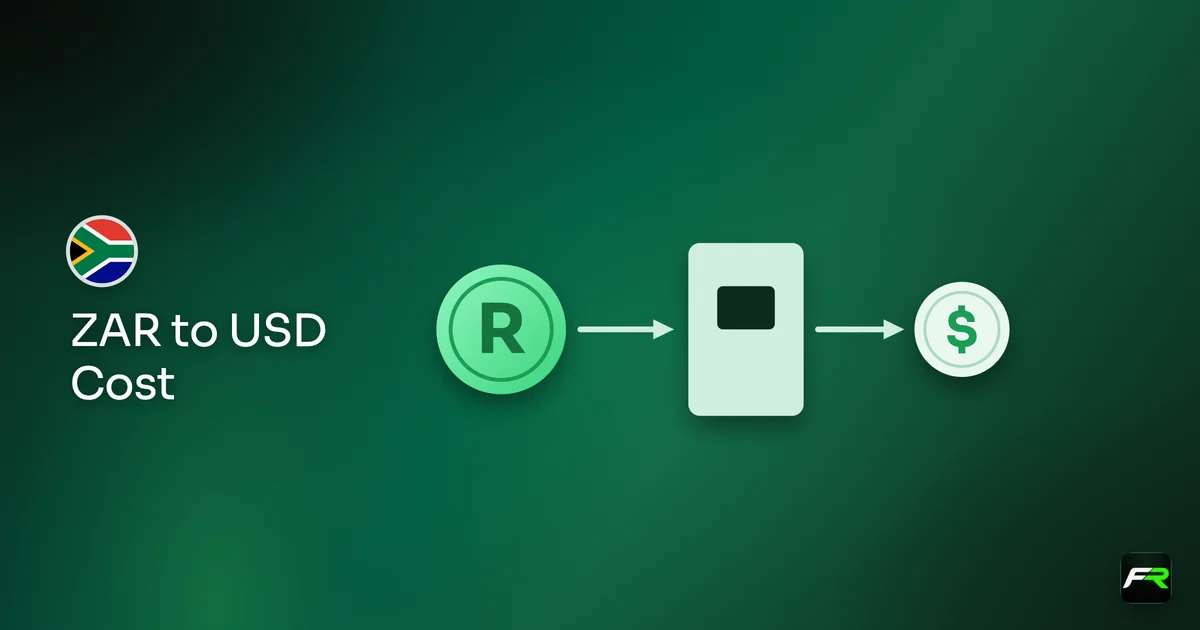
There are four common ways to get money from a South African bank to a forex broker, and they differ a lot in cost, speed and whether they touch your Reserve Bank allowance. The cheapest and fastest is usually a local rand transfer to a broker with a South African entity. At the other end, an international wire is the most expensive. This guide covers each method with the numbers.
The four methods
| Method | Speed | Typical cost | Uses SARB allowance? |
|---|---|---|---|
| Local EFT to a broker's SA entity | Same day to 1 day | Free | No |
| Ozow instant EFT | Minutes | Free to small fee | No (local entity) |
| Debit or credit card | Instant | 0% to 3%, plus conversion if USD account | No (local), yes if offshore |
| International bank transfer (SWIFT) | 1 to 4 days | R100 to R600 in fees plus conversion | Yes, Single Discretionary Allowance |
Local EFT and Ozow
If your broker has a South African entity with a local bank account, funding is a domestic rand transfer. A normal bank EFT clears same day or next day and costs nothing beyond your bank's standard transaction fee. Ozow is an instant EFT service that connects to your online banking and pushes the payment through in minutes; brokers often integrate it directly in the deposit screen. Neither uses your discretionary allowance, and neither involves currency conversion if you have a ZAR account.
Cards
A debit or credit card deposit is instant and convenient. With a local broker entity and a ZAR account it is usually free. An offshore broker or a USD account is different: expect a currency conversion and possibly a card fee, and note that a credit-card cash-advance treatment can apply, which your bank may charge interest on immediately. Card withdrawals, when supported, return to the same card and are one of the faster ways to get money out.
International transfers
Sending rand by SWIFT to an offshore broker is the most expensive route. Your bank charges a transfer fee, converts at its own rate, and the receiving bank may deduct a further fee, so on a R10,000 transfer you might lose R300 to R700 in total to fees and spread. It also uses your Single Discretionary Allowance. Use this only if the broker has no local funding option and you have a specific reason to be with that broker.
Palesa first funded an offshore broker by international transfer, sending R8,000 and receiving about R7,650 after fees and conversion. When she switched to a broker with a local ZAR entity, the same R8,000 went through by Ozow in three minutes for free, and her withdrawal came back by local EFT the next day in full. She had been losing roughly 4 per cent of every transfer for no reason.
Fund in fewer, larger amounts rather than many small top-ups, especially if you use any method with a fixed fee. And keep a record of the rand amount, date and exchange rate of every deposit for your tax return.
PayShap, Capitec Pay and the newer instant options
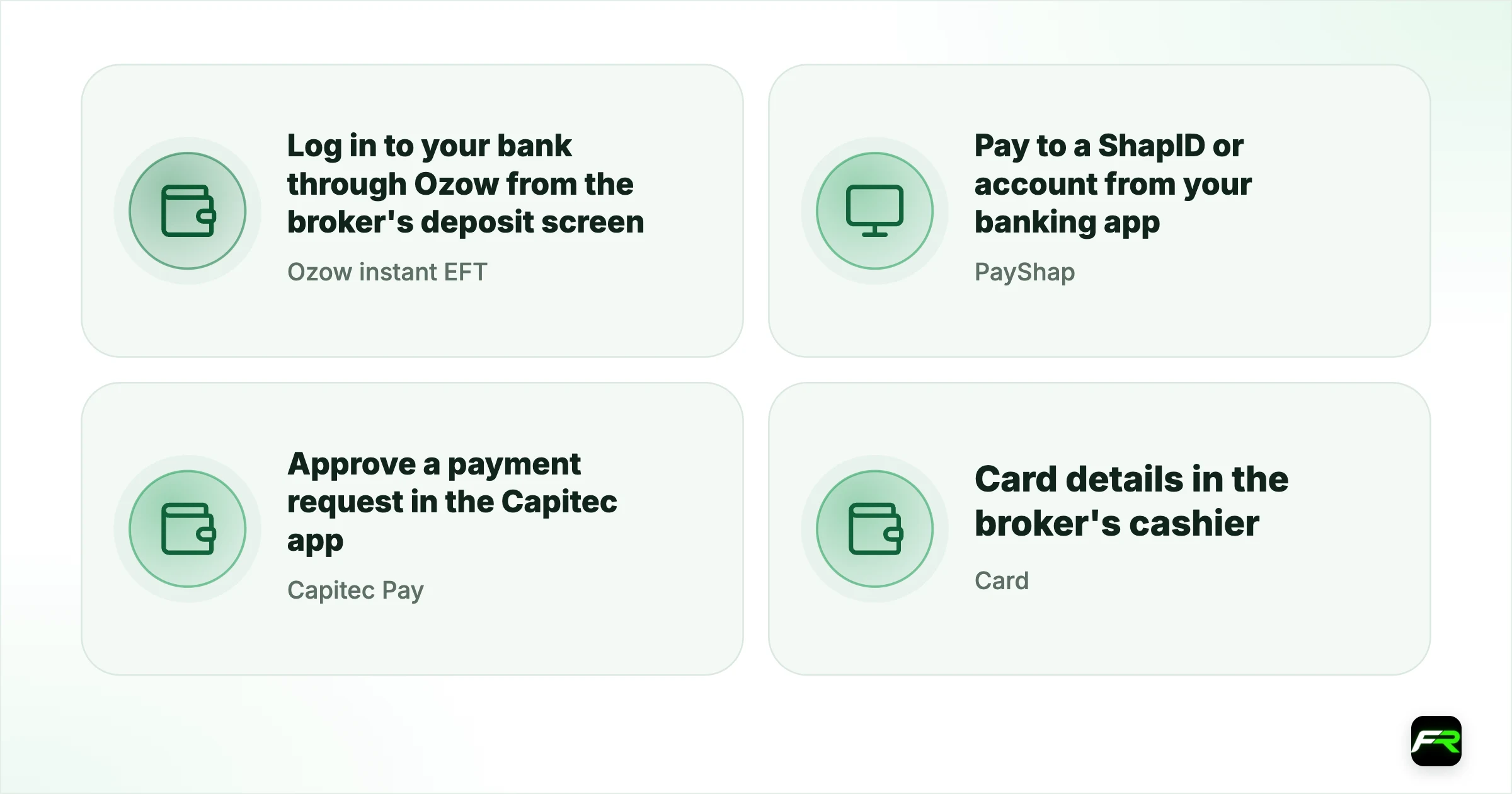
Ozow is no longer the only fast way to pay. PayShap, the national rapid-payment system, now runs through most large banks, and some banks offer their own checkout approval, such as Capitec Pay. Whether you can use them depends on your broker's deposit screen, so treat this as a guide to what you may see rather than a promise that every broker accepts them.
| Method | How you pay | Limits to know |
|---|---|---|
| Ozow instant EFT | Log in to your bank through Ozow from the broker's deposit screen | Your bank's online payment limit |
| PayShap | Pay to a ShapID or account from your banking app | Scheme ceiling of R50,000 a payment; each bank sets its own limit |
| Capitec Pay | Approve a payment request in the Capitec app | Your Capitec app limits |
| Card | Card details in the broker's cashier | Card limit; possible fees on a USD account |
The PayShap ceiling rose from R3,000 to R50,000 in late 2024, but banks were left to choose their own limits and pricing. Nedbank, for example, allows up to R50,000 a payment, while other banks have set lower caps. Check your own app before relying on it for a large deposit.
A PayShap or Capitec Pay request that comes from a person's name, rather than from your broker's own deposit screen, is a scam warning. Instant payments to individuals are very hard to reverse.
Matching your withdrawal method to your deposit
Anti-money-laundering rules mean brokers generally return funds the way they came, up to the amount you deposited, before paying any surplus to another method. If you deposit R5,000 by card and later withdraw R8,000, expect R5,000 back to the card and R3,000 by EFT. Plan around this: if you want withdrawals to land in your bank account, deposit by EFT or Ozow rather than card, so the return path is already your bank. It also means you cannot deposit from one person's account and withdraw to another, which is a deliberate control, not an obstacle.
First deposit, small
Whatever method you choose, make the first deposit small, R200 to R500, and run it all the way through: fund, place one tiny trade, close it, and withdraw most of the balance back to your bank. This confirms the full round trip works with your specific bank and the broker's process before you commit real money, and it clears the extra scrutiny brokers often apply to a first withdrawal while the stakes are trivial.
A sensible funding setup
- Choose a broker with a South African entity and a true ZAR account.
- Fund by Ozow or local EFT for zero cost and no conversion.
- Do one small deposit and test withdrawal before funding properly.
- Log every transfer in rand with the date and rate.
- Withdraw profits regularly rather than leaving a large balance with the broker.
The funding method is a quiet cost that people ignore. A trader doing small monthly top-ups through an international transfer can lose several per cent a year to fees and spread before they place a trade. A local ZAR account with Ozow funding removes that entirely, which is why it is near the top of our broker checklist for South Africans.
Frequently asked
What is the cheapest way to fund a forex account in South Africa?
A local EFT or Ozow instant EFT to a broker that has a South African entity and a ZAR account. Both are free or near-free, clear quickly, and do not use your Reserve Bank allowance or involve currency conversion.
Does funding a forex account use my SARB allowance?
Only if the money goes offshore. A domestic rand transfer to a broker's South African entity does not touch your Single Discretionary Allowance. An international transfer to an offshore broker does.
Can I fund a forex account with a credit card?
Usually yes, and it is instant. Be aware that some banks treat it as a cash advance with immediate interest, and an offshore or USD account will apply a currency conversion. Local broker entities with ZAR accounts are typically free.
How long does a deposit take?
Ozow and card deposits are usually instant to a few minutes. Local EFT is same day to next day. International transfers take one to four working days.
How much do international transfers cost?
Your bank's transfer fee plus its conversion spread plus a possible receiving-bank fee, often R300 to R700 in total on a R10,000 transfer. Use a local funding method instead where possible.
Can I fund a forex account with PayShap?
Only if your broker lists it in its deposit screen. PayShap allows payments up to R50,000 at scheme level, but each bank sets its own limit. Never pay a PayShap request sent from an individual's name; legitimate broker payments go to the company through its own platform.
Related reading
The team behind this guide
Researched, checked and approved by five forex specialists
Every guide is written, fact-checked and edited before it goes live, and updated when the facts change. Spotted an error? Tell us.