IC Markets

























Forex Trading Tax in South Africa: The Full SARS Guide
SARS taxes active forex profit as income at 18 to 45%, and regular traders must register for provisional tax. How it works, with examples.
 WriterAbir KhanWriterWrites the guides · checks every figure against primary sources View profileAbout Abir →
 Market analysisTanbir Habib RiyadForex & Crypto AnalystForex and crypto analyst · technical and fundamental analysis View profileAbout Tanbir →
 Fact-checking & riskJannatul FerdaushFact-Checker & Risk AnalystFact-checks every figure · risk analysis · Applied Statistics, University of Dhaka View profileAbout Jannatul →
 Trading reviewJowel RanaCo-Founder & Forex TraderCo-founder · forex trader · reviews guides from a trader's view View profileAbout Jowel →
 Final approvalRanjan NiskrityFounder, Owner & Forex TraderFounder and owner · forex trader · signs off every guide View profileAbout Ranjan →
The most expensive mistake a South African forex trader makes is not a bad trade. It is failing to deal with SARS, then getting a bill years later with penalties and interest attached. The rules are not complicated once you see them laid out. Profit from active forex trading is income, it is added to everything else you earn, and it is taxed at your marginal rate. If you trade with any regularity you also need to be a provisional taxpayer. Here is the whole thing.
This is a general overview, not tax advice. SARS assesses each trader's facts individually, and the classification of your trading and the deductions you can claim depend on your specific situation. A registered tax practitioner is worth the fee.
Income, not capital gains
For an active trader, forex profits are revenue in nature, meaning SARS taxes them as ordinary income, not as a capital gain. That matters because the capital gains inclusion rate is lower. Whether your trading is capital or revenue depends on your intention and behaviour: frequent trading, short holding periods, and an aim of profiting from price movement all point to revenue. Someone who buys a foreign currency amount once and holds it for years might argue capital, but a person placing regular CFD trades is almost certainly on revenue account. The income-vs-capital guide covers the classification test.
Practically, if you are reading a guide about forex trading tax, SARS will treat your gains as income.
The rate you pay
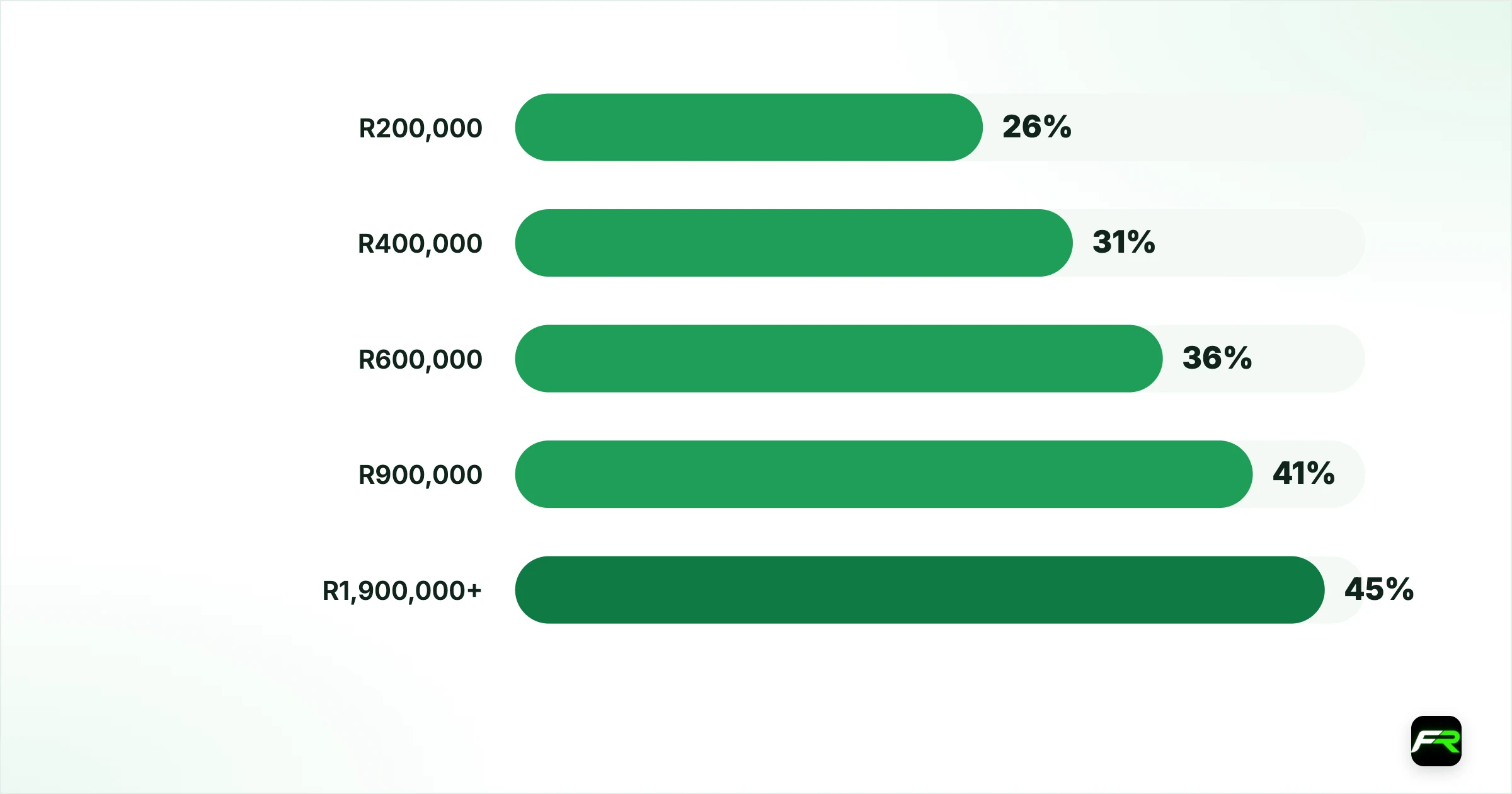
Your forex profit is added to your salary, rental income, interest and everything else, and the total is taxed on the individual sliding scale, which runs from 18 per cent on the lowest band up to 45 per cent on income above the top threshold. So the rate on your trading profit is your marginal rate: the rate that applies to your last rand of income.
| Your other taxable income | Approx marginal rate | Tax on R50,000 of forex profit (approx) |
|---|---|---|
| R200,000 | 26% | ~R13,000 |
| R400,000 | 31% | ~R15,500 |
| R600,000 | 36% | ~R18,000 |
| R900,000 | 41% | ~R20,500 |
| R1,900,000+ | 45% | ~R22,500 |
These are illustrative and ignore rebates and the effect of the profit pushing part of your income into the next band. The point is that a R50,000 trading profit is not taxed at a flat low rate; it is taxed at whatever your income already puts you at.
Provisional tax
A salaried employee has PAYE deducted monthly. Forex profit has no PAYE, so SARS collects the tax on it through the provisional tax system. If you earn income that is not subject to PAYE (which trading profit is), and it is above the threshold, you must register as a provisional taxpayer. That means:
- First IRP6 return, end of August: estimate your total taxable income for the year (salary plus trading) and pay tax on it.
- Second IRP6 return, end of February: update the estimate and pay the balance.
- Optional third payment, end of September: a top-up to avoid interest if the first two payments fell short.
- Annual ITR12 return after year end, where the final assessment is done and any over- or underpayment settled.
Underestimating your provisional income by too much, or paying late, triggers penalties and interest. This is the single most common way active traders get hurt by SARS. The provisional tax guide covers the IRP6 process in detail.
A worked example
Lerato earns a salary of R480,000 and makes a net forex profit of R70,000 over the tax year, from about 300 trades. Her marginal rate on the trading profit is around 36 per cent. The R70,000 is added to her R480,000, and roughly R25,000 in tax is due on the trading portion. Because she is a provisional taxpayer, she should have declared an estimate of the R70,000 in her August and February IRP6 returns and paid as she went. If she instead ignores it and only reports it on her ITR12, she faces an underestimation penalty plus interest on top of the R25,000.
A full year of trading without registering for provisional tax cost Lerato a penalty. When she filed her annual return and declared R70,000 of trading profit, SARS raised a charge for underestimation and added interest, about R6,000 on top of her bill. Her tax practitioner then registered her as a provisional taxpayer and set up a monthly transfer of 35 per cent of every withdrawal into a separate savings account, so the money was there when the IRP6 payments came due. The penalty did not recur.
When is the profit actually taxed?
The tax is on your realised profit for the tax year, meaning trades you have closed, not on unrealised gains on open positions. It does not matter whether you have withdrawn the money to your bank. If you closed trades for a net R40,000 profit over the year but left it all in the broker wallet, that R40,000 is still taxable in that year. Traders who assume "I only pay when I withdraw" build up a liability they have not planned for. Money still sitting with the broker is money SARS already expects tax on.
A demo account has no tax consequence at all, because there is no real money and no real profit. Tax starts with your first closed trade on a live, funded account.
What you can deduct
When SARS treats your trading as a trade, you can deduct expenses incurred in producing that income. For a home trader the realistic list is:
- Data and internet costs, apportioned to trading use.
- Platform, charting and news-feed subscriptions (for example a TradingView plan).
- A portion of the cost of a computer, monitors and a UPS or power station, usually claimed as wear and tear over time rather than all at once.
- A share of home-office costs (rent or bond interest, rates, electricity) if you have a dedicated space used regularly and exclusively for trading. SARS applies this strictly, so keep floor-area calculations and photos.
- Bank and transfer fees on funding and withdrawals, and the cost of a tax practitioner.
- Trading courses and educational material, where they relate to producing the income. SARS may query these, so keep invoices and be able to justify them.
You cannot deduct your trading losses as an "expense" here. Losses are dealt with separately, below. And you cannot deduct expenses if SARS treats your trading as a hobby rather than a trade, which is one more reason to run it in a businesslike way with proper records.
Losses
If your trading is genuinely a trade (revenue in nature), a trading loss can be set off against your other income in the same year, reducing your overall tax. Where SARS considers the activity a hobby or not carried on with a genuine profit motive, it can ring-fence the loss so it only offsets future trading gains. Proper records and a real, businesslike approach help establish that the activity is a trade. Our losses guide covers what counts.
The records SARS wants
- Monthly broker statements showing every trade, deposit and withdrawal.
- The ZAR value of every deposit and withdrawal, with the exchange rate used on the date the money moved.
- A running record of net profit or loss per month, in rand.
- Records of any expenses you intend to deduct (data, platform fees, a portion of home-office costs if applicable).
- Bank statements matching the deposits and withdrawals.
SARS can go back several years in an audit. Keeping this from day one costs almost nothing; reconstructing it later, after a broker has limited how far back you can pull statements, is a serious headache. The records guide has the full list.
Company or personal?
Some traders ask whether to trade through a company to cap the rate at the corporate rate. It is possible, but a company has its own costs (accounting, annual returns, a separate tax number), the corporate rate plus dividends tax can end up close to the personal marginal rate once you take the money out, and SARS scrutinises companies set up mainly to reduce tax. For most individual traders, trading in your own name and managing provisional tax properly is simpler and not much more expensive. The company guide works through the maths.
Not declaring forex profit is not a grey area. It is under-declaration of income, and the penalties and interest compound each year you leave it. If you have unreported trading profit from prior years, a tax practitioner can help you fix it through SARS' voluntary disclosure process before it becomes an audit.
Frequently asked
How is forex trading taxed in South Africa?
Active forex trading profit is taxed as ordinary income, added to your other income and taxed at your marginal rate of 18 to 45 per cent. It is not automatically a capital gain, and the offshore location of your broker does not exempt it.
Do I need to register for provisional tax?
Yes, if you earn trading income that is not subject to PAYE and it is above the threshold. Provisional taxpayers file IRP6 returns in August and February and pay tax on an estimate of the year's income, with an annual ITR12 to finalise it.
What tax rate do I pay on forex profits?
Your marginal rate: the rate that applies to your last rand of income once the trading profit is added to your salary and other income. That is between 18 and 45 per cent depending on your total income.
Can I deduct my forex trading losses?
If your trading is genuinely a trade (revenue in nature), a loss can offset your other income in the same year. If SARS considers it a hobby, the loss may be ring-fenced to offset only future trading gains. Good records help establish it is a trade.
What records do I need to keep for SARS?
Monthly broker statements, the rand value and exchange rate of every deposit and withdrawal, a monthly profit-and-loss record in rand, expense records for any deductions, and matching bank statements. Keep everything from day one.
Is it better to trade forex through a company?
Usually not for an individual. A company has its own costs and the combined corporate rate plus dividends tax can approach the personal marginal rate once you withdraw the money. For most traders, trading personally and managing provisional tax properly is simpler.
Do I only pay tax when I withdraw from my broker?
No. Tax is on your realised profit for the year, meaning closed trades, whether or not you have withdrawn the money to your bank. Profit left sitting in the broker wallet is still taxable in the year you made it.
Do I pay tax on a demo account?
No. A demo account has no real money and no real profit, so there is nothing to tax. Your tax position starts with the first closed trade on a live, funded account.
Can I deduct a forex trading course from my tax?
Potentially, if your trading is treated as a trade and the course relates to producing that income. SARS may query education costs, so keep the invoice and be ready to justify it. If SARS treats your trading as a hobby, you cannot deduct expenses at all.
What about profits from a crypto-funded or offshore account?
The location of the account and the funding method do not change the tax. If you are a South African resident making profit from active forex trading, SARS taxes it as income at your marginal rate and expects it on your return.
Related reading
The team behind this guide
Researched, checked and approved by five forex specialists
Every guide is written, fact-checked and edited before it goes live, and updated when the facts change. Spotted an error? Tell us.