IC Markets































Forex Traders and Provisional Tax: The IRP6 Process
If you earn regular trading income that has no PAYE deducted, SARS expects you to be a provisional taxpayer. Here is the IRP6 timetable, how to estimate, and how the penalties work.
 WriterAbir KhanWriterWrites the guides · checks every figure against primary sources View profileAbout Abir →
 Market analysisTanbir Habib RiyadForex & Crypto AnalystForex and crypto analyst · technical and fundamental analysis View profileAbout Tanbir →
 Fact-checking & riskJannatul FerdaushFact-Checker & Risk AnalystFact-checks every figure · risk analysis · Applied Statistics, University of Dhaka View profileAbout Jannatul →
 Trading reviewJowel RanaCo-Founder & Forex TraderCo-founder · forex trader · reviews guides from a trader's view View profileAbout Jowel →
 Final approvalRanjan NiskrityFounder, Owner & Forex TraderFounder and owner · forex trader · signs off every guide View profileAbout Ranjan →
This is a general overview, not tax advice. SARS assesses each trader's facts individually, and the classification of your trading and the deductions you can claim depend on your specific situation. A registered tax practitioner is worth the fee.
A salaried employee pays tax monthly through PAYE. A forex trader's profit has no PAYE, so SARS collects the tax on it through the provisional tax system: you estimate your income twice a year and pay tax on the estimate, then square it up on your annual return. Getting this wrong is the most common way active South African traders end up with penalties. This guide walks through the timetable and the maths.
Who has to register
You must register as a provisional taxpayer if you earn income that is not subject to PAYE and it is above the threshold. Active forex trading profit is exactly that kind of income. A person with a salary and occasional tiny trading gains may fall under the threshold; a person trading regularly with meaningful profit does not. If you are unsure, a tax practitioner can confirm, but assume that regular trading profit puts you in the provisional system.
The IRP6 timetable
| Return | Due | What you do |
|---|---|---|
| First IRP6 | End of August (six months into the tax year) | Estimate total taxable income for the year, pay tax on half of it |
| Second IRP6 | End of February (tax year end) | Update the estimate, pay the balance of tax due for the year |
| Third (voluntary) payment | End of September | Optional top-up to avoid interest if the first two fell short |
| Annual ITR12 | During the following filing season | Final assessment; refund or top-up settled |
The tax year runs March to February. So for the year to February 2027, the first IRP6 is due end of August 2026 and the second end of February 2027.
How to estimate
Your estimate is total taxable income: salary, rental, interest, and your trading profit for the year. For the first IRP6 you are guessing at half-year, so use your actual trading result to date and a sensible projection for the rest. SARS has a rule that your second estimate must be within a margin of your actual final taxable income, or a penalty applies, so the February estimate needs to be close.
- Add up your realised trading profit for the year so far, in rand.
- Project the rest of the year conservatively. Do not assume a good few months continue.
- Add your other income (a payslip year-to-date figure plus projection).
- Apply the tax tables to the total, subtract rebates and any PAYE already paid, and that is roughly your provisional tax.
- If in doubt, estimate a little high. Overpayment is refunded; underestimation is penalised.
A worked example
Nomvula has a salary of R360,000 with PAYE deducted, and by end of August her trading profit for the year is R30,000, which she thinks might reach R55,000 by February. Her first IRP6 estimate of total taxable income is about R415,000. The tax on that, less the PAYE her employer has already paid, leaves a provisional amount she pays in August. In February she updates the estimate to her actual R48,000 trading profit plus salary, pays the balance, and the annual ITR12 finalises it.
In her first trading year Nomvula ignored provisional tax, declared R40,000 of profit on her annual return, and was hit with an underestimation penalty and interest that added roughly R4,500. Her practitioner registered her for provisional tax, and she now moves 35 per cent of every withdrawal into a separate savings account the day it lands, so the August and February payments are already funded. The penalty has not come back.
Two penalties bite here. Late payment of a provisional amount attracts a percentage penalty plus interest. And if your February estimate is too far below your actual taxable income, an underestimation penalty applies on top. Both are avoidable by estimating carefully and paying on time.
The penalties, in numbers
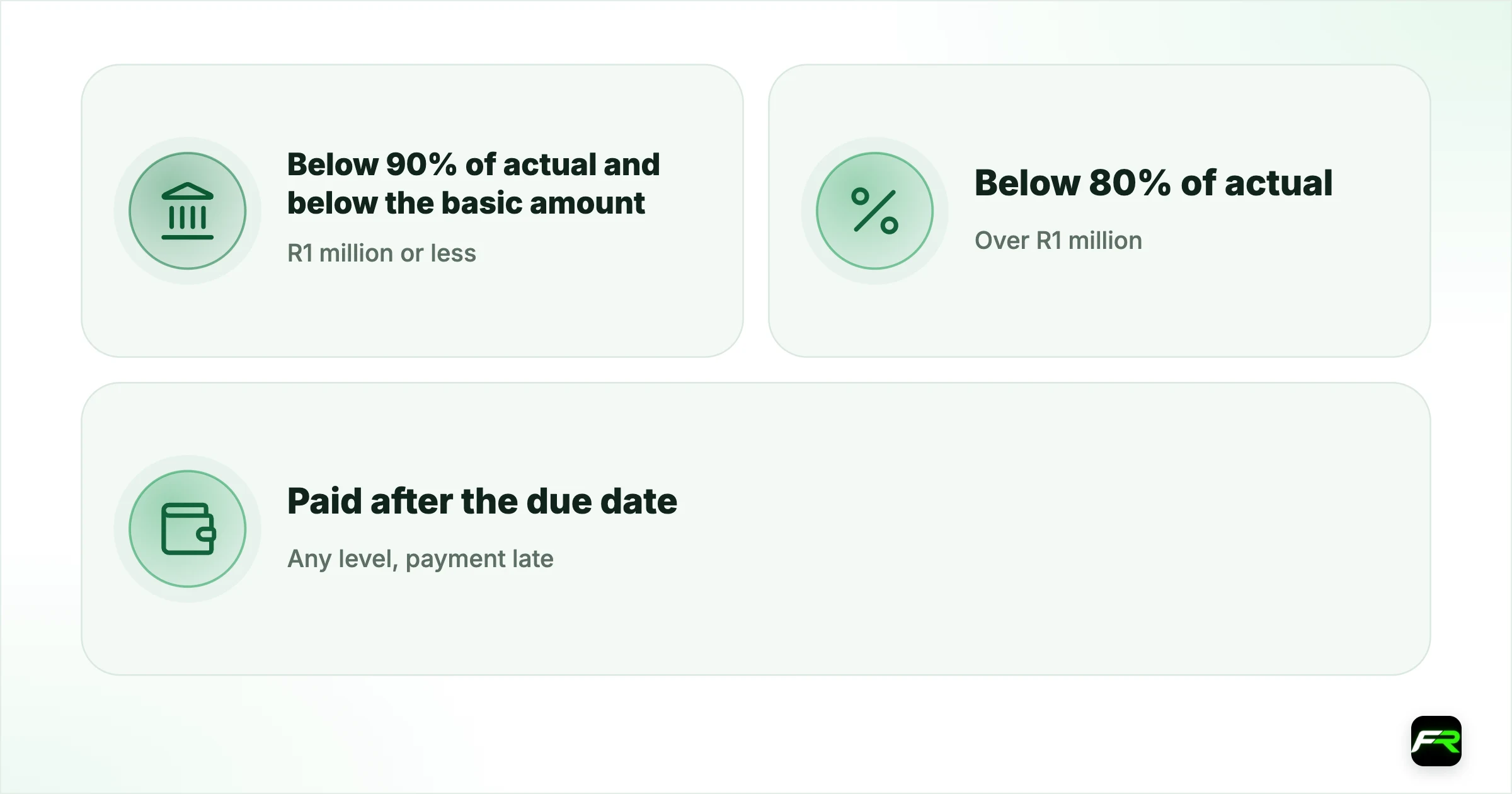
SARS spells out the underestimation penalty in its interpretation note on provisional tax. It looks at your second (February) estimate and compares it with the taxable income finally assessed. The test differs with income level:
| Your final taxable income | Penalty applies if your second estimate is | Penalty |
|---|---|---|
| R1 million or less | Below 90% of actual and below the basic amount | 20% of the shortfall in tax |
| Over R1 million | Below 80% of actual | 20% of the shortfall in tax |
| Any level, payment late | Paid after the due date | Late-payment penalty plus interest |
The basic amount is normally the taxable income on your last assessment, so a trader whose income has jumped because of a good trading year is the classic case that gets caught. SARS can reduce the penalty if it is satisfied the estimate was seriously calculated, which is another reason to keep your working.
2026/27 tax brackets for setting your estimate
For the year from 1 March 2026 to 28 February 2027, SARS's tables run from 18 per cent on the first R245,100 to 45 per cent above R1,878,600. The primary rebate is R17,820, and the tax-free threshold for someone under 65 is R99,000. Your trading profit is added to your other income, so the rate that matters is the bracket your total lands in.
Lerato earns R420,000 a year with PAYE deducted. Her trading profit for the year is R60,000, taking her total to R480,000, which sits in the 31 per cent bracket. The extra tax on the trading profit is therefore about R18,600, and that is what her provisional payments need to cover. She sets aside a third of each withdrawal, which leaves a small buffer.
A simple system that works
- Open a separate savings account for tax.
- Every time you withdraw trading profit, move a fixed percentage (35 to 40 per cent is a safe starting point for most brackets) into it immediately.
- Keep a running rand tally of realised profit per month.
- In August and February, use the tally to complete the IRP6 and pay from the tax account.
- Get a practitioner to review the first year. After that the routine is straightforward.
The traders who have no problem with SARS are not the ones with the best strategy, they are the ones who put money aside for tax the day it comes out of the broker. Provisional tax is not hard. It is just two dates a year and an honest estimate. The pain only comes from ignoring it and being surprised later.
The main SARS guide covers the rate you pay, and the records guide covers what to keep.
Frequently asked
Do forex traders have to register for provisional tax?
If you earn regular trading income with no PAYE deducted and it is above the threshold, yes. Provisional taxpayers file IRP6 returns in August and February and pay tax on an estimate of the year's income.
When are the IRP6 returns due?
The first is due at the end of August, halfway through the tax year, and the second at the end of February, the tax year end. An optional third top-up payment can be made by the end of September to reduce interest.
What happens if I underestimate my income?
If your February estimate is too far below your actual final taxable income, SARS charges an underestimation penalty. Late payment of a provisional amount adds a separate penalty plus interest. Estimating carefully and slightly high avoids both.
How much should I set aside for tax?
As a rough rule, move 35 to 40 per cent of every profit withdrawal into a separate account. Your exact rate depends on your marginal bracket once trading profit is added to your other income.
Can a tax practitioner handle this for me?
Yes, and it is worth it for at least the first year. They will register you, prepare the IRP6 estimates and file the annual return. After the first cycle many traders manage the routine themselves.
How big is the provisional tax underestimation penalty?
It is 20 per cent of the difference between the tax on your actual taxable income and the provisional and employees' tax paid. For income up to R1 million it applies if your second estimate was below 90 per cent of actual and below the basic amount; above R1 million the line is 80 per cent.
Related reading
The team behind this guide
Researched, checked and approved by five forex specialists
Every guide is written, fact-checked and edited before it goes live, and updated when the facts change. Spotted an error? Tell us.