IC Markets





































A Johannesburg Trader Who Made Forex Work Around a Full-Time Job
How a full-time employee built a small, consistent trading income without quitting, blowing up, or trading during meetings. The schedule, the rules, and the numbers.
 WriterAbir KhanWriterWrites the guides · checks every figure against primary sources View profileAbout Abir →
 Market analysisTanbir Habib RiyadForex & Crypto AnalystForex and crypto analyst · technical and fundamental analysis View profileAbout Tanbir →
 Fact-checking & riskJannatul FerdaushFact-Checker & Risk AnalystFact-checks every figure · risk analysis · Applied Statistics, University of Dhaka View profileAbout Jannatul →
 Trading reviewJowel RanaCo-Founder & Forex TraderCo-founder · forex trader · reviews guides from a trader's view View profileAbout Jowel →
 Final approvalRanjan NiskrityFounder, Owner & Forex TraderFounder and owner · forex trader · signs off every guide View profileAbout Ranjan →
The realistic version of forex for most South Africans is not full-time trading. It is a small, disciplined second income run around a job. This is a composite of how someone does that successfully: the daily schedule, the strategy constraints a job forces, and the returns to expect. It is deliberately unexciting, because the unexciting version is the one that works.
Composite case built from common patterns among employed part-time traders. Figures are representative, not a specific person's statement.
The situation
| Job | Full-time, office hours, Johannesburg |
|---|---|
| Trading capital | R25,000, built up over a year from savings |
| Time available | About 45 minutes at lunch, 90 minutes in the evening |
| Risk per trade | 1% (R250) |
| Goal | A few thousand rand a month, not a salary replacement |
The schedule
The South African time zone helps: the London to New York overlap, 14:00 to 18:00 SAST, is the best trading window, and it overlaps the end of the workday. Here is the routine:
- Morning, 10 minutes: check the economic calendar for the day, note any SARB, Fed or high-impact release, mark the levels on the two pairs.
- Lunch, 30 minutes: look for a setup on the 1-hour chart. If one is there and it is clean, take it with a defined stop and target, then leave it. If not, do nothing.
- Evening, 17:30 to 19:00: the main session. Manage the lunchtime trade, look for one evening setup during the overlap, journal both.
- No trading during work hours, no checking the phone in meetings, no trades held over the weekend.
The rules a job forces
- Higher-timeframe setups only (1-hour and 4-hour), because you cannot watch a 5-minute chart at your desk.
- Every trade has a stop and a take-profit set at entry, so it does not need babysitting.
- A hard maximum of two trades a day. Time scarcity enforces selectivity, which is an advantage.
- Flat by Friday evening, so the weekend is not spent worrying about a position.
- A VPS or the broker app so a trade is managed if you are pulled into something at work.
The numbers
| Period | Result | Note |
|---|---|---|
| Months 1-3 | About break-even | Learning the routine, two small losing months |
| Months 4-6 | +R2,900 total | Process settled, ~2% a month |
| Months 7-12 | +R7,400 total | Two losing months included; average ~2.5% on a growing balance |
| Year 1 total | +R10,300 | About 41% for the year on R25,000, with a worst drawdown near 9% |
A 41 per cent year is well above the 1 to 5 per cent a month long-run average, and it will not repeat every year. Some years will be flat or down. The point is the method: small size, high-timeframe setups, strict schedule, no heroics.
He says the job is what makes the trading work, not what holds it back. The salary covers his life, so he never needs a trade to pay a bill, which removes the pressure that makes people over-risk. Those 45 minutes at lunch and 90 in the evening are enough for two good setups a day, and the time limit stops him overtrading. He has no plans to go full-time, because full-time would reintroduce the pressure the job removes.
Trading around a job works because the salary removes financial pressure from each trade. Quitting a job to trade a small account reverses that, and is one of the most common ways people move from disciplined part-time trading to a blown account.
Handling a losing day at work
A part-time trader's hardest moment is a loss that lands during the workday, when you cannot process it or trade it back. This is actually an advantage disguised as a frustration. Because you are stuck in a meeting, you cannot revenge trade, cannot move a stop, cannot add to a loser. The trade does what the plan said and you review it that evening with a clear head. Traders who watch the screen all day have to manufacture that discipline; a job enforces it for you. The rule that makes it work is that every trade is fully set at entry, stop and target, so a bad hour at your desk cannot become a bad month.
The SARS side of a part-time year
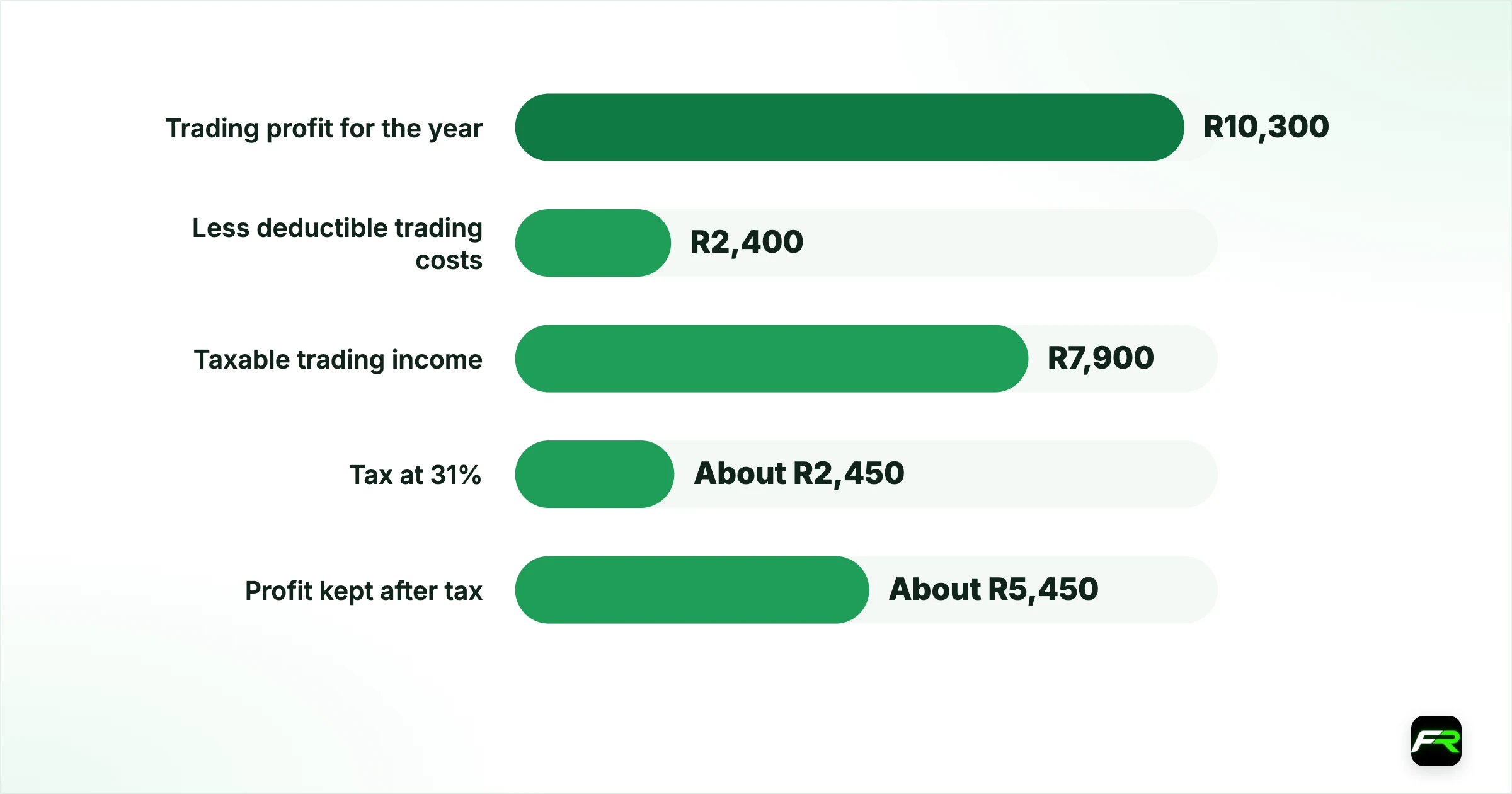
The year-one profit of R10,300 is not the amount the trader keeps. Trading profit is added to his salary and taxed at his marginal rate. Assume a salary of R420,000, which sits in the 31 per cent bracket for 2026/27, and R2,400 of deductible trading costs such as a charting subscription and a share of his internet:
| Line | Amount |
|---|---|
| Trading profit for the year | R10,300 |
| Less deductible trading costs | R2,400 |
| Taxable trading income | R7,900 |
| Tax at 31% | About R2,450 |
| Profit kept after tax (the R2,400 of costs was paid from it during the year) | About R5,450 |
Because his employer deducts PAYE only from his salary, the tax on the trading profit has to be paid separately, either through provisional tax or on assessment, depending on the amount and his circumstances. He moves a third of each withdrawal into a savings account the day it arrives so the money is there when SARS asks. The provisional tax guide covers the thresholds and dates.
Figures are illustrative and the tax rules are summarised. A registered tax practitioner can confirm how your own trading income should be declared.
Scaling up over time
The part-time path scales by adding capital from your salary and from realised profit, not by increasing risk per trade or trading more often. A trader who is consistent on R25,000 at 1 per cent risk can be consistent on R100,000 at 1 per cent risk with the same routine, and the rand amounts simply grow. What does not work is jumping the risk to 2 or 3 per cent because the account feels too small to matter. The account grows through compounding and contributions, slowly, which is exactly why the people doing it are still trading years later.
The employed part-time trader has structural advantages the full-timer does not: income security, forced selectivity, and a schedule. On top of that, the South African time zone puts the best hours right at the end of the workday. This is the realistic path, and the people doing it well are not trying to escape their jobs, they are using them.
Frequently asked
Can I trade forex with a full-time job in South Africa?
Yes, and the time zone helps. The best trading window, the London to New York overlap from 14:00 to 18:00 SAST, overlaps the end of the workday. Higher-timeframe setups, trades set and left with a stop and target, and a strict two-trade daily limit make it workable.
How much time do I need to trade around a job?
About 10 minutes in the morning to check the calendar and mark levels, and 60 to 90 minutes in the late afternoon or evening for the main session. More than that usually means overtrading, not better trading.
What returns are realistic for a part-time trader?
Over the long run, roughly 1 to 5 per cent a month with losing months included. Individual years vary widely; a strong year does not repeat annually. Treat it as a small second income, not a salary.
Should I quit my job to trade full-time?
For almost everyone, no. The salary is what removes the financial pressure that causes over-risking. Quitting to trade a small account reintroduces that pressure and is a common path to a blown account.
What strategy suits trading around a job?
Higher-timeframe setups on the 1-hour and 4-hour charts, with every trade given a fixed stop and take-profit at entry so it does not need watching. Day-trading a 5-minute chart is not compatible with being at work.
Do I pay tax on part-time forex profits in South Africa?
Yes. Trading profit is added to your salary and taxed at your marginal rate. Your employer's PAYE does not cover it, so you settle it through provisional tax or on assessment. Setting aside about a third of each withdrawal is a common habit for traders in the middle brackets.
Related reading
The team behind this guide
Researched, checked and approved by five forex specialists
Every guide is written, fact-checked and edited before it goes live, and updated when the facts change. Spotted an error? Tell us.