IC Markets





































Lowest-Spread Forex Brokers for South African Traders
The spread is your main ongoing cost, but the headline number hides commission, the spread at the hours you actually trade, and swap. Here is how to compare the real cost of trading.
 WriterAbir KhanWriterWrites the guides · checks every figure against primary sources View profileAbout Abir →
 Market analysisTanbir Habib RiyadForex & Crypto AnalystForex and crypto analyst · technical and fundamental analysis View profileAbout Tanbir →
 Fact-checking & riskJannatul FerdaushFact-Checker & Risk AnalystFact-checks every figure · risk analysis · Applied Statistics, University of Dhaka View profileAbout Jannatul →
 Trading reviewJowel RanaCo-Founder & Forex TraderCo-founder · forex trader · reviews guides from a trader's view View profileAbout Jowel →
 Final approvalRanjan NiskrityFounder, Owner & Forex TraderFounder and owner · forex trader · signs off every guide View profileAbout Ranjan →
Spread is the gap between the buy and sell price, and it is the cost you pay on every single trade, so over a year it matters more than almost anything else in a broker comparison. The problem is that the advertised "from 0.0 pips" number is close to meaningless on its own. What you actually pay depends on the account type, the commission, the time of day, and the pair. This guide covers how to compare the real cost.
The three parts of trading cost
- Spread. Quoted in pips. On EUR/USD a raw-spread account might show 0.1 pips; a standard account 1.0 pip or more.
- Commission. Raw-spread accounts charge a commission per lot, often around USD 3.5 per side, per standard lot. A "zero spread" account with a fat commission can cost more than a standard account.
- Swap. The overnight financing charge or credit for holding a position past the daily rollover. It matters for swing and position traders, and is often worse on rand pairs.
To compare brokers, add the spread and the commission into a single "cost per round-turn" figure for the pair and account you will use. That is the number that matters.
| Account style | Typical EUR/USD spread | Commission per round-turn lot | Effective cost |
|---|---|---|---|
| Standard (no commission) | 1.0-1.6 pips | None | ~USD 10-16 per lot |
| Raw or ECN | 0.0-0.3 pips | ~USD 7 per lot | ~USD 7-10 per lot |
| "Zero spread" with high commission | 0.0 pips | USD 10+ per lot | Often worse than raw |
Spread at the hours you trade
Spreads are tightest when London and New York overlap, roughly 14:00 to 18:00 South African time, and widest in the thin hours after New York closes and before Tokyo gets going. If you trade in the evening after work, around 19:00 to 22:00 SAST, check the spread then, not the daytime number the broker advertises. On some brokers the evening spread on EUR/USD is double the headline figure, and on rand pairs it can be much wider.
Rand pairs cost more
USD/ZAR has a wider spread than EUR/USD everywhere, because it is less liquid. Expect several pips even on a raw account, and a meaningful swap to hold overnight. GBP/ZAR and EUR/ZAR are wider still. If low cost is your priority, the major pairs are cheaper to trade than the rand crosses, which is one reason many experienced South African traders trade more EUR/USD than USD/ZAR.
Tebogo chose a broker on its "from 0.0 pips" headline, then found his account was the standard type with a 1.5 pip spread that widened to 3 pips in the evening when he actually traded. Over three months of active trading the cost difference against a raw-spread account was more than R2,000. He switched account type, checked the spread at 20:00 before committing, and his cost per trade roughly halved.
"Zero spread" and "no commission" are marketing phrases, not free trading. Someone is always paid. Work out the combined spread-plus-commission cost for your pair at your trading hours, and compare that.
Spread is not the only cost that matters
Chasing the tightest spread can lead you past bigger costs. An inactivity fee that kicks in after a few months idle, a withdrawal fee on every payout, a wide currency-conversion spread on a USD account, or slow execution that gives you worse fills than the quoted price all cost more over a year than a fraction of a pip on the spread. Price the whole package: spread plus commission, plus swap if you hold overnight, plus withdrawal and conversion costs, against the FSCA licence and the withdrawal record. The cheapest spread attached to a broker that is slow to pay is not cheap.
How spread affects different styles
| Style | Trades per week | How much spread matters |
|---|---|---|
| Scalping | Many per day | Critical: spread is a large share of each move you target |
| Day trading | 5-15 | High: it adds up across the week |
| Swing trading | 2-5 | Moderate: swap and overnight risk matter more |
| Position trading | A few per month | Low: swap and the licence matter far more than spread |
What spread costs over a month, in rand
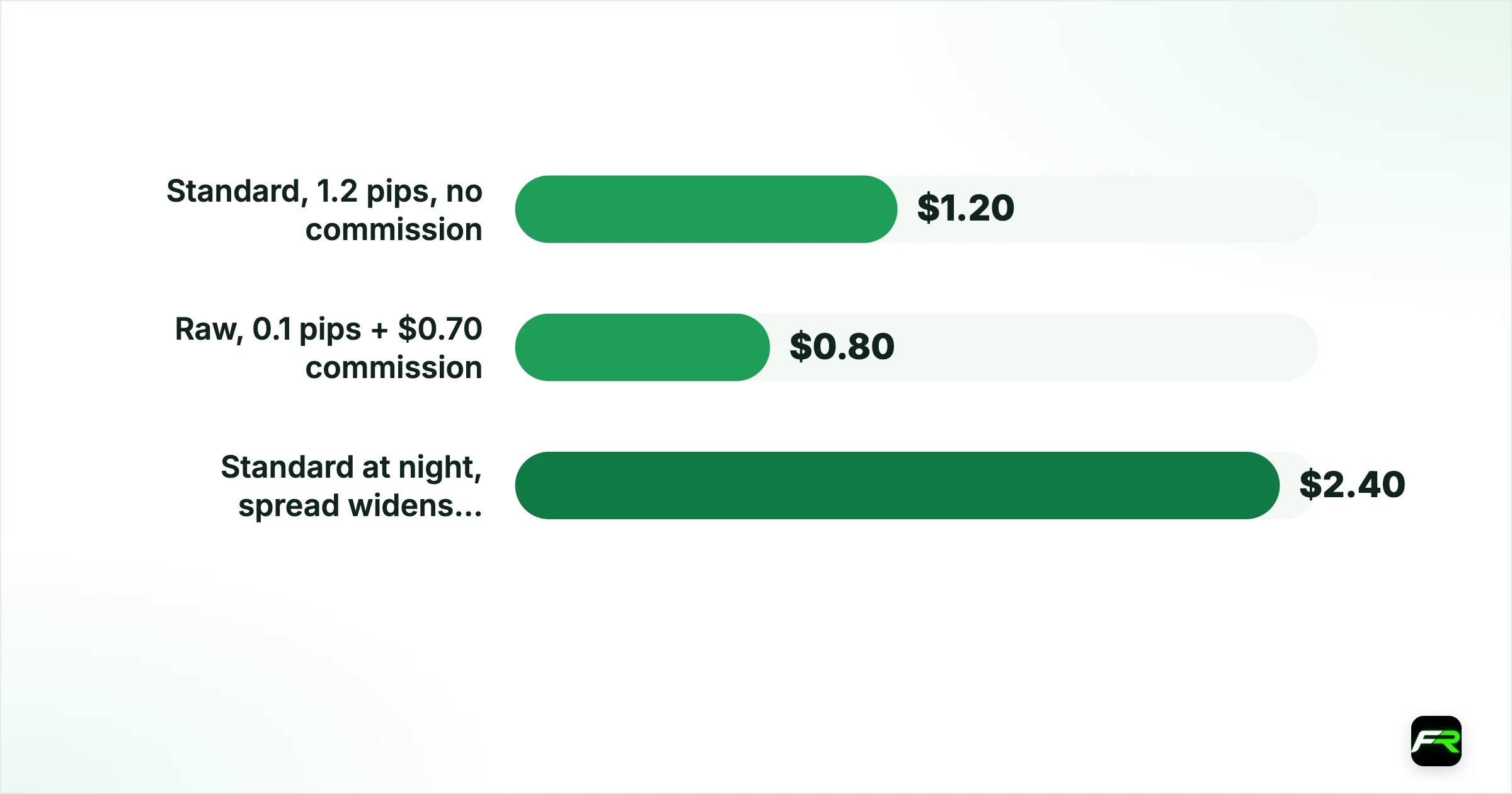
Pips are abstract, so translate them into rand at your own size and frequency. Take an active trader placing 60 round trips a month on EUR/USD at 0.1 lots, where one pip is worth $1, or about R17.50. Compare a standard account at 1.2 pips with a raw account at 0.1 pips plus a commission of $7 per standard lot round trip:
| Account | Cost per trade | 60 trades | In rand |
|---|---|---|---|
| Standard, 1.2 pips, no commission | $1.20 | $72 | About R1,260 |
| Raw, 0.1 pips + $0.70 commission | $0.80 | $48 | About R840 |
| Standard at night, spread widens to 2.4 pips | $2.40 | $144 | About R2,520 |
The third row is the one that surprises evening traders. If you trade after work, when liquidity is thin, a spread that doubles costs you more than the choice between account types. Moving your trading into the London and New York overlap can save more than switching brokers.
Swap: the cost that grows the longer you hold
For anyone holding positions overnight, swap can outweigh spread within a week. It is charged or credited each night at the daily rollover, triple on one weekday to cover the weekend, and it reflects the interest-rate gap between the two currencies plus the broker's markup. Because South African rates sit above US rates, a long USD/ZAR position, which in effect borrows rand to hold dollars, usually pays a noticeable swap each night, while a short position may earn a small credit or a reduced charge once the broker's markup is taken off. Check the swap figures in your platform's symbol specification before you hold a rand trade for more than a few days.
In MT4 or MT5, right-click the pair in Market Watch and open Specification. The swap long and swap short values there are what you will be charged or paid per lot per night.
How to compare properly
- Pick the one or two pairs you will actually trade.
- Open a demo on each shortlisted broker with the account type you would use.
- Check the live spread at the exact hours you trade, over a few days.
- Add the commission to get cost per round-turn lot.
- Check the swap if you hold overnight.
- Only then compare, and weigh it against the FSCA licence, the ZAR account and the withdrawal record.
The cheapest broker on the billboard is rarely the cheapest broker for your trading. I have seen people pick a standard account off a zero-pip advert and pay double what a raw account would cost, because they never checked the spread at the time of night they actually trade. Five minutes on a demo at 20:00 answers it.
Frequently asked
What is the lowest-spread account type?
A raw-spread or ECN account, which shows spreads from around 0.0 to 0.3 pips on EUR/USD but charges a commission per lot. Once you add the commission, the effective cost is usually still lower than a standard no-commission account.
Is a zero spread account actually free?
No. "Zero spread" accounts charge a commission instead, and if that commission is high the total cost can exceed a normal raw-spread account. Always compare spread plus commission as one figure.
When are spreads tightest?
During the London and New York overlap, roughly 14:00 to 18:00 South African time. They are widest in the thin hours after New York closes. If you trade in the evening, check the spread then, not the advertised daytime number.
Why is USD/ZAR more expensive to trade than EUR/USD?
It is less liquid, so the spread is wider and the overnight swap is larger. GBP/ZAR and EUR/ZAR are wider still. Traders focused on low cost often trade the major pairs rather than the rand crosses.
How do I compare broker costs?
Demo each broker with the account type you would use, check the live spread on your pairs at your trading hours over a few days, add the commission, check the swap, and compare cost per round-turn lot alongside the licence and withdrawal record.
How much does a 1-pip spread cost me in rand?
On EUR/USD a pip is $10 per standard lot, $1 per 0.1 lot and $0.10 per micro lot. At R17.50 to the dollar, a 1-pip spread on a 0.1-lot trade costs about R17.50. Multiply by your trades per month to see the real figure.
Related reading
The team behind this guide
Researched, checked and approved by five forex specialists
Every guide is written, fact-checked and edited before it goes live, and updated when the facts change. Spotted an error? Tell us.