IC Markets































Is Fusion Markets Safe? Licences, Client Money and Who It Accepts
Fusion Markets runs three licensed companies: one in Australia under ASIC, one in Vanuatu under the VFSC and one in Seychelles under the FSA. Here is which company holds your account, how client money is kept, and the countries the broker turns away.
 WriterAbir KhanWriterWrites the guides · checks every figure against primary sources View profileAbout Abir →
 Market analysisTanbir Habib RiyadForex & Crypto AnalystForex and crypto analyst · technical and fundamental analysis View profileAbout Tanbir →
 Fact-checking & riskJannatul FerdaushFact-Checker & Risk AnalystFact-checks every figure · risk analysis · Applied Statistics, University of Dhaka View profileAbout Jannatul →
 Trading reviewJowel RanaCo-Founder & Forex TraderCo-founder · forex trader · reviews guides from a trader's view View profileAbout Jowel →
 Final approvalRanjan NiskrityFounder, Owner & Forex TraderFounder and owner · forex trader · signs off every guide View profileAbout Ranjan →
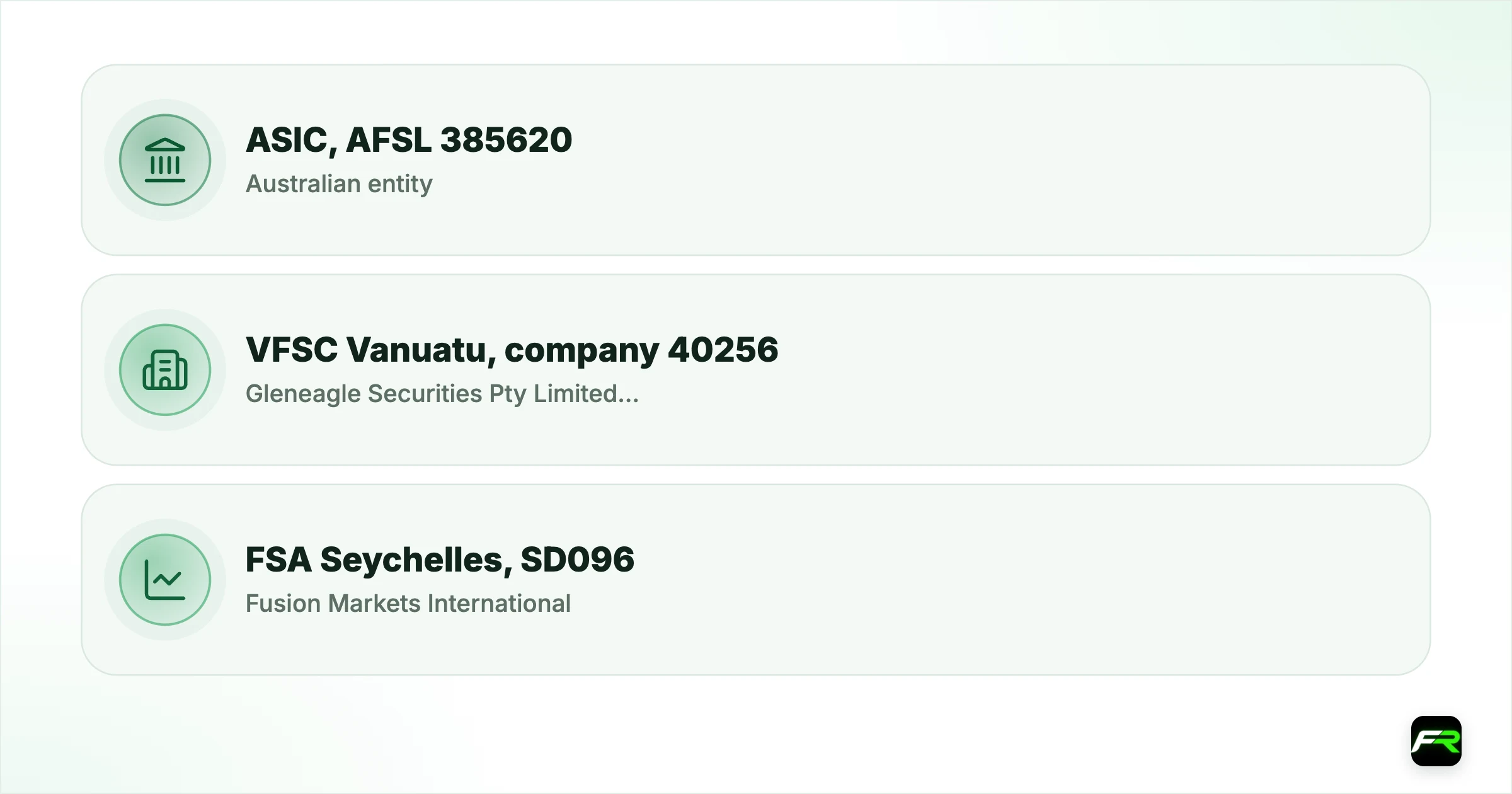
Fusion Markets is an Australian broker with its head office at 627 Chapel Street, South Yarra, Melbourne. Its website names three licences. Australian clients trade under an Australian Financial Services Licence, number 385620, issued by ASIC. Clients elsewhere are placed with either Gleneagle Securities Pty Limited, a Vanuatu company (number 40256) regulated by the Vanuatu Financial Services Commission, or Fusion Markets International, which holds Securities Dealer licence SD096 from the Financial Services Authority of Seychelles.
That mix matters because the rules differ a lot between the three. ASIC limits retail leverage and sets strict conduct rules. Vanuatu and Seychelles are lighter regimes that allow 500:1 leverage and give you fewer formal protections. Your client agreement tells you which company you signed with, so open it before you send money.
| Head office | 627 Chapel St, South Yarra, Melbourne |
|---|---|
| Australia | ASIC AFSL 385620 |
| Vanuatu | Gleneagle Securities Pty Limited, VFSC, company 40256 |
| Seychelles | Fusion Markets International, FSA licence SD096 |
| Client money | Segregated Client Trust Accounts at National Australia Bank |
| Founded | November 2017, trading from June 2019 |
The three Fusion Markets companies
| Company | Regulator and number | Who it serves |
|---|---|---|
| Australian entity | ASIC, AFSL 385620 | Residents of Australia |
| Gleneagle Securities Pty Limited trading as Fusion Markets | VFSC Vanuatu, company 40256 | International clients |
| Fusion Markets International | FSA Seychelles, SD096 | International clients |
Regulators list company names, not brands. Search the ASIC professional register for licence 385620, the VFSC list for Gleneagle Securities, and the Seychelles FSA list of Securities Dealers for Fusion Markets International. A two-minute check like that protects you from clone sites that copy a real broker's name.
Fusion's FAQ says the business was founded in November 2017 and started taking trades in June 2019. Phil Horner is named as founder and chief executive. Gleneagle, the group behind the Vanuatu licence, dates from 2010, and the FAQ adds that Fusion is 50% owned by an institutional FX broker.
Where your money sits
Client deposits go into segregated Client Trust Accounts with National Australia Bank, according to the regulation page. Segregation means the broker keeps your balance apart from its own operating cash, so it can't pay salaries or rent with it. NAB is one of Australia's four major banks.
Segregation is not insurance. None of the pages we read mention a compensation scheme that would repay you if the broker failed. Treat an account with the Vanuatu or Seychelles company as money held on trust by a private firm, and keep the balance to what you need for margin.
An account opened through the international site sits with the Vanuatu or Seychelles company. ASIC's retail protections apply only to clients of the Australian entity.
Negative balance protection
Fusion's FAQ says clients of the VFSC and FSA companies get negative balance protection. If a gap pushes one of your accounts below zero, the broker resets it to zero, once per working day, and the reset is applied to each account separately.
Several places are excluded: Mongolia, Türkiye, Indonesia, Hong Kong, Taiwan, Vietnam and China. Traders living there can owe the broker money after a violent move. Our Fusion Markets stop out guide explains how the 90% margin call and 20% stop out work before things get that far.
Who Fusion Markets won't accept
Residents of these places can't open an account: Afghanistan, Congo, Iran, Iraq, Japan, Myanmar, New Zealand, North Korea, Ontario, Palestine, Russia, Somalia, Sudan, Syria, Ukraine, Yemen, Spain and the United States with its territories. Ontario is listed on its own, so other Canadian provinces are served.
India, Pakistan, Bangladesh, Nigeria, South Africa, Malaysia, Thailand and the Philippines are absent from that list. Local law still applies to you, though. A broker accepting your sign-up doesn't mean your own regulator approves of offshore CFD trading.
How orders are handled
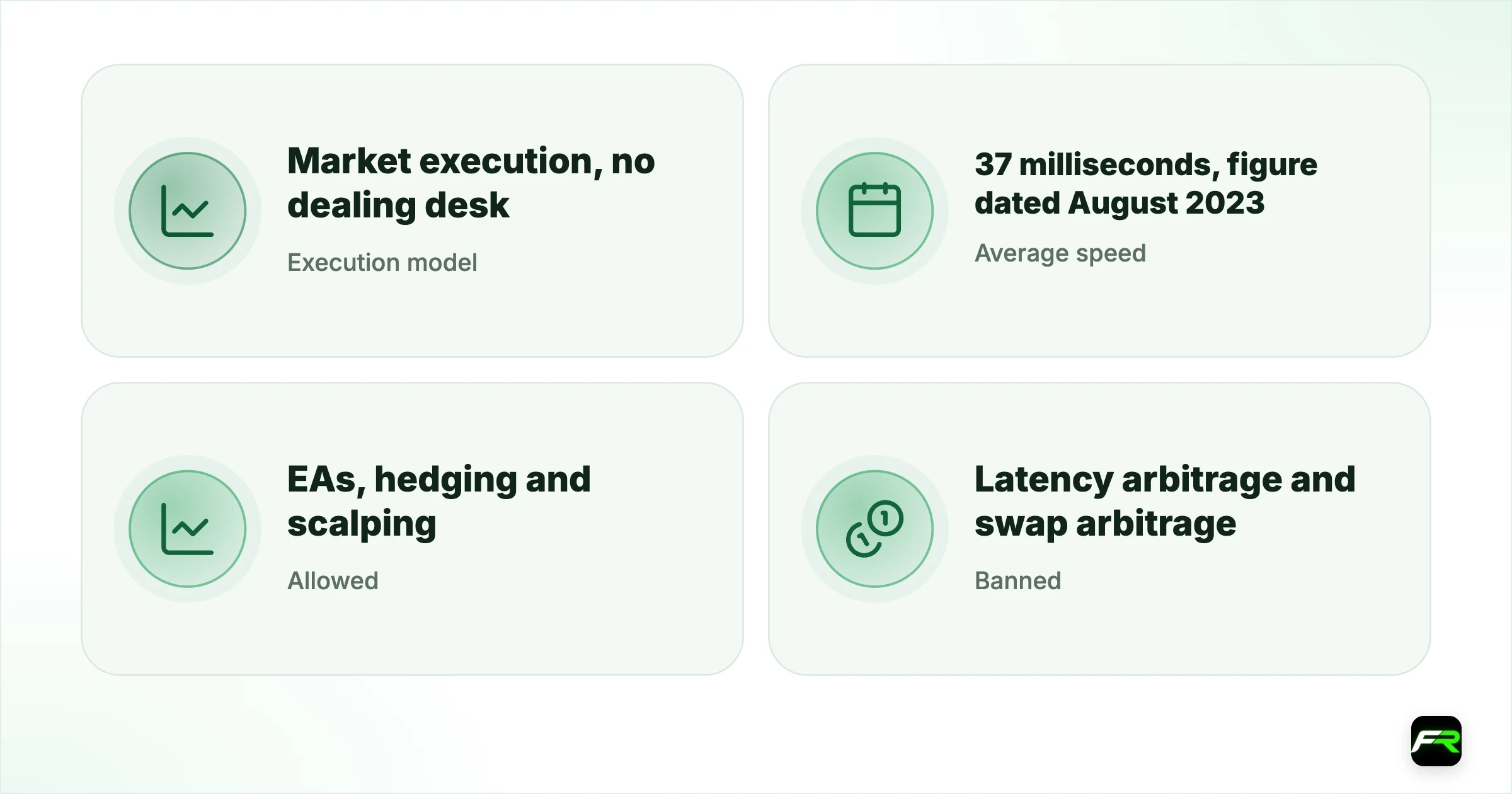
Fusion describes its model as market execution with no dealing desk. Expert advisors, hedging and scalping are all allowed. Two practices are banned: latency arbitrage and swap arbitrage. The FAQ quotes an average execution time of 37 milliseconds, a figure dated August 2023, with trade servers in New York.
| Rule | What Fusion states |
|---|---|
| Execution model | Market execution, no dealing desk |
| Average speed | 37 milliseconds, figure dated August 2023 |
| Allowed | EAs, hedging and scalping |
| Banned | Latency arbitrage and swap arbitrage |
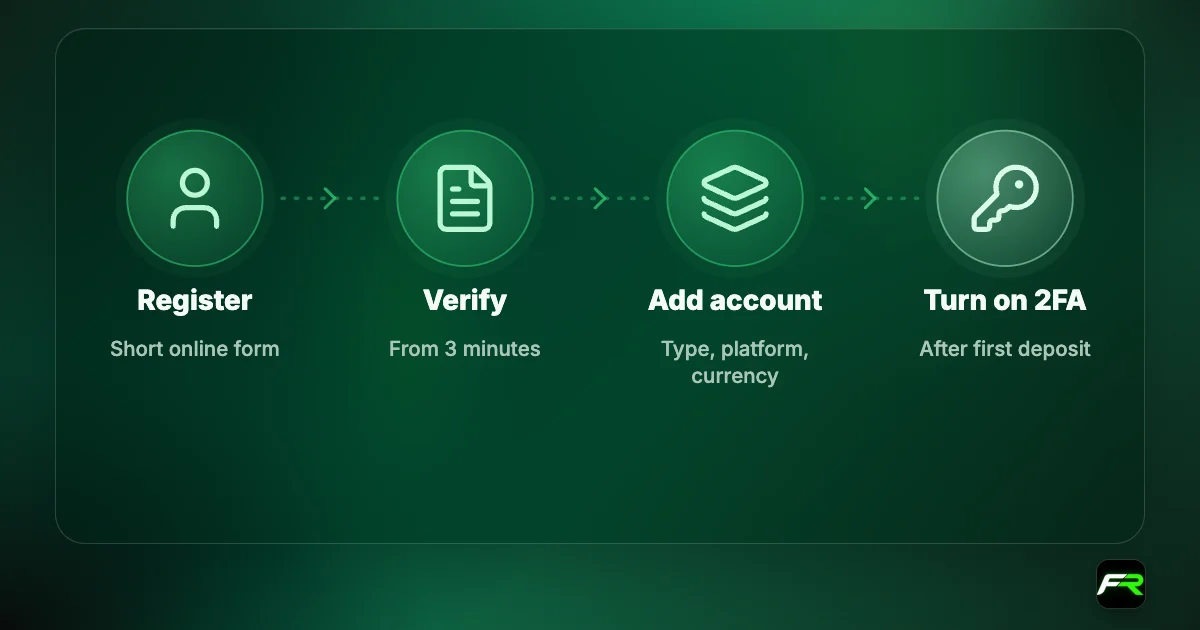
Account security has a hard rule. Two-factor authentication becomes mandatory after your first successful deposit, and every withdrawal needs a code from your authenticator app. Money leaves only to an account in your own name.
Is Fusion Markets safe?
Fusion Markets is a real, licensed group with an ASIC licence at its core, which is one of the stronger regulators in retail forex. Most readers outside Australia will not get that licence, however. They will get Vanuatu or Seychelles, with trust accounts at a major bank and negative balance protection in most countries. That is a reasonable setup for an offshore account, provided you size your deposit sensibly. Read our Fusion Markets withdrawal guide before you fund, and test a small withdrawal early.
Checks to run before you deposit
- Open your client agreement and write down the company name on it.
- Look that company up on the regulator's own website.
- Confirm your country is not on the excluded list for negative balance protection.
- Turn on two-factor authentication with an authenticator app, not SMS.
- Make one small deposit and one small withdrawal before sending a larger sum.
What an offshore licence means for you
Vanuatu and Seychelles license brokers, set capital rules and can withdraw a licence. They don't run the kind of ombudsman service or investor compensation fund that Australian or British clients can turn to. If a dispute with the international company can't be settled, your route is a complaint to that regulator, and outcomes there are far less predictable than in a tier-one system.
None of this makes the broker unsafe by default. It means more of the checking falls to you. Keep statements, save chat transcripts, and avoid parking savings in a trading account. Money you aren't using as margin is better off in your bank.
Awards and review scores appear all over broker websites, Fusion's included. They say something about service and price, and nothing about what happens to your money in a failure. Licence, segregation and your own deposit size are the three things that count for safety.
People hear ASIC and assume it covers them. For a trader in Dhaka or Lagos, the contract is with the Vanuatu or Seychelles company. That isn't a reason to avoid Fusion, but you should know which licence stands behind your balance.
Imran opened a Fusion account and found Gleneagle Securities Pty Limited named in his agreement. He looked the company up on the VFSC list, confirmed Pakistan wasn't excluded from negative balance protection, and funded $300. A week later he withdrew $50 to his e-wallet to see the process work before adding more.
Frequently asked
Is Fusion Markets regulated?
Yes. The group holds ASIC licence AFSL 385620 in Australia, a Vanuatu Financial Services Commission registration for Gleneagle Securities Pty Limited (company 40256), and Seychelles FSA Securities Dealer licence SD096 for Fusion Markets International. Which one applies depends on where you live.
Where is Fusion Markets based?
Its head office is at 627 Chapel Street, South Yarra, Melbourne, Australia. The international companies have offices in Port Vila, Vanuatu and in Providence, Mahe, Seychelles, as listed on the broker's contact page.
Does Fusion Markets keep client money separate?
The broker says client funds are held in segregated Client Trust Accounts at National Australia Bank, apart from company money. Segregation is not a compensation scheme, and none is described on the pages we checked.
Does Fusion Markets have negative balance protection?
Clients of the Vanuatu and Seychelles companies get it, with a reset once per working day on each account. Residents of Mongolia, Türkiye, Indonesia, Hong Kong, Taiwan, Vietnam and China are excluded.
Can US or Japanese residents open a Fusion Markets account?
No. The United States and its territories, Japan, New Zealand, Spain, Russia, Ukraine, Ontario and several sanctioned countries are on the broker's restricted list.
Who owns Fusion Markets?
The FAQ names Phil Horner as founder and chief executive and says the business is 50% owned by an institutional FX broker. Gleneagle, the group linked to the Vanuatu company, was founded in 2010.
Related reading
The team behind this guide
Researched, checked and approved by five forex specialists
Every guide is written, fact-checked and edited before it goes live, and updated when the facts change. Spotted an error? Tell us.