IC Markets




































Fusion Markets Leverage: Up to 500:1, Equity Tiers and Margin Examples
International clients of Fusion Markets can use up to 500:1 on forex and metals, 100:1 on indices and 10:1 on crypto. The cap falls as your equity grows. Here are the tiers, the margin each setting needs, and how to choose a level you can survive.
 WriterAbir KhanWriterWrites the guides · checks every figure against primary sources View profileAbout Abir →
 Market analysisTanbir Habib RiyadForex & Crypto AnalystForex and crypto analyst · technical and fundamental analysis View profileAbout Tanbir →
 Fact-checking & riskJannatul FerdaushFact-Checker & Risk AnalystFact-checks every figure · risk analysis · Applied Statistics, University of Dhaka View profileAbout Jannatul →
 Trading reviewJowel RanaCo-Founder & Forex TraderCo-founder · forex trader · reviews guides from a trader's view View profileAbout Jowel →
 Final approvalRanjan NiskrityFounder, Owner & Forex TraderFounder and owner · forex trader · signs off every guide View profileAbout Ranjan →
Fusion Markets offers leverage of up to 500:1 on forex and precious metals to clients of its Vanuatu and Seychelles companies. Indices go up to 100:1 and crypto CFDs up to 10:1, according to the broker's FAQ. Australian residents trading under the ASIC licence face much lower retail limits set by that regulator.
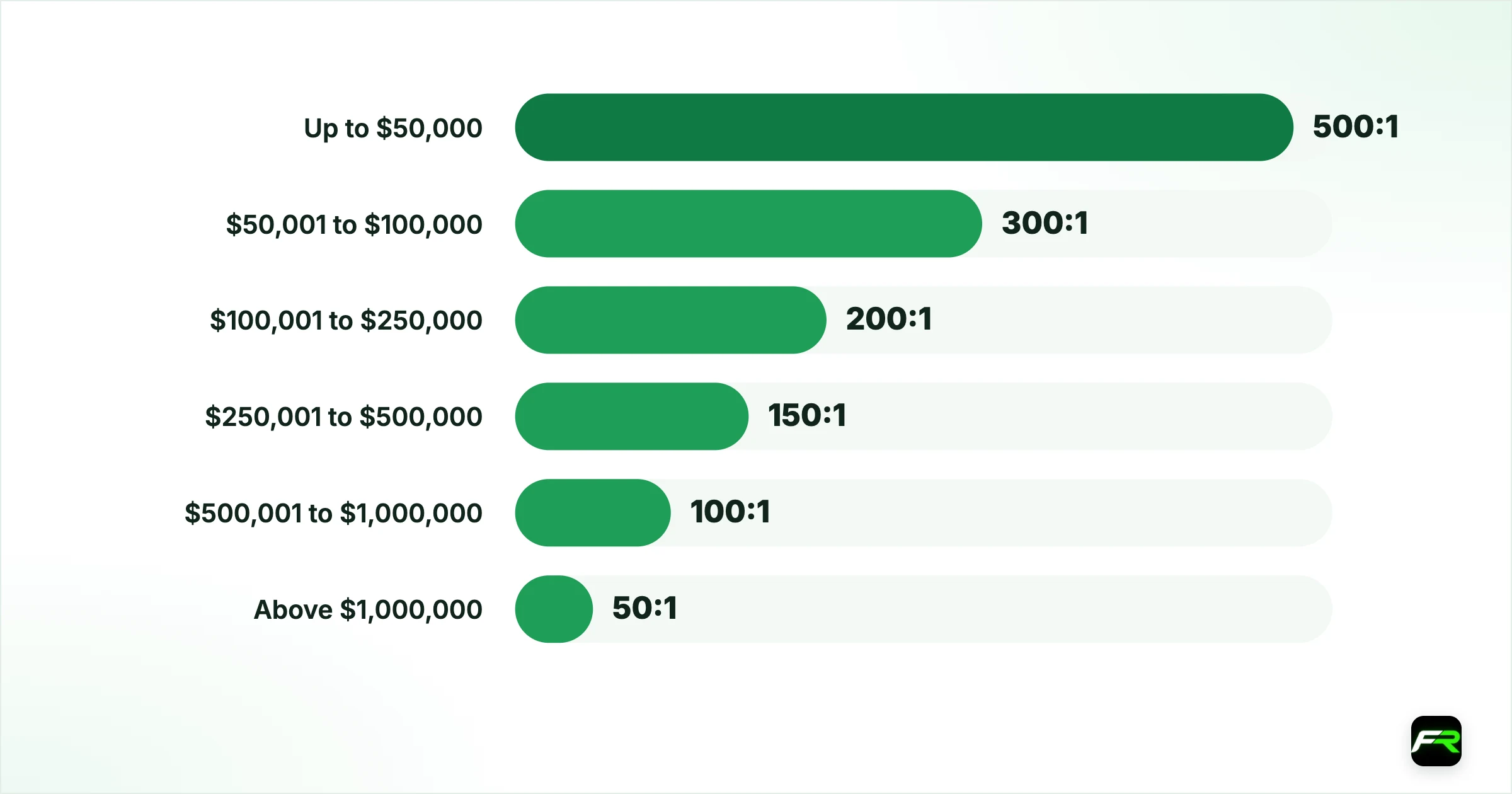
The maximum isn't fixed for life. It steps down as the equity in your account rises, starting at $50,000. You pick a setting when you create the account and can change it later in the Client Hub.
| Forex and metals | Up to 500:1 |
|---|---|
| Indices | Up to 100:1 |
| Crypto CFDs | Up to 10:1 |
| First tier change | Above $50,000 equity |
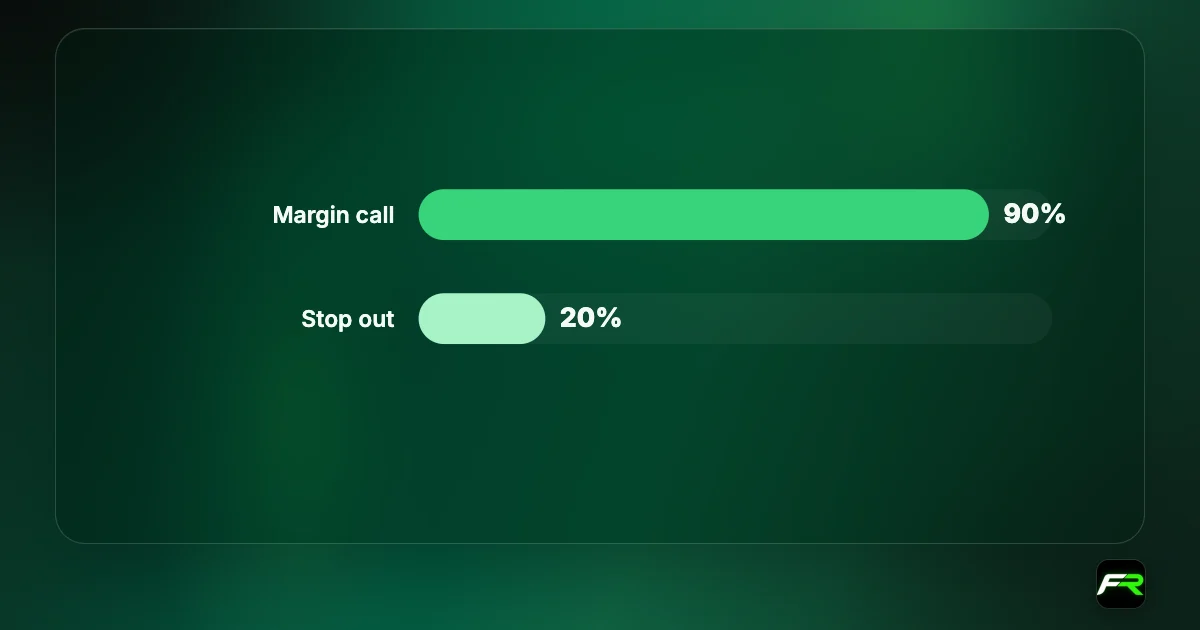
| Margin call | 90% margin level |
| Stop out | 20% margin level |
Leverage tiers by account equity
| Account equity | Maximum leverage |
|---|---|
| Up to $50,000 | 500:1 |
| $50,001 to $100,000 | 300:1 |
| $100,001 to $250,000 | 200:1 |
| $250,001 to $500,000 | 150:1 |
| $500,001 to $1,000,000 | 100:1 |
| Above $1,000,000 | 50:1 |
Tiers like these are common at offshore brokers. Bigger accounts carry bigger positions, and the firm reduces its own exposure by asking for more margin. Almost every retail reader sits in the first row, so the practical cap is 500:1.
One Fusion product page quotes crypto leverage of 1:2 for retail and 1:10 for professional clients, which matches Australian rules. Your Client Hub shows the figure that applies to your account.
What leverage does to margin
Leverage sets how much of your own money is locked up as margin for a position. Take a position worth $100,000, which is one standard lot of a pair with the dollar as its base currency. At 500:1 the margin is $200. Drop to 100:1 and the same trade needs $1,000.
| Leverage | Margin for $100,000 | Margin for $10,000 | Margin for $1,000 |
|---|---|---|---|
| 500:1 | $200 | $20 | $2 |
| 200:1 | $500 | $50 | $5 |
| 100:1 | $1,000 | $100 | $10 |
| 30:1 | About $3,333 | About $333 | About $33 |
| 10:1 | $10,000 | $1,000 | $100 |
Notice what doesn't change. A pip on one lot of EUR/USD is worth about $10 whether you use 500:1 or 30:1. Higher leverage doesn't make a position riskier by itself. It lets you open a bigger position than your balance could otherwise carry, and the bigger position is where the danger lies.
Why 500:1 wipes out small accounts
Take a $200 account. At 500:1 it can open a full standard lot, where each pip is worth $10. A 16-pip move against you costs $160 and takes the margin level to 20%, the point at which Fusion begins closing positions. EUR/USD often moves that far in a few minutes.
The same account trading 0.02 lots risks 20 cents a pip. A 50-pip loss costs $10, or 5% of the balance. Nothing about the leverage setting changed between those two cases. Only the lot size did.
Leverage is not extra money. It is a loan of exposure, and losses are counted on the full position size, not on your margin.
How to choose a setting
- Decide your risk per trade first, for example 1% of the balance.
- Size the position from the stop distance, so the loss at the stop equals that 1%.
- Check the margin that position needs at your leverage setting.
- Keep used margin under about a fifth of your equity, leaving room for several open trades and for swings.
- Lower the account's leverage if you catch yourself opening oversized trades.
Followed in that order, the leverage figure becomes almost irrelevant. A trader risking 1% with a 25-pip stop on a $500 account trades 0.02 lots, which needs about $4 of margin at 500:1 and $20 at 100:1. Both are tiny next to the balance.
How to change leverage
- Log in to the Client Hub and open Accounts.
- Select Demo or Live and find the trading account.
- Choose the option to change leverage and pick a new level.
- Confirm, then check the new figure in your platform.
Change the setting while you have no open positions if you can. A lower setting raises the margin on existing trades at once, and that can push a stretched account towards the stop out level.
Leverage and negative balance protection
High leverage and price gaps are how accounts go below zero. Fusion resets negative balances for clients of its Vanuatu and Seychelles companies, once per working day and for each account separately. Residents of Mongolia, Türkiye, Indonesia, Hong Kong, Taiwan, Vietnam and China are excluded, so they should be especially careful around weekends and news. The Fusion Markets stop out guide explains the margin call and liquidation levels, and the regulation guide sets out which company you are with.
Test your position sizing on a demo set to the same leverage and balance you will use live.
Leverage on other markets
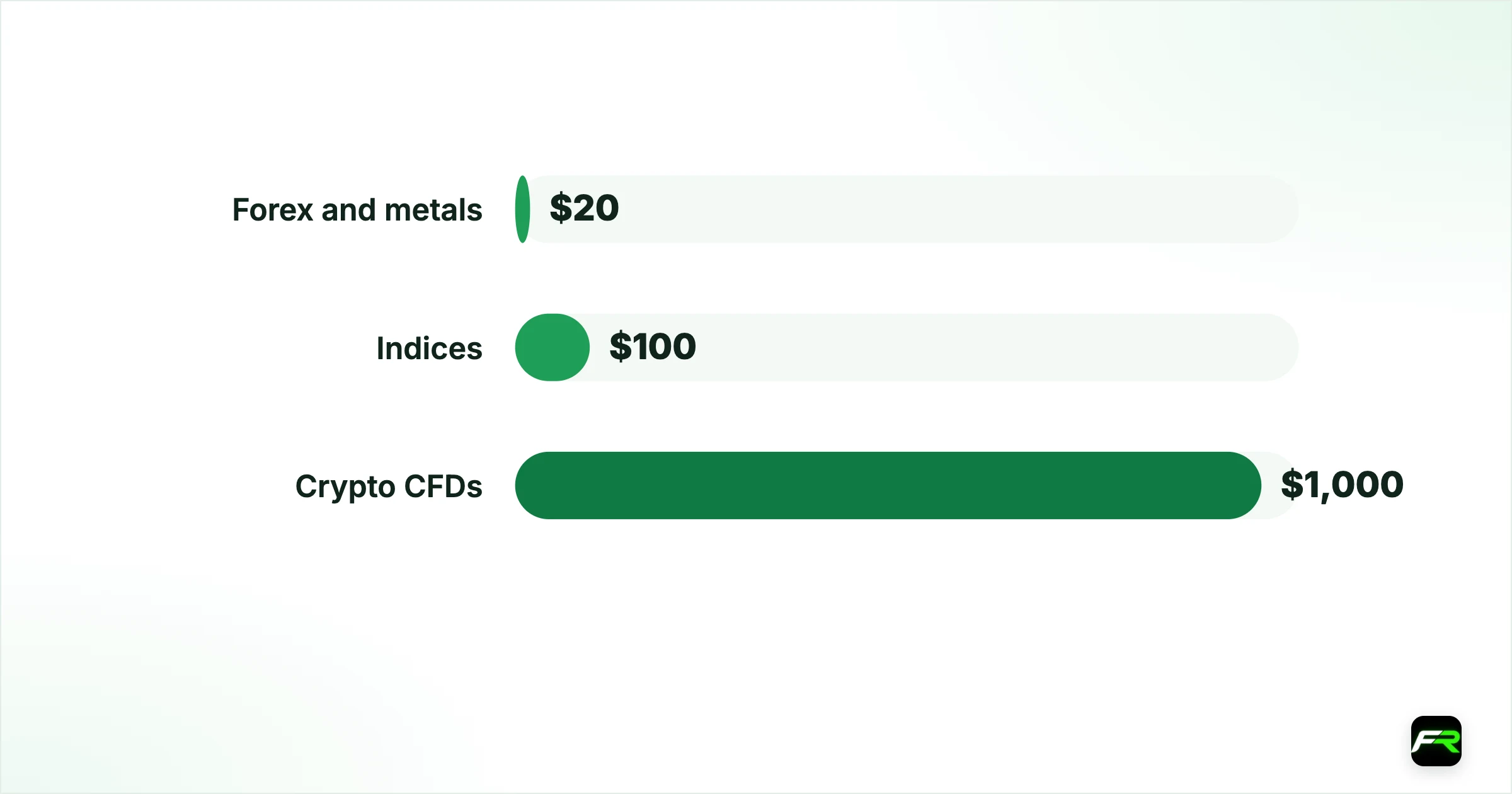
That 500:1 figure applies to forex and precious metals only. Fusion's FAQ gives a ceiling of 100:1 for index CFDs and 10:1 for crypto CFDs. Lower caps on those markets reflect how they move. An index can gap 2% at the open and Bitcoin can swing 5% in an afternoon, so the broker asks for more margin against them.
| Market | Maximum leverage | Margin on a $10,000 position |
|---|---|---|
| Forex and metals | 500:1 | $20 |
| Indices | 100:1 | $100 |
| Crypto CFDs | 10:1 | $1,000 |
Mixed portfolios need care. A trader used to forex margin who opens a crypto position of the same dollar value will see fifty times more margin locked up. Free margin shrinks, and the margin level on the whole account falls with it.
Australian clients and ASIC limits
Residents of Australia trade with Fusion's ASIC-licensed entity. ASIC's product intervention order caps retail CFD leverage at 30:1 on major currency pairs, with lower limits on other assets, down to 2:1 on crypto. Those caps explain why one of Fusion's product pages quotes 1:2 crypto leverage for retail clients. Higher levels in Australia are reserved for clients who qualify as professional or wholesale.
Myths about leverage
One common belief is that high leverage raises the cost of a trade. It doesn't; spread, commission and swap depend on position size, not on the setting. Another is that low leverage makes you safe. A trader at 30:1 who puts the whole balance into margin is in more danger than one at 500:1 using a fiftieth of it. Safety comes from the size of the trade against the size of the account.
I have used high leverage for years and I still size every trade from the stop, never from the margin available. With 500:1 on a small account, the platform will let you place a trade that one ordinary candle can end.
Budi opened a $300 account at 500:1 and, knowing Indonesia is excluded from negative balance protection, cut the setting to 100:1 in the Client Hub. He traded 0.03 lots with a 20-pip stop, risking about $6 a trade. A sharp move on a Friday news release cost him one stop, not the account.
Frequently asked
What is the maximum leverage at Fusion Markets?
Up to 500:1 on forex and metals for clients of the Vanuatu and Seychelles companies, 100:1 on indices and 10:1 on crypto CFDs. Australian retail clients under ASIC have lower limits.
Does leverage change with account size?
Yes. The cap is 500:1 up to $50,000 in equity, then 300:1 to $100,000, 200:1 to $250,000, 150:1 to $500,000, 100:1 to $1 million and 50:1 above that.
How do I change my leverage?
Log in to the Client Hub, open Accounts, choose the demo or live account and select a new leverage level. The change applies to that account only.
How much margin do I need for one lot?
For a position worth $100,000, margin is $200 at 500:1, $500 at 200:1 and $1,000 at 100:1. Pairs priced in other currencies need the equivalent in your account currency.
Is high leverage dangerous?
It becomes dangerous when it leads you to open positions that are too large for your balance. Keep risk to about 1% per trade and size from your stop distance, and the leverage setting matters far less.
Can I lose more than my deposit?
Fusion applies negative balance protection for Vanuatu and Seychelles clients, so most traders can't. Residents of Mongolia, Türkiye, Indonesia, Hong Kong, Taiwan, Vietnam and China are excluded from that protection.
Related reading
The team behind this guide
Researched, checked and approved by five forex specialists
Every guide is written, fact-checked and edited before it goes live, and updated when the facts change. Spotted an error? Tell us.