IC Markets





































Forex Signal Groups in South Africa: What They Don't Tell You
Paid WhatsApp and Telegram signal groups sell entries and exits. Most South African subscribers end up down on trading and out of pocket on fees. Here is how they really make money.
 WriterAbir KhanWriterWrites the guides · checks every figure against primary sources View profileAbout Abir →
 Market analysisTanbir Habib RiyadForex & Crypto AnalystForex and crypto analyst · technical and fundamental analysis View profileAbout Tanbir →
 Fact-checking & riskJannatul FerdaushFact-Checker & Risk AnalystFact-checks every figure · risk analysis · Applied Statistics, University of Dhaka View profileAbout Jannatul →
 Trading reviewJowel RanaCo-Founder & Forex TraderCo-founder · forex trader · reviews guides from a trader's view View profileAbout Jowel →
 Final approvalRanjan NiskrityFounder, Owner & Forex TraderFounder and owner · forex trader · signs off every guide View profileAbout Ranjan →
Signal groups sell you trade calls: buy this pair here, stop there, target there. They are everywhere in South African forex, usually on WhatsApp or Telegram, usually R500 to R3,000 a month. The pitch is that you can profit by copying an expert without learning to trade. For most subscribers the reality is a small trading loss plus the subscription fees. This guide explains why.
How signal groups actually make money
- Subscription fees. The main revenue. It is paid whether the signals win or lose, so the incentive is to keep subscribers paying, not to make them profitable.
- Broker affiliate commissions. Many groups require or push you to a specific broker through their referral link, and earn a cut of your spread or a payment per lot you trade. This creates an incentive to send more signals, not better ones.
- Upsells. A "VIP" tier, a course, a mentorship, a "funded account" programme.
Notice what is missing: a share of your trading profits. Almost no signal group is paid based on whether you make money, which tells you what they are optimising for.
Why copying signals rarely works
- Execution slippage. By the time you see the signal, open your platform and place the trade, the price has moved. You get worse entries and exits than the group's stated ones.
- No context. A signal is an entry and a stop. It does not teach you why, so you cannot judge when to skip a bad one or manage a trade that goes sideways.
- Cherry-picked results. Groups post winners loudly and losers quietly, or count a trade as a win if it touched target before reversing. The stated win rate is marketing.
- Volume for affiliate income. Groups tied to a broker send frequent signals to generate trading volume, which is bad for you and good for their commission.
- You never build skill. A year of copying signals leaves you unable to trade on your own, still dependent, still paying.
| What the group shows | What is really going on |
|---|---|
| High win rate screenshots | Selected results, generous definitions of a win |
| "Free" signals channel | Funnel to the paid tier and the broker link |
| Withdrawal proof images | Often affiliate-commission payouts, not trading profit |
| "Use our recommended broker" | Referral link paying the group per lot you trade |
Bongani paid R2,500 a month for six months and followed the signals on a R15,000 account. He finished down about R4,000 on trading and R15,000 on fees. When he asked for a verified track record, he was removed from the group. The mentor's income, he later worked out, came from the broker affiliate link and the subscriptions, not from trading, which is why the signals were frequent and the results were never audited.
Auditing a signal group on demo
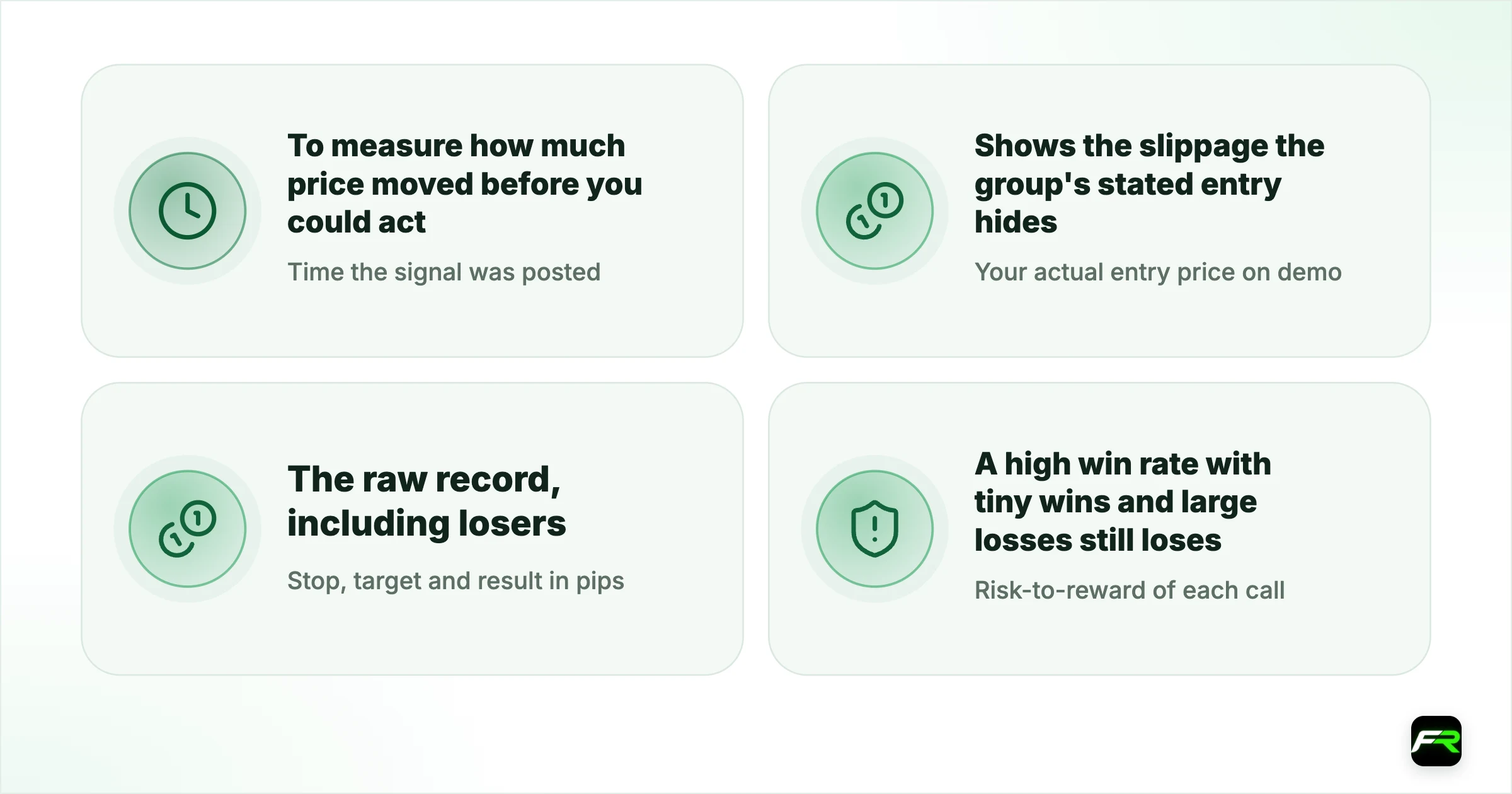
A group's posted results are marketing. Your own log of its calls, traded on a demo account, is evidence. Run it for at least 60 days, or about 50 signals, recording every call the moment it is posted:
| Log this | Why it matters |
|---|---|
| Time the signal was posted | To measure how much price moved before you could act |
| Your actual entry price on demo | Shows the slippage the group's stated entry hides |
| Stop, target and result in pips | The raw record, including losers |
| Risk-to-reward of each call | A high win rate with tiny wins and large losses still loses |
| Signals later edited or deleted | A common way losing calls disappear |
At the end, add up the pips from your own entries and set them against the subscription. If the result is not clearly positive after costs, you have your answer for the price of a demo account.
Questions to ask before paying
- Can I see every signal from the last six months, including the losers, with timestamps?
- Is your trading account verified by a third party, and can I see it live?
- Do you earn commission from a broker you recommend?
- What happens to my money if I cancel: is the subscription refundable?
A group that answers clearly is unusual. One that removes you for asking, as happened to Bongani above, has given you the most useful answer of all.
If you are going to use one anyway
- Treat the fee as a sunk cost you will probably not recoup, and keep it small relative to your account.
- Demo the signals for two months before risking real money. Track every call, including the losers, yourself.
- Do not use the group's referral broker link. Choose your own FSCA-licensed broker.
- Ask directly how the group earns money. If the honest answer is fees and affiliate commission, you know the incentive.
- Use it to learn, by asking why each trade was taken, not just to copy.
A signal group that guarantees returns, posts only winners, requires its broker link, or sells a 'funded account' upsell is closer to a marketing scheme than a trading service. The FSCA has warned about operations of this kind.
The test for any signal group is simple: how do they get paid? If it is subscription fees and broker commissions, their interest is your activity and your renewal, not your profit. A year later the group has your money and you still cannot trade. Spend the subscription on a demo account and your own education instead.
Frequently asked
Do forex signal groups work?
For most subscribers, no. The typical outcome is a small trading loss plus the subscription fees. Execution slippage, lack of context, cherry-picked results and volume-driven signals all work against the person copying.
How do signal groups make money?
Mainly subscription fees, paid whether signals win or lose, plus broker affiliate commissions earned on the volume you trade through their referral link, plus upsells like courses and mentorships. Almost none are paid on your trading profits.
Are the win rates signal groups advertise real?
Usually not as presented. Groups post winners prominently and losers quietly, and often count a trade as a win if price touched target before reversing. Track the signals yourself on demo to see the real record.
Should I use the broker a signal group recommends?
No. The recommended broker is almost always a referral link that pays the group per lot you trade, which is why they send frequent signals. Choose your own FSCA-licensed broker.
Is there a safe way to use a signal group?
Treat the fee as likely unrecoverable, demo the signals for two months tracking every call yourself, avoid the group's broker link, and use it to learn why trades are taken rather than just to copy them.
How do I check if a signal group's results are real?
Follow every signal on a demo account for at least 60 days, logging the posting time, your real entry, the stop, target and result. Compare your pips after slippage with the subscription cost. Posted screenshots and win rates are not evidence.
Are free forex signal channels safe?
Free channels are usually a funnel. They post a few calls to build trust, then push you to a paid tier or to open an account through a referral link that pays the group on your trading volume. Treat a free channel as advertising, and never deposit with a broker just because a channel recommends it.
Related reading
The team behind this guide
Researched, checked and approved by five forex specialists
Every guide is written, fact-checked and edited before it goes live, and updated when the facts change. Spotted an error? Tell us.