IC Markets




































What Forex Trading Expenses You Can Deduct on Your SARS Return
If your trading is a trade, you can deduct costs like data, platforms, equipment and home-office share. The realistic list, and what SARS queries.
 WriterAbir KhanWriterWrites the guides · checks every figure against primary sources View profileAbout Abir →
 Market analysisTanbir Habib RiyadForex & Crypto AnalystForex and crypto analyst · technical and fundamental analysis View profileAbout Tanbir →
 Fact-checking & riskJannatul FerdaushFact-Checker & Risk AnalystFact-checks every figure · risk analysis · Applied Statistics, University of Dhaka View profileAbout Jannatul →
 Trading reviewJowel RanaCo-Founder & Forex TraderCo-founder · forex trader · reviews guides from a trader's view View profileAbout Jowel →
 Final approvalRanjan NiskrityFounder, Owner & Forex TraderFounder and owner · forex trader · signs off every guide View profileAbout Ranjan →
This is a general overview, not tax advice. SARS assesses each trader's facts individually, and the classification of your trading and the deductions you can claim depend on your specific situation. A registered tax practitioner is worth the fee.
If SARS treats your forex trading as a trade, which it does for active traders, you can deduct expenses incurred in producing that income, the same way any small business does. This reduces your taxable profit. The deductions have to be real, related to the trading, and supported by records. This guide covers what is reasonable to claim and where SARS pushes back.
The realistic deduction list
| Expense | How it is usually claimed | Notes |
|---|---|---|
| Internet and data | Apportioned to trading use | Keep a reasonable percentage, not 100% unless the line is trading-only |
| Platform and charting subscriptions | Full cost if used only for trading | TradingView, news feeds, scanner tools |
| Computer, monitors, UPS or power station | Wear and tear over the asset's life | Not the full cost in year one unless it is a small item |
| Home-office share | Portion of rent or bond interest, rates, electricity by floor area | Dedicated, regular, exclusive use only. SARS applies this strictly |
| Bank and transfer fees | Full cost | SWIFT fees, EFT charges, card fees on funding and withdrawals |
| Tax practitioner fees | Full cost | For preparing the trading portion of your return |
| Courses and education | Where they relate to producing the income | SARS may query these; keep invoices and justification |
The home-office rule
This is the deduction SARS scrutinises most. To claim a portion of your home costs you need a specific area used regularly and exclusively for trading. A corner of the lounge where the family also watches TV does not qualify. A spare room set up as a trading office does. You calculate the deductible share by the floor area of that room as a percentage of the home, then apply it to rent or bond interest, rates and taxes, electricity and cleaning. Keep a floor plan, measurements and photos.
Claiming a home-office deduction can have a knock-on effect when you sell your home, because that portion may not qualify for the primary-residence capital gains exclusion. For most traders the annual saving is worth it, but ask a practitioner if you own a high-value property.
What you cannot deduct
- Your trading losses as an "expense". Losses are handled separately, set against income if the activity is a trade, and possibly ring-fenced if it is not.
- The cost of a computer or car in full in year one, if it is a substantial asset. It is claimed as wear and tear over time.
- Personal use portions. If your internet, phone or laptop is 60 per cent personal, only 40 per cent is deductible.
- Anything if SARS treats your trading as a hobby rather than a trade. No trade, no deductions.
- Speculative "expenses" with no invoice. Every deduction needs a record.
Karabo set up a spare bedroom as a dedicated trading office, kept the TradingView and data-feed invoices, logged her internet at 50 per cent trading use, and claimed wear and tear on her two monitors and a power station over three years. Her practitioner also claimed the floor-area share of her bond interest and electricity for the office room. The deductions reduced her taxable trading profit by about R22,000 that year. She keeps every invoice in one folder and photographed the office setup in case of a query.
Apportioning shared costs: a worked example
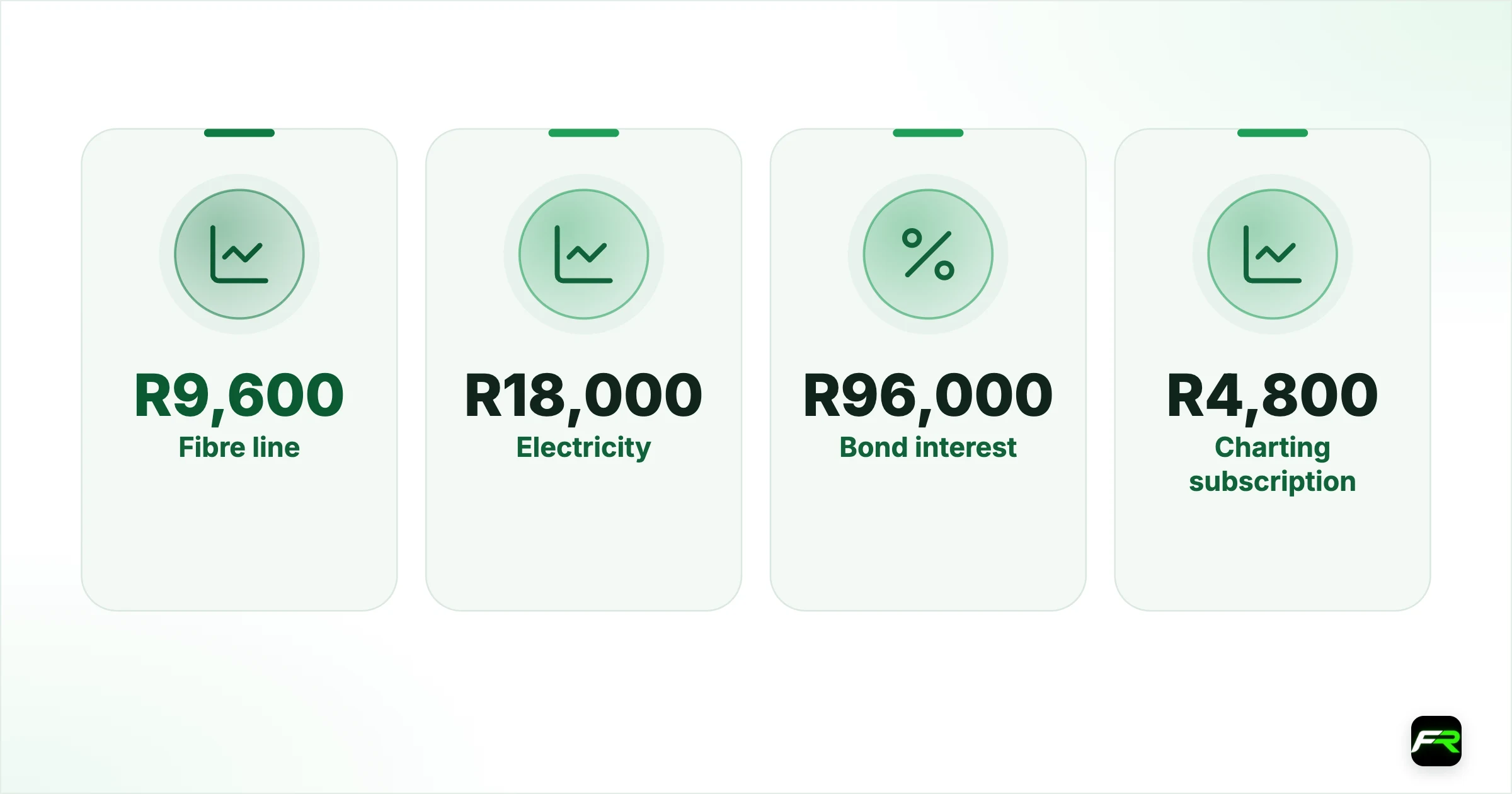
Most of a home trader's costs are shared with ordinary life, so the deduction is a percentage, not the full bill. SARS expects that percentage to rest on something you can explain, such as hours of use, floor area or a separate line. Here is an illustrative year for a trader with a dedicated office room covering 12 per cent of the home's floor area:
| Cost for the year | Total | Business share | Claim |
|---|---|---|---|
| Fibre line | R9,600 | 40% (trading hours) | R3,840 |
| Electricity | R18,000 | 12% (floor area) | R2,160 |
| Bond interest | R96,000 | 12% (floor area) | R11,520 |
| Charting subscription | R4,800 | 100% (trading only) | R4,800 |
| Tax practitioner | R3,500 | 100% | R3,500 |
The total claim of R25,820 reduces taxable trading profit, so at a 36 per cent marginal rate it saves roughly R9,300 in tax. Every line needs its invoice and a note of how the percentage was worked out.
The difference between a deduction and a capital allowance
Equipment that lasts several years, such as a computer, monitors or a power station, is claimed as a wear-and-tear allowance over its useful life rather than in full in the year you buy it. SARS publishes write-off periods for common assets, and small items below a low cost threshold can be written off at once. Keep the purchase invoice for as long as you are claiming the allowance, and for five years after.
Records make the deduction
A deduction you cannot support is a deduction SARS will disallow on audit, with a penalty. For every expense keep the invoice, proof of payment, and a short note on how it relates to trading, and for apportioned items keep the basis for the percentage. Our records guide has the full checklist.
Traders either claim nothing, and overpay, or claim aggressively with no paperwork, and get caught. The right approach is boring: claim the real costs of running the operation, keep every invoice, be conservative on apportionment, and treat the home office rule as the strict test it is. Done properly it meaningfully lowers the tax bill.
Frequently asked
Can I deduct forex trading expenses in South Africa?
Yes, if SARS treats your trading as a trade. You can deduct the costs of producing the income: data, platform subscriptions, equipment wear and tear, bank fees, practitioner fees and a share of home-office costs, all supported by records.
Can I claim a home office for forex trading?
Only if you have an area used regularly and exclusively for trading. You claim the floor-area share of rent or bond interest, rates and electricity. SARS applies this strictly, so keep a floor plan, measurements and photos.
Can I deduct a trading course?
Potentially, where the course relates to producing your trading income. SARS may query education costs, so keep the invoice and be ready to justify it. If your trading is treated as a hobby, you cannot deduct anything.
Can I deduct my trading losses as an expense?
No. Losses are handled separately from expenses. If your trading is a genuine trade, a loss can be set against your other income; if it is a hobby, the loss may be ring-fenced.
Do I need to keep receipts?
Yes. Every deduction needs an invoice, proof of payment and a note on how it relates to trading. Apportioned items also need the basis for the percentage claimed. Unsupported deductions are disallowed on audit.
How do I work out the business share of my internet?
Use a basis you can defend, such as the share of hours the line is used for trading, and write it down. If the line is used only for trading, you can claim it in full. Claiming 100 per cent of a family line used for streaming is the kind of claim SARS disallows.
Related reading
The team behind this guide
Researched, checked and approved by five forex specialists
Every guide is written, fact-checked and edited before it goes live, and updated when the facts change. Spotted an error? Tell us.