IC Markets



































How to Use the FSCA Warning List Before You Deposit
The FSCA publishes public warnings against entities it believes are operating without authorisation. Here is where to find it, how to read a warning, and what its limits are.
 WriterAbir KhanWriterWrites the guides · checks every figure against primary sources View profileAbout Abir →
 Market analysisTanbir Habib RiyadForex & Crypto AnalystForex and crypto analyst · technical and fundamental analysis View profileAbout Tanbir →
 Fact-checking & riskJannatul FerdaushFact-Checker & Risk AnalystFact-checks every figure · risk analysis · Applied Statistics, University of Dhaka View profileAbout Jannatul →
 Trading reviewJowel RanaCo-Founder & Forex TraderCo-founder · forex trader · reviews guides from a trader's view View profileAbout Jowel →
 Final approvalRanjan NiskrityFounder, Owner & Forex TraderFounder and owner · forex trader · signs off every guide View profileAbout Ranjan →
Alongside its register of licensed firms, the FSCA publishes a stream of public warnings against entities it believes are soliciting South Africans without authorisation. Checking it takes two minutes and it is one of the highest-value habits before depositing anywhere. This guide covers how to use it and what it does not tell you.
Where to find it
Go to the FSCA's official website, fsca.co.za, and look for "press releases" or "public warnings" in the media or consumer section. Warnings are published regularly, often several a week, each naming the entity, describing what it appears to be doing, and stating that it is not authorised to provide the relevant financial services. Use the site search to check a specific name.
How to read a warning
- The entity name and any aliases. Scam operations rebrand, so note related names and website addresses.
- What the FSCA says it is doing. Often "soliciting investments", "claiming to be authorised", or "impersonating a licensed provider".
- The date. Older warnings still matter; the entity may still be active under the same or a new name.
- Whether it names a real licensed firm being impersonated. Clone scams copy a legitimate broker's details, so verify the contact details independently.
| Warning type | What it means for you |
|---|---|
| Unauthorised entity soliciting investments | Do not deposit; likely a scam |
| Entity claiming false FSCA authorisation | The licence claim is fake; check the register |
| Clone of a licensed provider | Someone is impersonating a real broker; use only official contact details |
| Warning against a named individual | That person is not licensed to manage money or advise |
Reading a warning, line by line
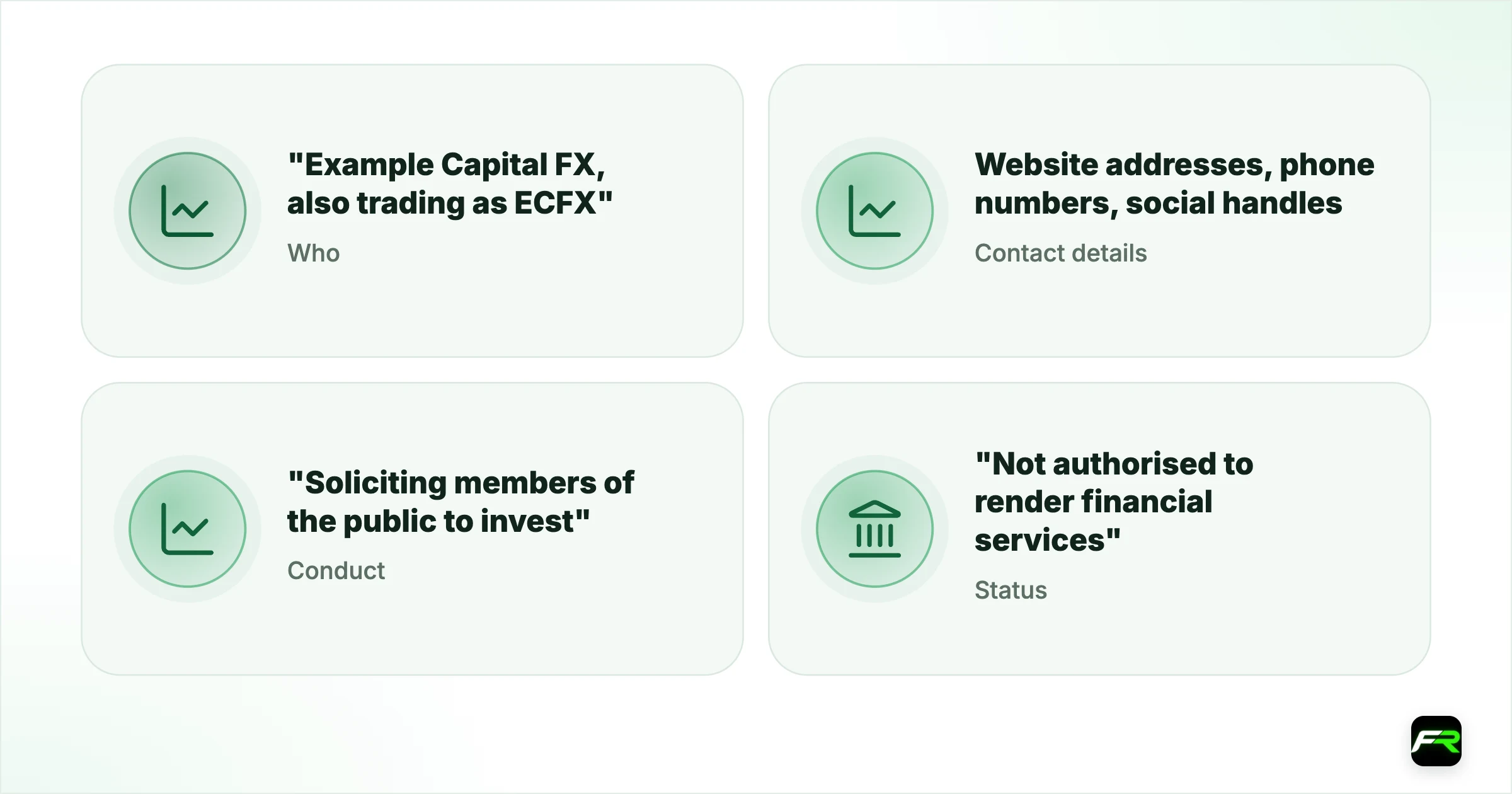
FSCA warnings follow a similar pattern. Here is how the parts of a typical notice map to what you should do, using an imaginary operator called Example Capital FX.
| Part of the notice | Typical wording | What to take from it |
|---|---|---|
| Who | "Example Capital FX, also trading as ECFX" | Search every name and alias, not just the one you were given |
| Contact details | Website addresses, phone numbers, social handles | Compare with the details you were sent |
| Conduct | "Soliciting members of the public to invest" | What the operator was doing to people |
| Status | "Not authorised to render financial services" | No licence; do not deposit |
| Advice | "The public is advised to exercise caution" | A standard line; take it literally |
The contact details are the most useful part. Operators change their brand names often, but phone numbers, web domains and social accounts are reused, so a match on any of them is enough reason to walk away.
When you search the FSCA site, also try the website domain without the "www" and the phone number without spaces. Notices format these differently.
The limits of the list
A clean check is reassuring but not a guarantee. The FSCA cannot warn about every scam the moment it appears, so a brand-new operation may not be listed yet. And the absence of a warning does not mean a firm is licensed; that is a separate check on the register. Use the warning list together with the register, not instead of it. The licence-check guide covers the register.
A two-minute routine
- Search the broker or scheme name on the FSCA warning list. A hit is a stop.
- Repeat the search for any related brand names, the website domain, and the name of any individual involved.
- Separately, confirm an active licence on the FSCA register.
- If the firm claims to be a well-known broker, get its contact details from the broker's official global site, not the link you were sent.
- Only then consider depositing.
Sibusiso was sent a link to a broker by a WhatsApp contact. The name did not appear on the FSCA register, and a search of the website domain turned up an FSCA warning from four months earlier naming that exact domain as an unauthorised operation. He did not deposit. The contact who sent it, it turned out, was being paid to recruit.
Other lists worth checking
The FSCA is the primary source for South Africa, but a few other checks add confidence. International regulators publish their own warning lists: the UK's FCA, Australia's ASIC and the EU regulators all maintain registers of firms flagged for targeting their residents without authorisation, and a scam operation working South Africa is often on one of those too. Independent broker-review sites and forums also aggregate scam reports, though treat those as leads to verify rather than proof. The one source not to trust is the broker's own website, which will always say it is regulated.
Reporting an unlisted scam
- If you encounter an operation that looks unauthorised and is not yet on the FSCA warning list, report it to the FSCA through the complaints channel on fsca.co.za.
- Include the entity name, website, any social-media handles, and how you were approached.
- If money has changed hands, also open a case with the South African Police Service and keep the case number.
- Warn the person who referred you, if they were not knowingly involved.
Reporting matters because the warning list is built partly from public complaints. An entity you flag today may be the warning that stops someone else next month.
Scam operations rebrand frequently. A warning against 'ABC Capital' may resurface as 'ABC Markets' or 'ABC Global' with the same people behind it. Search broadly, and be suspicious of any brand-new firm with heavy social-media advertising and no track record.
The warning list and the register are the two-minute check that prevents most retail scam losses. People skip it because the marketing looks professional, and professional-looking marketing is exactly what the FSCA is warning you about. Check both lists, every time, before any deposit.
Frequently asked
What is the FSCA warning list?
A stream of public warnings the FSCA publishes against entities it believes are soliciting South Africans for financial services without authorisation. Each names the entity, describes its conduct, and states it is not authorised.
Where do I find the FSCA warning list?
On the FSCA's official website, fsca.co.za, in the press releases or public warnings section. Use the site search to check a specific broker, scheme, domain or individual name.
Does no warning mean a broker is safe?
No. The FSCA cannot list every scam immediately, so a new operation may not appear yet, and the absence of a warning is not proof of a licence. Always check the register for an active licence as a separate step.
What if a broker is a clone of a real one?
Clone scams copy a licensed broker's name and details. If a firm claims to be a known broker, get its contact details from the broker's official global website, not from any link you were sent, and verify the licensed entity on the register.
Scam operators rebrand. How do I check for that?
Search broadly: the brand name, related names, the website domain, and any individual named. A warning against one name often applies to the same people operating under a new one.
What does "not authorised to render financial services" mean in an FSCA warning?
It means the named person or firm holds no FSCA licence to give financial advice or provide financial services, including forex or investment schemes. Any money you give them has no regulatory protection. Do not deposit, and report it if you have already been approached.
Related reading
The team behind this guide
Researched, checked and approved by five forex specialists
Every guide is written, fact-checked and edited before it goes live, and updated when the facts change. Spotted an error? Tell us.