IC Markets





























Are South African Forex Mentorships and Courses Worth It?
Some forex education is genuine and useful. A lot of it is a recruitment funnel selling the dream to the next person. How to tell a real educator from a hustle, and what a fair price looks like.
 WriterAbir KhanWriterWrites the guides · checks every figure against primary sources View profileAbout Abir →
 Market analysisTanbir Habib RiyadForex & Crypto AnalystForex and crypto analyst · technical and fundamental analysis View profileAbout Tanbir →
 Fact-checking & riskJannatul FerdaushFact-Checker & Risk AnalystFact-checks every figure · risk analysis · Applied Statistics, University of Dhaka View profileAbout Jannatul →
 Trading reviewJowel RanaCo-Founder & Forex TraderCo-founder · forex trader · reviews guides from a trader's view View profileAbout Jowel →
 Final approvalRanjan NiskrityFounder, Owner & Forex TraderFounder and owner · forex trader · signs off every guide View profileAbout Ranjan →
Forex education in South Africa runs from legitimate teachers with real experience to outright pyramids where the product is recruiting the next student. Both use similar language and similar Instagram feeds. This guide is about telling them apart, deciding whether you need a paid course at all, and what a reasonable price looks like.
The two kinds of forex educator
| Genuine educator | Recruitment hustle |
|---|---|
| Teaches a method, then expects you to trade it yourself | Keeps you dependent on signals or the group |
| Talks about losing trades and drawdowns | Shows only wins and lifestyle content |
| Fixed, disclosed one-time price | Tiered upsells, "VIP", recurring fees, "funded" programmes |
| No pressure to recruit others | Rewards you for bringing in new students |
| Realistic about timelines and win rates | Implies fast income from a small deposit |
| Broker-neutral, or discloses any affiliate link | Requires you to use their referral broker link |
Do you need a paid course?
Probably not to start. The core knowledge, how orders work, risk and position sizing, reading a chart, the main strategy types, is available free from broker education sections, reputable books, and established sites. A good paid course can save you time and give you structure and feedback, but it is an accelerant, not a requirement. Spend months on free material and a demo account first. If you then want a course for structure, you will be able to judge whether one is any good.
Red flags in forex education
- Lifestyle marketing: cars, Dubai, watches, cash. A real trader's returns do not fund that from retail trading, and it signals the income is from selling courses.
- Recruitment rewards: commission or status for bringing in new students. That is a pyramid.
- A required broker link. The educator earns from your trading volume, so their incentive is your activity.
- Recurring fees for "ongoing mentorship" with no end point.
- "Funded account" or prop-firm upsells bundled into the course.
- No verifiable trading record, and defensiveness when you ask for one.
What a fair offer looks like
- A one-time price, disclosed upfront, typically in the low thousands of rand, not tens of thousands.
- A defined curriculum you can see before paying.
- The explicit goal that you trade independently afterward.
- Honest content about losses, drawdowns and realistic returns.
- No requirement to use a specific broker, or clear disclosure if there is an affiliate relationship.
- Nothing that rewards you for recruiting other students.
Karabo paid R18,000 for a "mentorship" that turned out to be a Telegram group, weekly calls that were mostly motivational, a required broker link, and a push to sign up friends for a commission. She learned little she could not have got free. A year later she did a R2,500 structured course from a teacher who showed real losing trades, expected her to trade alone, and recommended no particular broker. That one helped. The difference was the incentive structure, not the price alone.
If a course or mentorship rewards you for recruiting other students, it is a pyramid scheme regardless of how much genuine trading content is attached. The FSCA and consumer bodies have repeatedly warned about forex operations of this kind in South Africa.
A low-cost learning path, in order
You can get most of the way to trading competently without paying for a mentorship. The order matters more than the source: each stage builds on the one before.
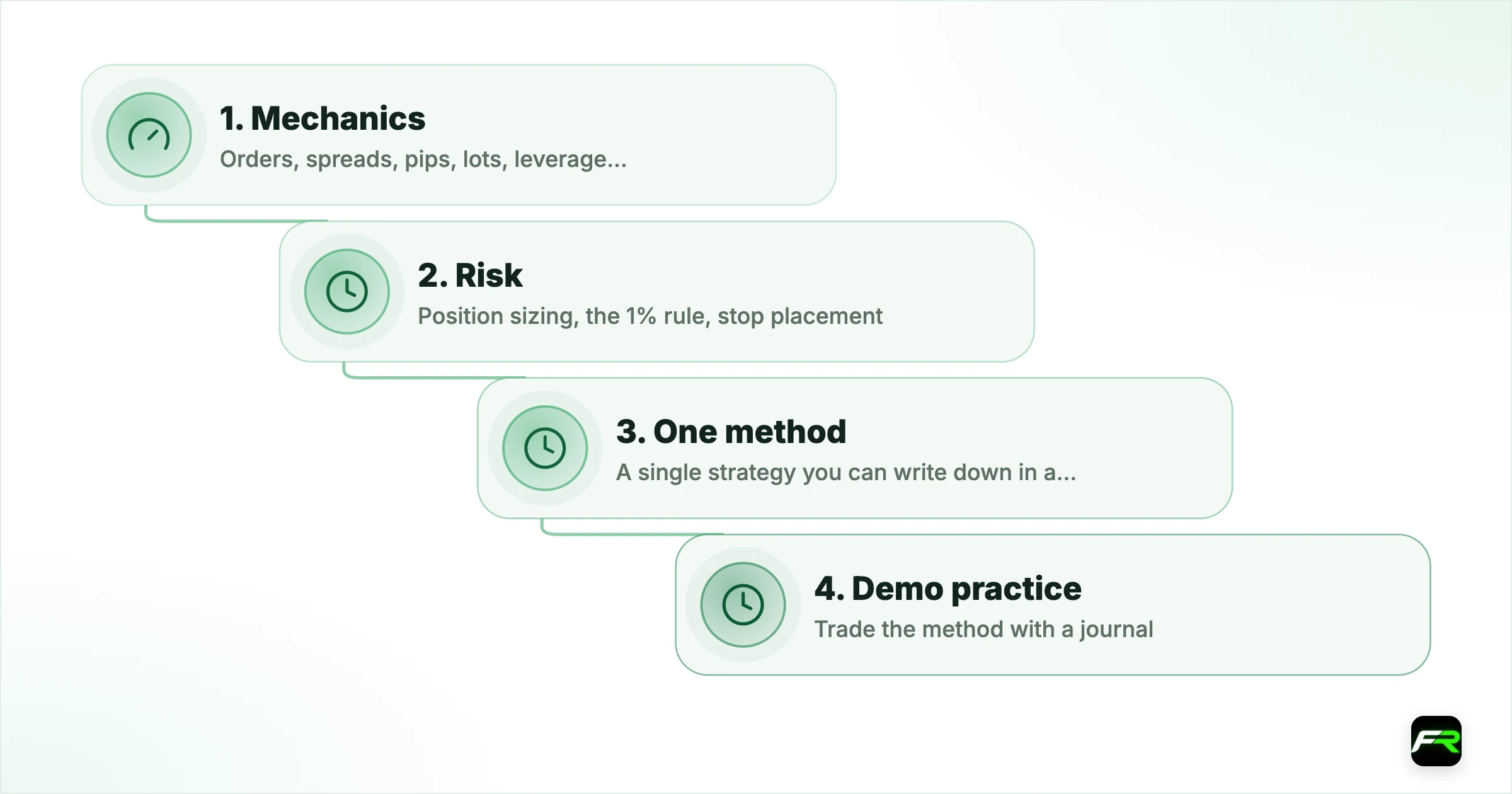
| Stage | What to learn | Typical cost | Time |
|---|---|---|---|
| 1. Mechanics | Orders, spreads, pips, lots, leverage, margin | Free | Two to three weeks |
| 2. Risk | Position sizing, the 1% rule, stop placement | Free | One to two weeks, then practice |
| 3. One method | A single strategy you can write down in a page | Free to a book's price | One to two months |
| 4. Demo practice | Trade the method with a journal | Free | Three months or more |
| 5. Small live account | The same method with real money at 1% risk | A deposit you can lose | Ongoing |
| 6. Optional course | Structure and feedback, if you want it | Low thousands of rand | As needed |
A paid course earns its place at stage six, once you know enough to judge it. Bought at stage one, it is easy to be sold something that sounds advanced and teaches little. The position-sizing guide and the beginner case studies cover stages two and five from a South African angle.
Checking a teacher before you pay
- Ask whether the teacher or company is licensed with the FSCA. Teaching alone does not need a licence, but managing money or giving personal advice does.
- Search the teacher's name and company on the FSCA warning list.
- Request a sample lesson or a refund period before paying in full.
- Ask how the teacher earns money: course fees only, or broker commissions too.
A sensible path
Start with free material and a demo account for a few months. If you want structure after that, choose a one-time course from someone who teaches a method, shows their losses, expects you to become independent, and does not tie you to a broker or ask you to recruit. Keep the spend modest. Put the bulk of your money into your trading account, not your education, and treat any course as a supplement to screen time, not a substitute for it.
There are good forex teachers in South Africa, and there are far more people selling a dream to the next person in the queue. The tell is always the incentive: does this person make money when I learn to trade, or when I keep paying and bring a friend? Answer that and the decision makes itself.
Frequently asked
Are forex courses worth it in South Africa?
Some are, many are not. A genuine one-time course from an experienced teacher can add structure and feedback. A large part of the market is recurring-fee mentorships and recruitment schemes that keep you dependent. The core knowledge is available free to start.
How much should a forex course cost?
A fair one-time price is typically in the low thousands of rand with a curriculum you can see before paying. Be wary of tens of thousands, tiered upsells, recurring "mentorship" fees, and bundled "funded account" programmes.
What are the red flags in forex education?
Lifestyle marketing, rewards for recruiting other students, a required broker referral link, open-ended recurring fees, no verifiable trading record, and implied fast income from a small deposit.
Do I need a mentor to learn forex?
No, not to start. Order mechanics, risk and position sizing, chart reading and the main strategy types are available free from broker education sections, reputable books and established sites. Spend time there and on a demo first.
When is a forex mentorship a pyramid scheme?
When it rewards you with commission or status for bringing in new students. That structure is a pyramid regardless of how much genuine trading content is attached, and the FSCA has warned about such operations.
Does a forex teacher need an FSCA licence?
General education does not, but managing other people's money or giving them personal financial advice does. A teacher who offers to trade your account, or tells you exactly what to buy for your circumstances, should hold an FSCA licence. Check the register and the warning list.
Related reading
The team behind this guide
Researched, checked and approved by five forex specialists
Every guide is written, fact-checked and edited before it goes live, and updated when the facts change. Spotted an error? Tell us.