IC Markets





































Pepperstone Account Types: Standard vs Razor, and Pepperstone Pro
Pepperstone offers two live CFD accounts. Standard builds its cost into a wider spread; Razor gives raw spreads plus a commission on forex and gold. Pro status is a separate client category with higher leverage and rebates. Here is how to choose.
 WriterAbir KhanWriterWrites the guides · checks every figure against primary sources View profileAbout Abir →

 Market analysisTanbir Habib RiyadForex & Crypto AnalystForex and crypto analyst · technical and fundamental analysis View profileAbout Tanbir →

 Fact-checking & riskJannatul FerdaushFact-Checker & Risk AnalystFact-checks every figure · risk analysis · Applied Statistics, University of Dhaka View profileAbout Jannatul →

 Trading reviewJowel RanaCo-Founder & Forex TraderCo-founder · forex trader · reviews guides from a trader's view View profileAbout Jowel →

 Final approvalRanjan NiskrityFounder, Owner & Forex TraderFounder and owner · forex trader · signs off every guide View profileAbout Ranjan →

Pepperstone keeps its account line-up short. There are two live CFD accounts, Standard and Razor, and both trade the same 1,350+ markets on the same terms apart from pricing and platform choice. On top of that, any client who meets the tests can ask to be classed as a Pepperstone Pro, which changes leverage, rebates and protections rather than the account itself.
The difference between the two accounts is simple. On Standard, Pepperstone adds a mark-up of 1 pip to the raw forex price, half on each side, and charges no commission. On Razor you see the raw spread and pay a commission of $3.50 per lot per side on forex and spot gold, which is $7 for a round turn.
| Accounts | Standard and Razor |
|---|---|
| Minimum deposit | None for either |
| Standard pricing | Spread from 1.0 pip, no commission |
| Razor pricing | Spread from 0.0 pips + $3.50 per lot per side |
| Markets | 1,350+ CFDs on both |
| Base currencies | 10, including USD, EUR, GBP and AUD |
Standard and Razor compared
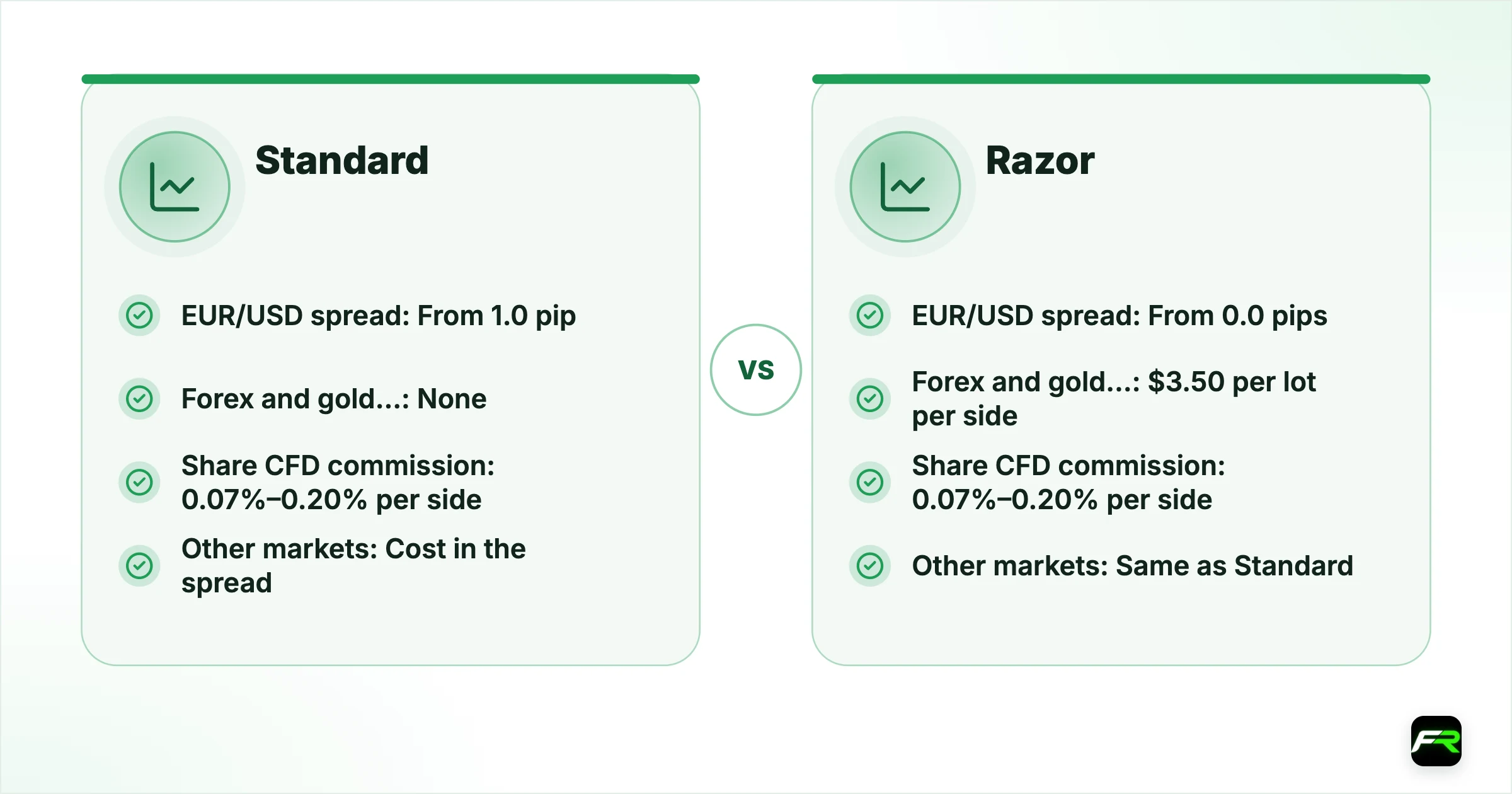
| Feature | Standard | Razor |
|---|---|---|
| EUR/USD spread | From 1.0 pip | From 0.0 pips |
| Forex and gold commission | None | $3.50 per lot per side (Pepperstone platform) |
| Share CFD commission | 0.07%–0.20% per side | 0.07%–0.20% per side |
| Other markets | Cost in the spread | Same as Standard |
| Platforms | Pepperstone platform, MT4, MT5, cTrader | Same, plus TradingView |
| Hedging | Allowed | Allowed |
| Pepperstone's suggestion | Beginners and simple pricing | Scalpers and high-volume traders |
Commission also depends on the platform. cTrader charges $6 per lot round turn and TradingView $7, while MT4 and MT5 commission depends on your account currency. On the Pepperstone platform it is $3.50 per side. Our Razor account guide works through the numbers.
Which one costs less?
Compare the two on one standard lot of EUR/USD at their minimum spreads. Standard costs 1.0 pip, which is $10. Razor costs 0.0 pips plus $7 commission, which is $7. At those minimums Razor is $3 a lot cheaper. In live markets both spreads float, so the gap moves, but the 1-pip mark-up on Standard stays.
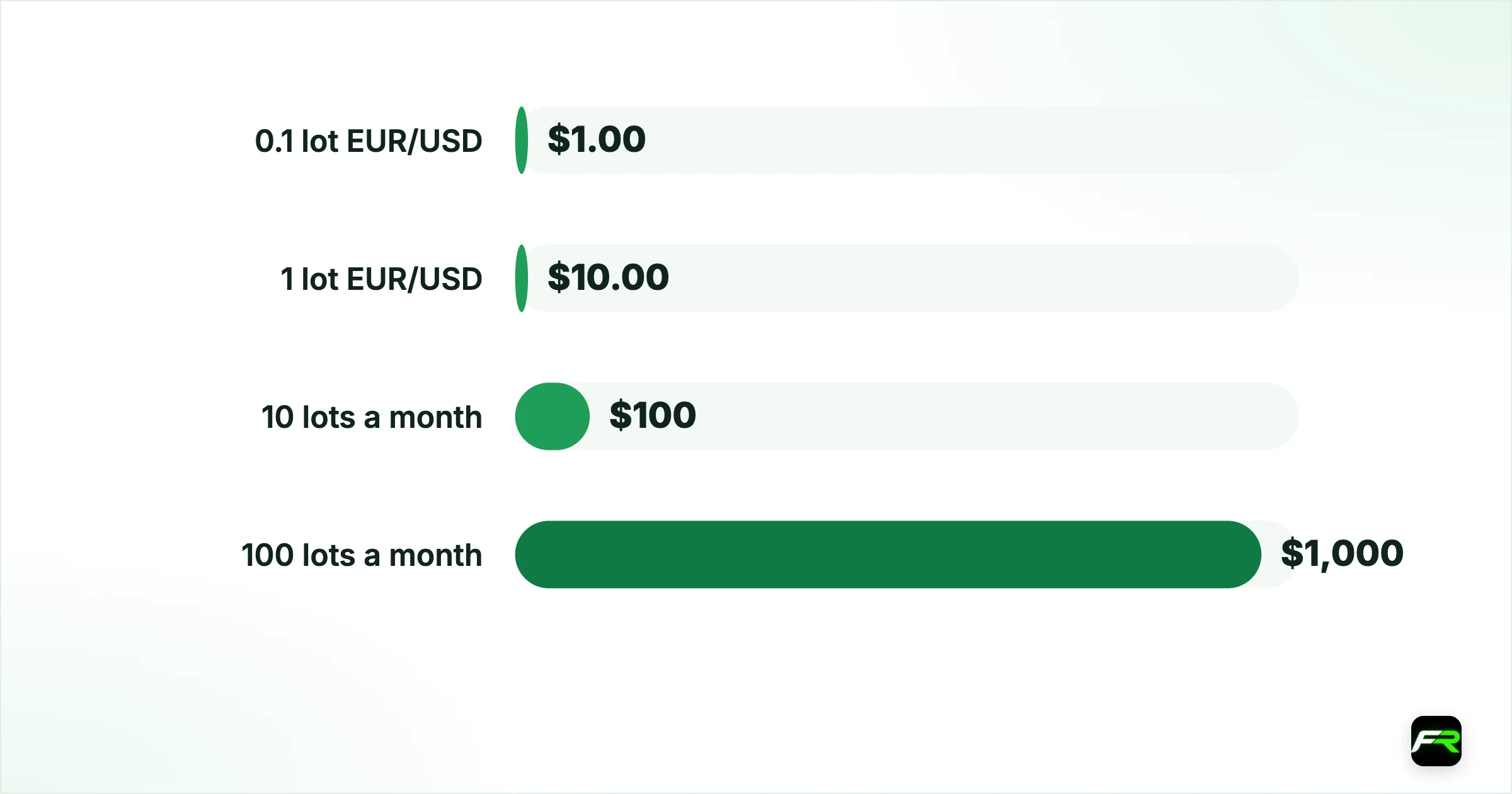
| Trade | Standard (1.0 pip) | Razor (0.0 + $7) |
|---|---|---|
| 0.1 lot EUR/USD | $1.00 | $0.70 |
| 1 lot EUR/USD | $10.00 | $7.00 |
| 10 lots a month | $100 | $70 |
| 100 lots a month | $1,000 | $700 |
These are minimum-spread examples from Pepperstone's own tables. Real spreads widen at the open, around news and in thin markets, and swaps are extra on positions held overnight.
On indices, commodities other than gold, crypto and ETFs, both accounts are priced the same way, so the choice matters only for forex and gold. A trader who mostly trades the US500 or oil gains nothing from Razor and might prefer Standard for its simpler statements.
Pepperstone Pro: a client status, not an account
Pepperstone Pro is a professional-client category. You self-certify in the client area and must meet two of three tests: experience trading leveraged products, cash and investments above USD 500,000, or work experience in financial services. Pro clients of the Bahamas company get leverage up to 1:1000 on forex and gold, and can join the active trader program for rebates.
Pro status removes protection as well as limits. Negative balance protection becomes discretionary and capped at USD 100,000, given once, and Pro clients may agree to title-transfer terms on their margin money. Apply only if you understand that trade-off.
Switching and opening more accounts
- You can hold a Standard and a Razor account at the same time under one profile.
- New accounts are added from the secure client area, choosing account type, platform and currency.
- Demo accounts come in both types, so you can test Razor pricing before funding it.
- Pepperstone's global site describes no swap-free live account, so ask support first if you need one.
Which account should you pick?
Choose Standard if you are new, trade small sizes or mostly trade indices and commodities. Choose Razor if you trade forex or gold often, scalp, use TradingView or simply want to see the raw market spread. Many traders open both and compare a week of real trades before committing.
For anyone trading forex more than a few times a week, Razor is the account to use. The commission is visible and the spread is honest, which makes your costs easy to track.
Kofi traded 20 lots of EUR/USD a month on Standard. Moving to Razor at the same sizes cut his minimum-spread cost from about $200 to about $140 a month before swaps, so he kept Standard only for index trades.
Frequently asked
What account types does Pepperstone offer?
Two live CFD accounts, Standard and Razor. Pepperstone Pro is a separate professional-client status.
Which Pepperstone account is best for beginners?
Pepperstone itself suggests the Standard account, because the cost is in the spread and there is no commission to work out.
Is Razor cheaper than Standard?
At minimum spreads, yes on forex and gold: about $7 a lot against $10 on EUR/USD. Other markets cost the same on both.
Can I use TradingView on a Standard account?
No. TradingView is available only with the Razor account.
Does Pepperstone have a cent or micro account?
No separate one, but both accounts accept trades from 0.01 lot.
Can I have both a Standard and a Razor account?
Yes. You can open several accounts under one client profile.
Related reading
The team behind this guide
Researched, checked and approved by five forex specialists
Every guide is written, fact-checked and edited before it goes live, and updated when the facts change. Spotted an error? Tell us.