IC Markets





































Pepperstone Copy Trading: CopyTrading by Pepperstone and cTrader Copy
Pepperstone offers copy trading through CopyTrading by Pepperstone on MT4 and MT5, and through cTrader Copy. There is no separate Pepperstone fee to copy, but providers may take a performance fee. Here is how it works and what to check before you copy anyone.
 WriterAbir KhanWriterWrites the guides · checks every figure against primary sources View profileAbout Abir →

 Market analysisTanbir Habib RiyadForex & Crypto AnalystForex and crypto analyst · technical and fundamental analysis View profileAbout Tanbir →

 Fact-checking & riskJannatul FerdaushFact-Checker & Risk AnalystFact-checks every figure · risk analysis · Applied Statistics, University of Dhaka View profileAbout Jannatul →

 Trading reviewJowel RanaCo-Founder & Forex TraderCo-founder · forex trader · reviews guides from a trader's view View profileAbout Jowel →

 Final approvalRanjan NiskrityFounder, Owner & Forex TraderFounder and owner · forex trader · signs off every guide View profileAbout Ranjan →

Copy trading lets you follow another trader automatically: when they open a position, a proportional one opens in your account, and when they close, yours closes too. Pepperstone offers two routes. CopyTrading by Pepperstone works through a linked MT4 or MT5 account, and cTrader Copy runs inside cTrader. Pepperstone notes that availability varies by region and by company.
Copying moves the trading decisions to someone else, but not the risk. Pepperstone's own guide puts it plainly: the financial outcome is yours either way, and most retail CFD accounts lose money, 79.6% at Pepperstone when the guide was written.
| Services | CopyTrading by Pepperstone (MT4/MT5), cTrader Copy |
|---|---|
| Pepperstone fee to copy | None |
| Provider fees | Often a performance fee, commonly 20% of profit |
| Minimum to copy | No extra minimum beyond the account's own |
| Minimum to become a provider | $500 |
| Demo | cTrader copy trading isn't available in demo mode |
The two copy services
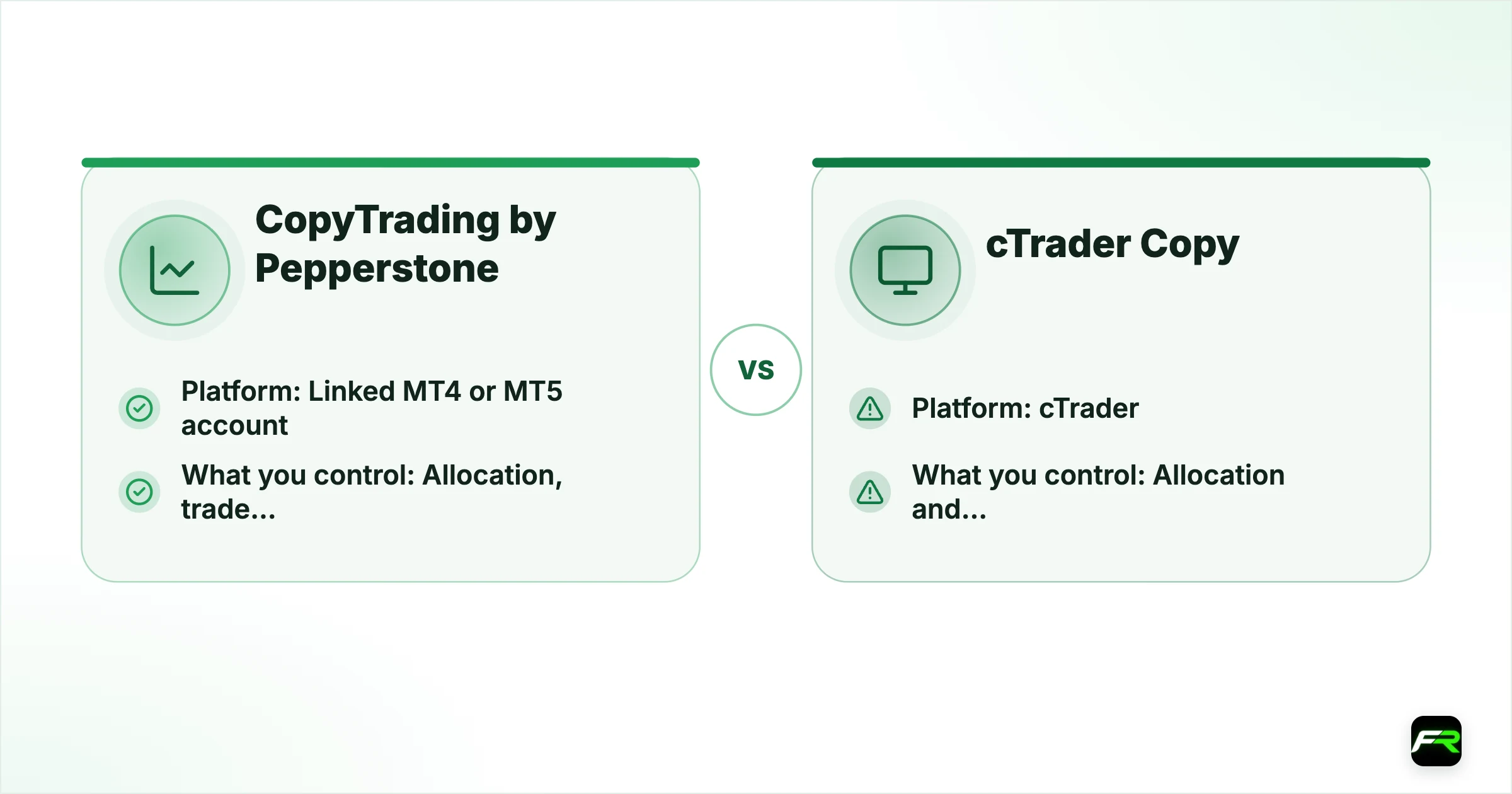
| Service | Platform | What you control |
|---|---|---|
| CopyTrading by Pepperstone | Linked MT4 or MT5 account | Allocation, trade sizing, maximum drawdown, stop losses |
| cTrader Copy | cTrader | Allocation and stop-copy levels inside cTrader |
In both, you browse provider profiles, look at their history and strategy, choose how much to allocate and set your own risk limits before you start copying.
What it costs
Pepperstone doesn't charge a separate platform fee for copying. What you pay depends on the provider: some charge nothing, others take a performance fee, a share of the profit their trades make in your account. Pepperstone's guide says 20% is common. No performance fee applies to a copied trade that loses.
You still pay normal trading costs on every copied trade, meaning spreads, commission on Razor and swaps. A provider who trades often on a Standard account can cost you more in spreads than you might expect. Our Pepperstone fees guide explains each one.
Pepperstone's copy trading terms say it doesn't calculate provider fees itself and relies on the figures in the copy service.
Sizing and risk settings
- Proportional sizing scales trades by your equity or balance against the provider's.
- Fixed sizing uses a set trade size you choose.
- Mirrored sizing copies the provider's exact trade size.
- A maximum drawdown limit stops copying automatically once it is reached.
- Your own stop losses work on top of anything the provider sets.
How to choose a provider
A headline return says little on its own. Two traders can post the same gain with very different risk: one with small, steady trades, the other with a few large, highly leveraged bets that happened to work. Look first at maximum drawdown, the largest fall from a peak, and at how long the record runs across different market conditions.
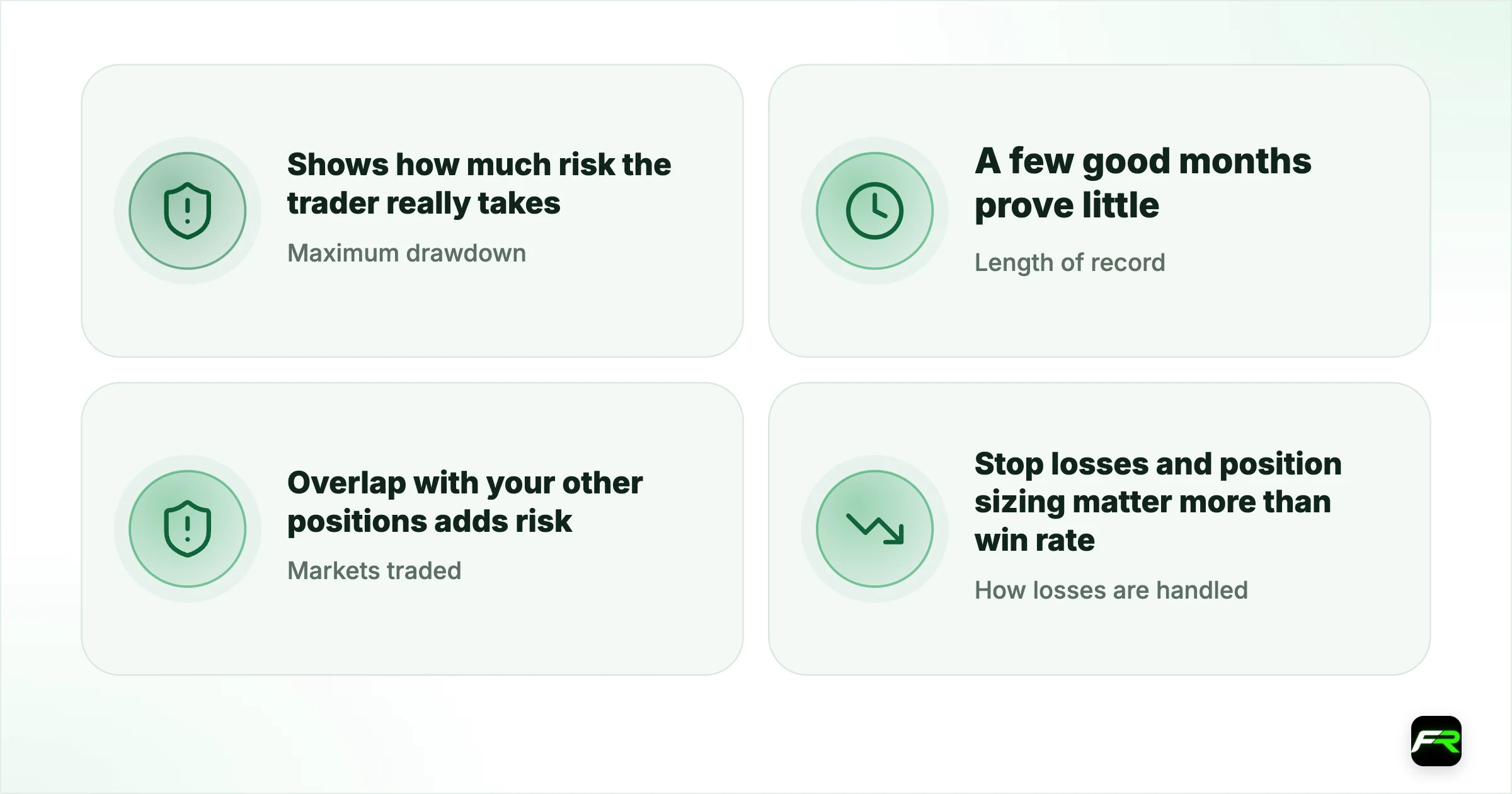
| Check | Why it matters |
|---|---|
| Maximum drawdown | Shows how much risk the trader really takes |
| Length of record | A few good months prove little |
| Markets traded | Overlap with your other positions adds risk |
| How losses are handled | Stop losses and position sizing matter more than win rate |
| Fee structure | A 20% performance fee changes your net return |
A high win rate can hide a dangerous strategy. A trader who wins eight trades out of ten but lets the other two run can still lose money overall.
Becoming a provider
If you would rather be copied, Pepperstone requires a minimum deposit of $500 to register as a signal provider. Providers set their own fee terms within the copy service's rules.
Getting started
- Open a live Pepperstone account on MT4, MT5 or cTrader.
- Link the account to CopyTrading by Pepperstone, or open cTrader Copy.
- Compare providers on drawdown, history and fees.
- Set a small allocation and a maximum drawdown before you copy.
- Review the provider's results monthly and stop if the style changes.
Treat copy trading as hiring someone with your money. Start small, cap the drawdown, and judge a provider on how they lose, not how they win.
Ahmed split $1,000 between two providers with different styles and set a 15% maximum drawdown on each. When one provider's account fell 15% in a volatile week, copying stopped automatically and he kept the other running.
Frequently asked
Does Pepperstone offer copy trading?
Yes, through CopyTrading by Pepperstone on linked MT4 or MT5 accounts and through cTrader Copy. Availability varies by region.
How much does Pepperstone copy trading cost?
Pepperstone charges no separate fee. Providers may take a performance fee, commonly 20% of profit, and normal trading costs apply.
Is there a minimum deposit for copy trading at Pepperstone?
No extra minimum beyond your trading account's own. Becoming a provider needs $500.
Can I copy trades on a Pepperstone demo account?
Pepperstone says copy trading on cTrader is restricted in demo mode.
Is copy trading safe?
It doesn't remove risk. You remain responsible for the losses copied trades make, so use small allocations and drawdown limits.
Related reading
The team behind this guide
Researched, checked and approved by five forex specialists
Every guide is written, fact-checked and edited before it goes live, and updated when the facts change. Spotted an error? Tell us.