IC Markets


































Is Forex Trading Legal in Pakistan?
No rulebook for retail forex isn't the same as permission. The SECP warns against unauthorised platforms, and you trade with no local protection.
 WriterAbir KhanWriterWrites the guides · checks every figure against primary sources View profileAbout Abir →
 Market analysisTanbir Habib RiyadForex & Crypto AnalystForex and crypto analyst · technical and fundamental analysis View profileAbout Tanbir →
 Fact-checking & riskJannatul FerdaushFact-Checker & Risk AnalystFact-checks every figure · risk analysis · Applied Statistics, University of Dhaka View profileAbout Jannatul →
 Trading reviewJowel RanaCo-Founder & Forex TraderCo-founder · forex trader · reviews guides from a trader's view View profileAbout Jowel →
 Final approvalRanjan NiskrityFounder, Owner & Forex TraderFounder and owner · forex trader · signs off every guide View profileAbout Ranjan →
Pakistan has no specific regulation for retail margin forex trading. The SECP regulates securities and the State Bank of Pakistan controls foreign exchange, but neither licenses a retail forex broker, and the SECP has issued public warnings about unauthorised online forex and “crypto” trading platforms. Trading is not expressly criminalised for an individual, but it is unregulated and unprotected, and the funding side runs straight into currency controls.
“No rule against it” and “allowed” are not the same thing. The absence of a framework means there is no licensed broker, no dispute process, and no one to appeal to if a withdrawal is refused. It also means the recovery-scam industry has a free run. These are people who contact you after a loss offering to get your money back for a fee, and there is no real authority for them to impersonate or for you to check them against. If it happens to you, that is a fraud complaint, not a forex complaint, report it to the National Cyber Crime Investigation Agency (NCCIA), which took over this role from the FIA’s former Cyber Crime Wing in 2025, not the original broker or platform. Our best forex brokers in Pakistan guide covers the firms with a verifiable licence and Easypaisa or JazzCash support.
The two authorities and what they cover
- State Bank of Pakistan: controls how foreign currency moves in and out of the country. A direct bank transfer abroad to fund a trading account runs into these rules and is usually declined.
- SECP: regulates the securities market. It has repeatedly cautioned the public that online forex and crypto trading platforms operating in Pakistan are not authorised by it, and that people should be wary of schemes promising high returns.
Neither authority has built a licensing regime for the product. So the brokers Pakistani traders use are all regulated abroad, by bodies such as ASIC, CySEC, FSCA in South Africa or FSA in Seychelles. The strength of that foreign licence is the only thing standing between you and a bad outcome, which makes it the first thing to check.
Funding is the real obstacle
Because a direct transfer abroad for forex will usually be blocked, Pakistani traders fund accounts with Easypaisa or JazzCash to a broker’s payment partner, through local bank transfer via a processor, or with USDT bought locally. Each route adds a fee and a step you may need to explain later. Deposits through mobile money are typically instant. Withdrawals are the slow part, often taking a week or more, and usually you must withdraw to the exact method you deposited with.
Bilal funded a small account with an FSA-regulated broker through JazzCash. Deposits landed in seconds. His first withdrawal, about PKR 30,000, took nine days and two rounds of document requests, because the broker’s payment partner needed to match his wallet to his ID. He now keeps screenshots of every transaction, only withdraws to the exact method he deposited with, and does not keep more in the account than he is willing to wait a fortnight for.
If you trade anyway
- Use a broker with a licence you can verify on the regulator’s own website.
- Deposit small and test a withdrawal before adding more.
- Keep every deposit and withdrawal record, matched to your own name and CNIC.
- Avoid anyone offering to trade for you or promising a monthly return. That is where the losses concentrate, and it is what the SECP warns about, see our scam broker list for the patterns they share.
Tax
Trading gains are declarable to the FBR as income for a resident. The offshore broker will not withhold anything or report anything for you, so the record-keeping is entirely your responsibility. Our Pakistan tax guide covers how to treat it in a return and how it interacts with your filer status.
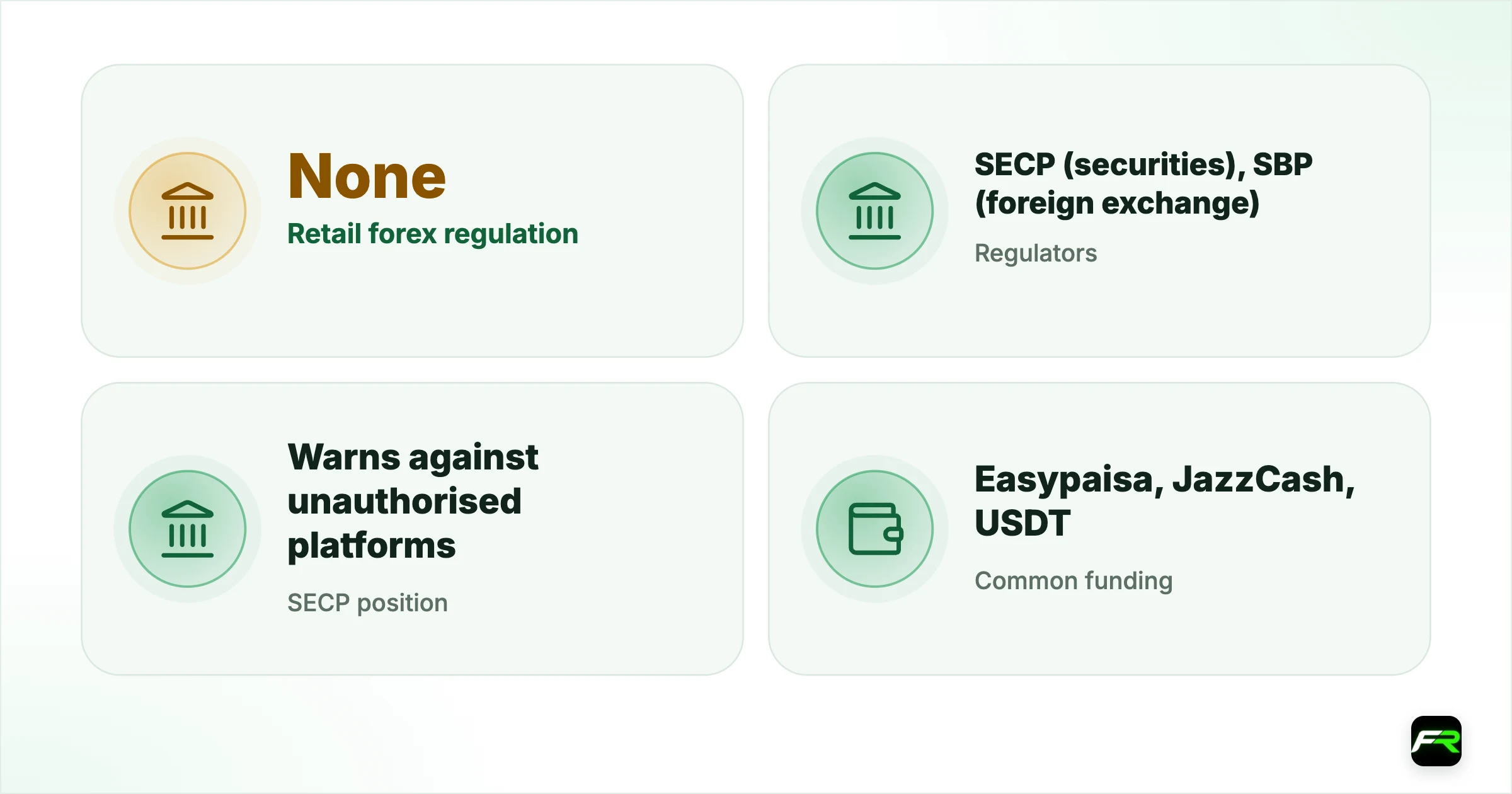
| Retail forex regulation | None |
|---|---|
| Regulators | SECP (securities), SBP (foreign exchange) |
| SECP position | Warns against unauthorised platforms |
| Common funding | Easypaisa, JazzCash, USDT |
| Withdrawal speed | Often a week or more |
| Local recourse | None |
What trading costs from Pakistan
The spread and commission on a trade are the same for you as for anyone. The costs that are specific to trading from Pakistan are the currency conversion and the payment friction, and they are easy to underestimate.
Say you fund PKR 25,000 through JazzCash. The broker’s payment partner takes a cut of 1 to 2%, then your rupees are converted to USD at the broker’s rate, which is usually 0.5 to 1% worse than the interbank rate. So before you place a single trade you are down roughly PKR 400 to 750. The same conversion spread applies when you withdraw. Do that cycle a few times a month and the drag on a small account is real.
- Payment partner fee on mobile-money deposits: roughly 1–2%.
- Broker PKR-to-USD conversion: roughly 0.5–1% each way.
- Withdrawal delays: budget a week or more, and only to the method you deposited with.
None of this makes trading impossible. It does mean that churning deposits and withdrawals is expensive, and that keeping a stable balance you top up rarely costs less than moving money back and forth.
A local office, an Urdu-language site and a WhatsApp support number do not make a broker legitimate. The licence does. Check it on the regulator’s website, not on the broker’s.
Frequently asked
Is forex trading banned in Pakistan?
It is not expressly banned for individuals, but there is no regulation for it, the SECP warns against unauthorised platforms, and moving money to fund an account runs into State Bank foreign-exchange controls.
Which broker can I use from Pakistan?
One regulated by a recognised authority such as ASIC, CySEC or the FSA, with a verifiable licence number, that supports Easypaisa or JazzCash, and that pays a test withdrawal without excessive friction.
Can I fund a forex account with JazzCash or Easypaisa?
Many brokers serving the region support them through payment partners. Deposits are usually instant; withdrawals can take days and normally require you to withdraw to the same method you deposited with.
Do I have to pay tax on forex profits in Pakistan?
Yes. Trading gains are declarable to the FBR as income. The offshore broker withholds and reports nothing, so keeping the records is on you.
Has the SECP banned any forex brokers?
The SECP has issued public cautions naming the risk of unauthorised online forex and crypto platforms rather than a formal ban, because it does not license the activity in the first place.
Someone contacted me offering to recover my lost forex money, is that legitimate?
Almost certainly not. Genuine regulators do not cold-contact individual traders to offer fund recovery for a fee, and neither does a legitimate broker’s real support team. This is the recovery-scam model described above, usually targeting people who already lost money once. Do not pay an upfront fee or share account access, and report the approach to the NCCIA instead of engaging with it.
The team behind this guide
Researched, checked and approved by five forex specialists
Every guide is written, fact-checked and edited before it goes live, and updated when the facts change. Spotted an error? Tell us.