IC Markets





































Forex Trading Tax in Pakistan
Trading gains are declarable to the FBR as income. Nothing is withheld for you, filer status matters for your banking, and the record-keeping is entirely on you.
 WriterAbir KhanWriterWrites the guides · checks every figure against primary sources View profileAbout Abir →
 Market analysisTanbir Habib RiyadForex & Crypto AnalystForex and crypto analyst · technical and fundamental analysis View profileAbout Tanbir →
 Fact-checking & riskJannatul FerdaushFact-Checker & Risk AnalystFact-checks every figure · risk analysis · Applied Statistics, University of Dhaka View profileAbout Jannatul →
 Trading reviewJowel RanaCo-Founder & Forex TraderCo-founder · forex trader · reviews guides from a trader's view View profileAbout Jowel →
 Final approvalRanjan NiskrityFounder, Owner & Forex TraderFounder and owner · forex trader · signs off every guide View profileAbout Ranjan →
Key takeaways
- Forex profit is income for a Pakistani resident and must be declared to the FBR on your annual return.
- It is reported as income from other sources or, if frequent, as business income under Section 18.
- The Section 37A capital-gains regime covers PSX-listed securities, not offshore forex or CFD gains.
- Offshore brokers withhold nothing, but banks may report account data under the OECD's Common Reporting Standard.
For a Pakistani resident, profit from forex trading is income and is declarable to the FBR on your annual return. There is no separate framework for it, no withholding by the offshore broker, and no reporting to Pakistani authorities from the broker’s side directly, though Pakistan participates in the OECD's Common Reporting Standard (CRS), so the bank or payment institution on the other end of a transfer may separately report account information to the FBR even though the broker itself does not. Either way, what appears on your return is whatever you put there.
This is a general overview, not tax advice. Tax rules change, they depend on your personal circumstances, and the treatment of offshore trading is an area where enforcement and interpretation both evolve. Speak to a qualified local accountant before you file, ideally before you have a large gain to explain.
How it is treated
The Income Tax Ordinance, 2001 does not name forex or CFD trading specifically, so classification is a facts-and-circumstances question rather than a fixed rule. In practice, gains are typically reported either under "income from other sources" for occasional trading, or as business income under Section 18 if the activity is frequent enough to look like your livelihood, on the consolidated annual return filed through the FBR's IRIS portal. Which classification fits depends on scale, and an accountant familiar with the FBR’s current approach can advise. Either way, the profit is added to your other income for the year.
Pakistani tax law does have a distinct capital-gains regime (Section 37A), but it is defined narrowly around securities listed or registered on the Pakistan Stock Exchange, shares, mutual fund units, debt securities and similar. Offshore retail forex or CFD gains do not fit that definition and are very unlikely to qualify for capital-gains treatment as an alternative to being taxed as income; treat that route as effectively unavailable rather than a live option worth pursuing.
If you funded the account through crypto, buying USDT locally and sending it to the broker, the purchase and disposal of that USDT may also have tax implications, separate from the trading result, crypto tax treatment in Pakistan has been an evolving area (current as of 2026), so confirm the latest position with an accountant rather than assuming last year's rule still applies. Keep those records too.
Filer status and your bank
Pakistan’s tax system distinguishes “filers” (those on the Active Taxpayers List) from “non-filers”, and the practical consequences fall on banking and withholding rates. Non-filers face higher withholding on many transactions and more friction moving money. Since funding a forex account already involves scrutinised payment channels, being on the Active Taxpayers List with a clean return makes the whole activity less fraught, quite apart from the legal obligation to declare.
Usman traded a small offshore account for a year and did not declare the profit, reasoning that the amounts were small and the activity unregulated. When he later tried to move a larger withdrawal through his bank, the transaction was flagged and he was asked for the source of funds. Having no reported trading income and no filed return made that conversation much harder than it needed to be. He now files, reports the trading profit, and keeps every statement.
Tax compliance vs. broker legality
Everything above is about how trading profit is taxed once you have it. It is a separate question from whether the broker you used is authorised to deal with Pakistani residents in the first place, which sits with the SECP (capital markets) and the State Bank of Pakistan (foreign-exchange controls), not the FBR. The SECP does not licence retail offshore forex/CFD brokers, which makes the legal status of that broker relationship genuinely unsettled rather than clearly permitted or clearly banned. Filing and paying tax on the profit is still the right move regardless, since undeclared income is its own separate risk, but it does not resolve this second question.
Where to find current annual rate schedules
Pakistan's income-tax slab rates and thresholds are set annually through the Finance Act and can change from one budget to the next. Rather than relying on a figure from an older article, check the current schedule directly on the FBR's own website (fbr.gov.pk) or confirm the applicable rates with an accountant when you file, since a rate that was correct last year may not be this year.
How to self-assess your trading status
Since the Ordinance does not name forex specifically, ask yourself the same questions an accountant would: how often do you trade, is it systematic with a defined method and records, how much time and capital does it take relative to your other income, and is it effectively your livelihood or a side activity around a job. Frequent, systematic, income-replacing activity points toward business income; occasional trading around a salaried job points toward other-source income. When genuinely unsure, the more conservative classification, and a conversation with an accountant before you file, costs less than a dispute with the FBR later.
Record-keeping
- Monthly net trading profit or loss from platform statements.
- Every Easypaisa, JazzCash or bank deposit and withdrawal, with dates and rupee amounts, matched to your CNIC.
- Any USDT purchase and sale records, if you funded through crypto.
- Your filed returns and the FBR acknowledgement for each year.
A worked example
Suppose you are salaried, already filing as a taxpayer, and you make a net forex profit of PKR 400,000 over the year. That amount is added to your taxable income and taxed at the slab rate that applies to the incremental band you fall into. If the trading were large and systematic enough to be treated as a business, the profit would be computed as business income, broadly receipts less allowable expenses, but for a modest side account it is usually simplest to include the net figure as income. Either way, there is no lower “trading” rate; it is taxed like any other income you earn.
If you also bought and sold USDT to move money, keep those records separately. A gain between buying USDT and converting it back can be a taxable event of its own, and the FBR has been paying more attention to crypto flows.
The banking angle is the real pressure
In practice, the tax return matters less for the FBR’s sake than for your bank’s. Pakistani banks scrutinise inbound transfers, especially larger ones and those from payment processors. If a withdrawal is flagged and you are asked for the source of funds, a filed return that already includes your trading income turns an awkward inquiry into a formality. Without one, you are explaining an unreported foreign income stream after the fact, which is a much worse position to be in than simply having disclosed it.
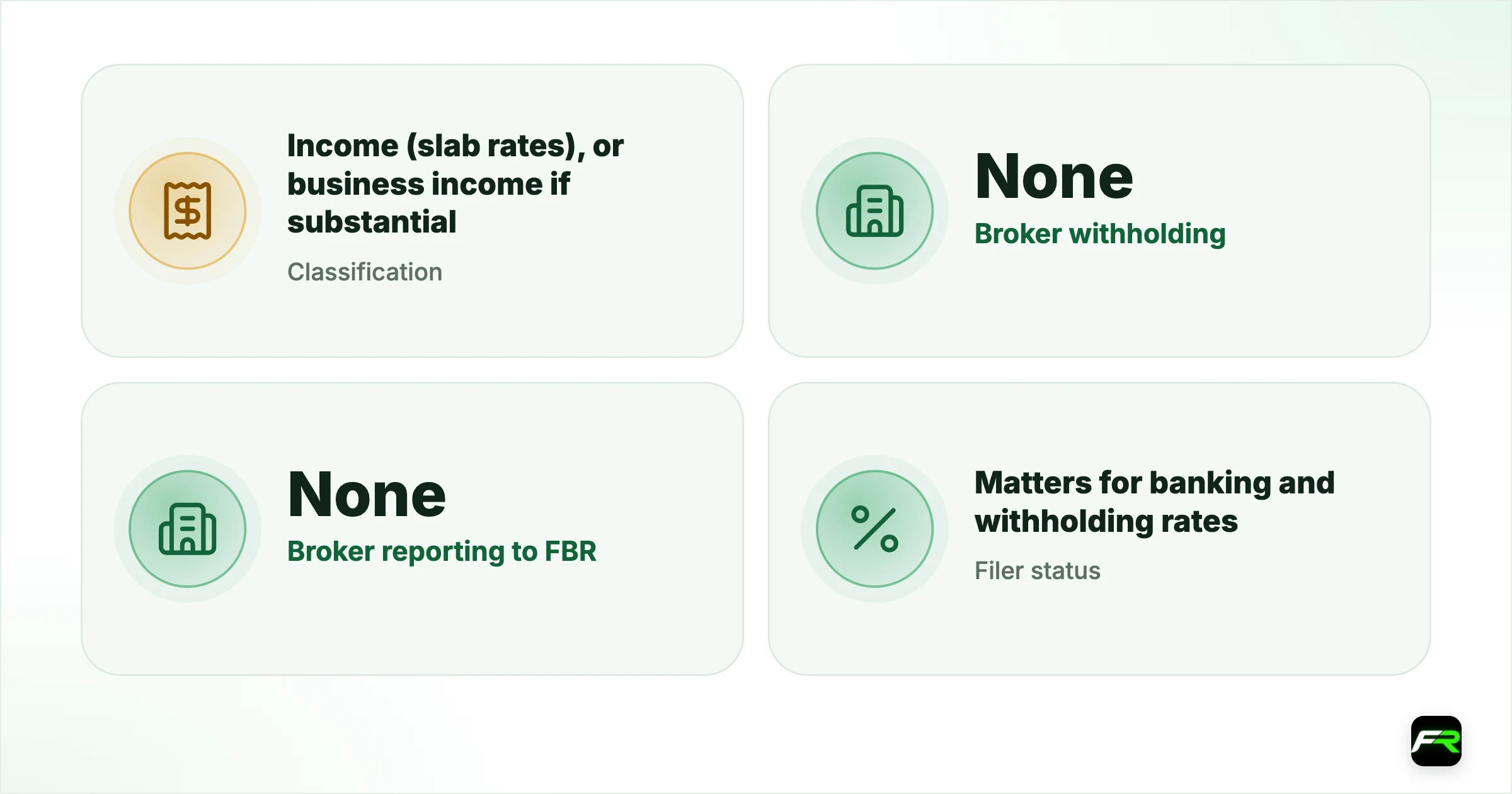
| Classification | Income (slab rates), or business income if substantial |
|---|---|
| Broker withholding | None |
| Broker reporting to FBR | None |
| Filer status | Matters for banking and withholding rates |
| Crypto funding | USDT purchase and disposal may have separate implications |
Undeclared trading income becomes a problem the moment a bank flags a withdrawal and asks for the source of funds. A filed return that includes the trading profit turns that conversation into a formality.
Comparing rules across the region, or funding an account for the first time? See the same question for the Philippines, India, how to spot a fake forex broker.
Sources and where to check it yourself
- Federal Board of Revenue: income tax rules, forms and circulars
- FBR IRIS portal: where the annual return is filed
For the rules and brokers that apply where you live, see our guide to forex brokers in Pakistan.
Frequently asked
Do I have to pay tax on forex trading in Pakistan?
Yes. Trading gains are income and are declarable to the FBR on your annual return, taxed at your slab rates or as business income if the activity is substantial. Nothing is withheld or reported for you by the offshore broker.
How much tax will I pay on forex profits?
It depends on your total income. Trading profit is added to your other income and taxed at the applicable slab rate. There is no separate flat rate for it.
Does the offshore broker report my trading to the FBR?
No. Offshore brokers do not report to Pakistani authorities. Your return reflects only what you declare, which is a legal obligation regardless.
Why does filer status matter for a forex trader?
Non-filers face higher withholding and more friction on banking transactions. Since funding a forex account already runs through scrutinised channels, being a registered filer with a clean return makes the activity much smoother.
Is USDT used to fund my account taxable separately?
Potentially. The purchase and disposal of USDT may have its own tax implications, separate from the trading result. Keep those records and ask an accountant.
What if my bank asks about the source of a withdrawal?
A filed return that includes your trading income, plus deposit and withdrawal records matched to your CNIC, makes that a straightforward answer. Without them, a flagged transaction is much harder to resolve.
Do I pay tax if I only withdraw my original deposit?
Returning your own capital is not income and is not taxed. Only the gain above what you put in is taxable. Deposit and withdrawal records are what let you show the split if asked.
Should I register the trading as a business with the FBR?
For a small side account, most traders include the net profit as income without a separate business registration. If trading is substantial and systematic, business treatment and its record-keeping may apply. An accountant can tell you which side of that line you are on.
The team behind this guide
Researched, checked and approved by five forex specialists
Every guide is written, fact-checked and edited before it goes live, and updated when the facts change. Spotted an error? Tell us.