IC Markets




































How to Deposit to a Forex Broker from Indonesia
Local bank transfer is what almost everyone uses, and it is usually free. Here is the flow step by step, the real cost, and the mistakes that get withdrawals stuck.
 WriterAbir KhanWriterWrites the guides · checks every figure against primary sources View profileAbout Abir →
 Market analysisTanbir Habib RiyadForex & Crypto AnalystForex and crypto analyst · technical and fundamental analysis View profileAbout Tanbir →
 Fact-checking & riskJannatul FerdaushFact-Checker & Risk AnalystFact-checks every figure · risk analysis · Applied Statistics, University of Dhaka View profileAbout Jannatul →
 Trading reviewJowel RanaCo-Founder & Forex TraderCo-founder · forex trader · reviews guides from a trader's view View profileAbout Jowel →
 Final approvalRanjan NiskrityFounder, Owner & Forex TraderFounder and owner · forex trader · signs off every guide View profileAbout Ranjan →
Key takeaways
- Indonesian traders fund accounts by local transfer (BCA, Mandiri, BNI, BRI) through a Bank Indonesia-licensed payment company.
- Deposits usually arrive within 10 to 60 minutes; start with Rp 100,000 to 200,000 as a test.
- Conversion costs about 0.3% to 0.8% each way, so a Rp 1,000,000 round trip costs under Rp 20,000.
- The bank account name must match your trading account exactly, or withdrawals will be blocked.
For traders in Indonesia, the standard way money goes in and out of a broker is local bank transfer: BCA, Mandiri, BNI or BRI. The broker works with an Indonesian payment company licensed by Bank Indonesia, so you are really sending rupiah to a domestic bank account, not wiring money overseas. It is fast, it is usually free, and it is the method most withdrawal problems can be traced back to when something goes wrong. Our best forex brokers in Indonesia guide covers which firms support it and the rest of the setup.
The flow, step by step
- In the broker’s deposit page, choose local bank transfer (IDR).
- Enter the amount in rupiah. The broker shows you the USD your account will be credited with, at its own rate.
- You are given a virtual account number, or transfer instructions naming a specific bank and reference.
- Transfer from your mobile banking app to that virtual account, using the reference exactly as shown.
- The money usually reaches your trading balance within 10 to 60 minutes. Some brokers credit instantly; a few take a few hours.
Make your first deposit small, around Rp 100,000 to 200,000. You want to see the money arrive, and confirm the account name on the broker’s side matches your bank account name, before you send anything real.
What it costs
- Deposit fee: usually zero on local transfer. Your own bank might charge a small inter-bank fee of Rp 2,500 to 6,500 if the virtual account is at a different bank.
- Conversion: your rupiah is converted to USD at the broker’s rate, which is typically 0.3 to 0.8% worse than the mid-market rate. On Rp 1,000,000 that gap is roughly Rp 3,000 to 8,000. It applies again, in the other direction, when you withdraw.
So the round-trip cost of putting Rp 1,000,000 in and taking it back out is usually under Rp 20,000, plus any bank fees. Small on a single cycle, but if your strategy involves moving money in and out weekly to “lock in” profits, the conversion spread quietly becomes one of your largest costs over a year.
Withdrawing your own capital back to your bank is not itself a taxable event, but any trading profit is taxable income for an Indonesian resident, added to your other income at the country’s progressive personal rates and declared yourself on your annual SPT Tahunan return, there is no separate lower rate for trading gains and no exemption for using an offshore broker. Our Indonesia tax guide covers the rates and what records to keep in full.
Rian deposited Rp 300,000 via BCA to a broker’s virtual account. He was credited USD 18.40; the mid-market value at the time was about USD 19.05, so the conversion cost him roughly Rp 10,000. Two weeks later he withdrew USD 25, which landed back in his BCA account in about three hours with no fee. His takeaway: the transfer itself is basically free, the cost is the exchange rate, and it is charged both ways.
Where deposits and withdrawals go wrong
Name mismatch
The name on your bank account must match the name on your trading account exactly. Brokers block withdrawals to a different name because it is an anti-money-laundering requirement, not because they are being difficult. If you opened the trading account with a nickname or a different spelling, fix it before you try to withdraw.
Expired virtual account or wrong reference
Transfer instructions often expire after 30 to 60 minutes, and the reference code matters. If you are slow, or you leave the reference out, the payment can bounce or sit unmatched for days. Generate a fresh deposit request rather than sending to an old virtual account number.
Withdrawing to a method you did not deposit with
Most brokers make you withdraw your original deposit back to the same bank first. Only profit above that amount can sometimes go elsewhere. Plan your withdrawal method at the point you deposit, not later.
E-wallets
Some brokers also accept DANA or OVO. These are convenient for small top-ups but sometimes carry a small percentage fee, and withdrawals must usually return to the same wallet. Bank transfer is the cheaper default.
How much to move, and how often
A pattern worth adopting early: fund the account once with a sensible amount, trade it, and withdraw profit on a schedule rather than reacting to every green week. Every deposit and every withdrawal costs you the conversion spread both ways, so a trader who moves money in and out four times a month is paying that spread eight times, on top of any bank fees. Over a year that can quietly exceed what they lose on their worst trade.
It also matters for withdrawal reliability. Brokers flag frequent small in-and-out movements as unusual, and a first-time large withdrawal after months of tiny ones gets a closer look than a steady monthly withdrawal of a consistent amount. Predictable behaviour clears faster. If your plan involves “locking in” profit constantly, reconsider whether that habit is helping your trading or just your anxiety.
For most Indonesian traders starting out, a working balance of Rp 500,000 to Rp 2,000,000, topped up when it runs low and drawn down monthly, is a reasonable rhythm. It keeps the conversion drag small and the account behaviour clean.
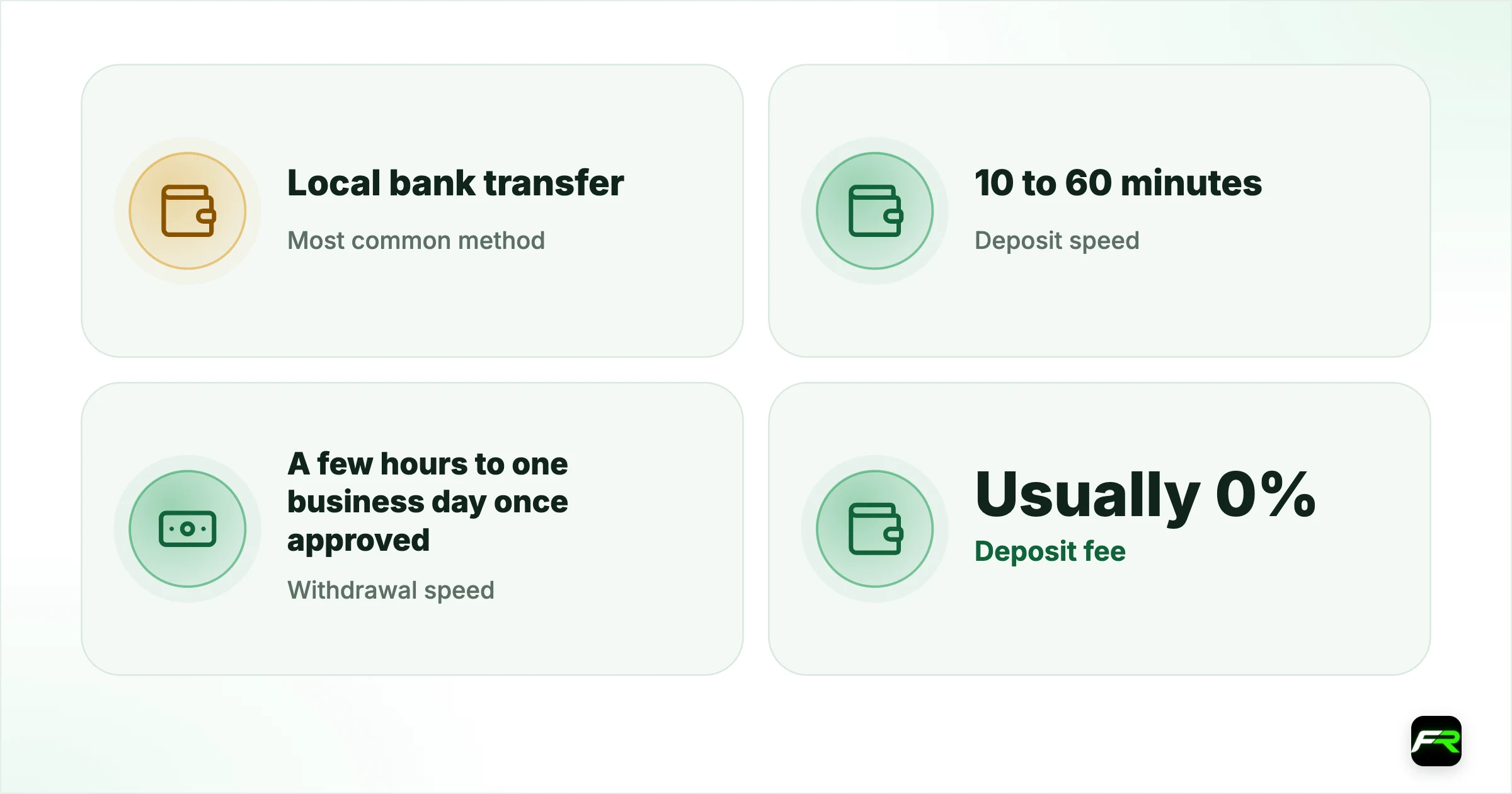
| Most common method | Local bank transfer (BCA, Mandiri, BNI, BRI) |
|---|---|
| Deposit speed | 10 to 60 minutes |
| Withdrawal speed | A few hours to one business day once approved |
| Deposit fee | Usually 0%; your bank may charge Rp 2,500–6,500 |
| Real cost | IDR-to-USD conversion spread, both directions |
| Biggest pitfall | Name mismatch between bank and trading account |
Never transfer to a personal rekening given to you by a “mentor” or “fund manager”. A real deposit only ever happens through the broker’s own deposit page, to a virtual account the broker generated for you.
Frequently asked
Which Indonesian banks work for forex deposits?
BCA, Mandiri, BNI and BRI are the ones brokers serving Southeast Asia support most often, through a local payment partner. Some also accept DANA and OVO e-wallets.
How long do withdrawals to an Indonesian bank take?
Once the broker approves the request, funds typically reach a local bank the same day, often within a few hours. The broker’s internal processing time is the main variable, not the bank.
Is there a fee to deposit rupiah to a forex broker?
Local bank transfer is usually free on the broker’s side. Your own bank may charge a small inter-bank fee if the virtual account is at a different bank. The unavoidable cost is the IDR-to-USD conversion, applied both ways.
Why was my forex deposit not credited?
The most common causes are an expired virtual account, a missing or wrong reference code, or a transfer sent after the instructions timed out. Generate a fresh deposit request and include the reference exactly as shown.
Can I withdraw to a different bank than I deposited from?
Usually not for your original deposit amount, which must return to the source. Profit above that can sometimes go to another account. Decide your withdrawal route when you deposit.
Is there tax on money I withdraw from a forex broker in Indonesia?
Bringing your own capital back is not a taxable event by itself, but trading profits are taxable income for residents. Keep records of every deposit and withdrawal.
The team behind this guide
Researched, checked and approved by five forex specialists
Every guide is written, fact-checked and edited before it goes live, and updated when the facts change. Spotted an error? Tell us.