IC Markets




































USDT and Crypto Deposits for Asian Forex Traders
Stablecoin funding sidesteps blocked bank transfers, which is why it is popular where currency controls bite. It also adds risks the bank route does not have. Here is the honest trade-off.
 WriterAbir KhanWriterWrites the guides · checks every figure against primary sources View profileAbout Abir →
 Market analysisTanbir Habib RiyadForex & Crypto AnalystForex and crypto analyst · technical and fundamental analysis View profileAbout Tanbir →
 Fact-checking & riskJannatul FerdaushFact-Checker & Risk AnalystFact-checks every figure · risk analysis · Applied Statistics, University of Dhaka View profileAbout Jannatul →
 Trading reviewJowel RanaCo-Founder & Forex TraderCo-founder · forex trader · reviews guides from a trader's view View profileAbout Jowel →
 Final approvalRanjan NiskrityFounder, Owner & Forex TraderFounder and owner · forex trader · signs off every guide View profileAbout Ranjan →
In countries where a bank transfer for forex gets declined, such as India, Pakistan, Bangladesh and Sri Lanka, funding a broker with USDT has become common. It works, and sometimes it is the only thing that does. But “it works” and “it is the safe option” are different claims, and the marketing tends to blur them.
Why traders use it
- Bank transfers for forex are blocked or questioned; USDT is not seen by your bank as a forex transfer.
- Deposits and withdrawals are fast once you are set up, in minutes rather than days.
- It works around currency-control limits on outward remittance.
The risks the bank route does not have
Price risk in transit
USDT is meant to hold a 1:1 peg to the dollar, and mostly it does, but the peg has wobbled before, and the local price you pay to buy it can sit above the true rate. Between buying USDT and it landing in your trading account, you carry that risk.
Tax treatment if USDT’s price moves before you deposit
Because USDT is a crypto asset, not cash, some tax authorities treat any gain between when you bought it and when you spend or convert it as a disposal, even if the amount is a fraction of a cent from the peg holding steady. In practice the numbers involved are usually too small to matter, but if you buy USDT in bulk, hold it for a while, and the peg moves in your favour before you deposit, that gain can technically be a taxable event depending on your country’s crypto tax rules. This is separate from, and in addition to, any question about whether the trading activity itself is permitted. Keep the purchase price and date alongside your other records if your local rules tax crypto disposals, and check with a local tax adviser rather than assuming stablecoin movements are automatically exempt.
Network mistakes are final
Send USDT on the wrong network (TRC-20 vs ERC-20 vs BEP-20), or to a slightly wrong address, and the money is gone. There is no bank to call, no reversal, no dispute. Copy the address, check the network the broker specified, and send a tiny test amount first.
Buying and selling spreads
You pay a spread buying USDT locally, and another selling it when you withdraw. On a P2P exchange in a country with capital controls, that spread can be several percent, which is far more than the 0.5 to 1% a bank conversion costs.
Counterparty risk on the purchase
If you buy USDT from a local P2P seller or a Telegram contact rather than an established exchange, the seller is a counterparty who can not deliver. This is a real and common way people lose money before the broker is even involved.
AML reporting thresholds on larger P2P trades
Exchanges and P2P platforms are not exempt from anti-money-laundering rules just because the asset is a stablecoin. Most apply enhanced verification once a single trade or your cumulative volume crosses a threshold, commonly in the range of a few thousand dollars, and international guidance under the FATF “Travel Rule” expects exchanges to collect and share sender and receiver information above a much lower threshold, often around $1,000. Expect to supply source-of-funds information for a larger deposit, and do not assume a big P2P trade will move as quietly as a small one; splitting a large deposit into many small trades to avoid this is itself a pattern that can get an account flagged.
Kavya funded a broker with USDT after her bank blocked a card payment. The deposit worked. When she withdrew, the broker sent USDT back, she sold it on a P2P exchange, and between the buy spread, the sell spread and a slightly off-peg local price, she calculated the round trip had cost her about 4.5%, against roughly 1.5% each way she would have paid on a bank conversion. The convenience was real, and so was the cost.
Where USDT genuinely makes sense
Strip out the hype and there is a real case for USDT in a narrow set of situations. If you are in a country where a bank transfer for forex is reliably declined, and the alternative is not trading at all, then USDT bought from a reputable exchange and sent directly to the broker is a reasonable choice, made with open eyes about the cost. It is also defensible if you already hold crypto for other reasons and moving some to a broker is a small step.
Where it does not make sense is as a default in a country where local bank transfer or an e-wallet works fine. Traders in Indonesia, the Philippines, Malaysia and Thailand who use USDT “because it is faster” are usually giving up a meaningful chunk of their deposit in spreads to save a day, and taking on irreversible-transfer risk they did not need. Match the method to the constraint: use USDT when the bank route is closed, not when it is merely slightly slower.
If you use it, do it carefully
- Buy USDT on a reputable, well-known exchange, not from a random seller.
- Confirm the exact network the broker wants (usually TRC-20 for low fees).
- Send a small test amount, confirm it arrives, then send the rest.
- Withdraw to a wallet you control, then sell there. Do not let the broker convert to your local currency at a rate you cannot check.
- Keep records: the buy, the transfer hash, the deposit confirmation, the withdrawal, the sell.
Crypto deposits do not make an unregulated broker safe, and they do not make trading legal where it is restricted. They change how the money moves, nothing else.
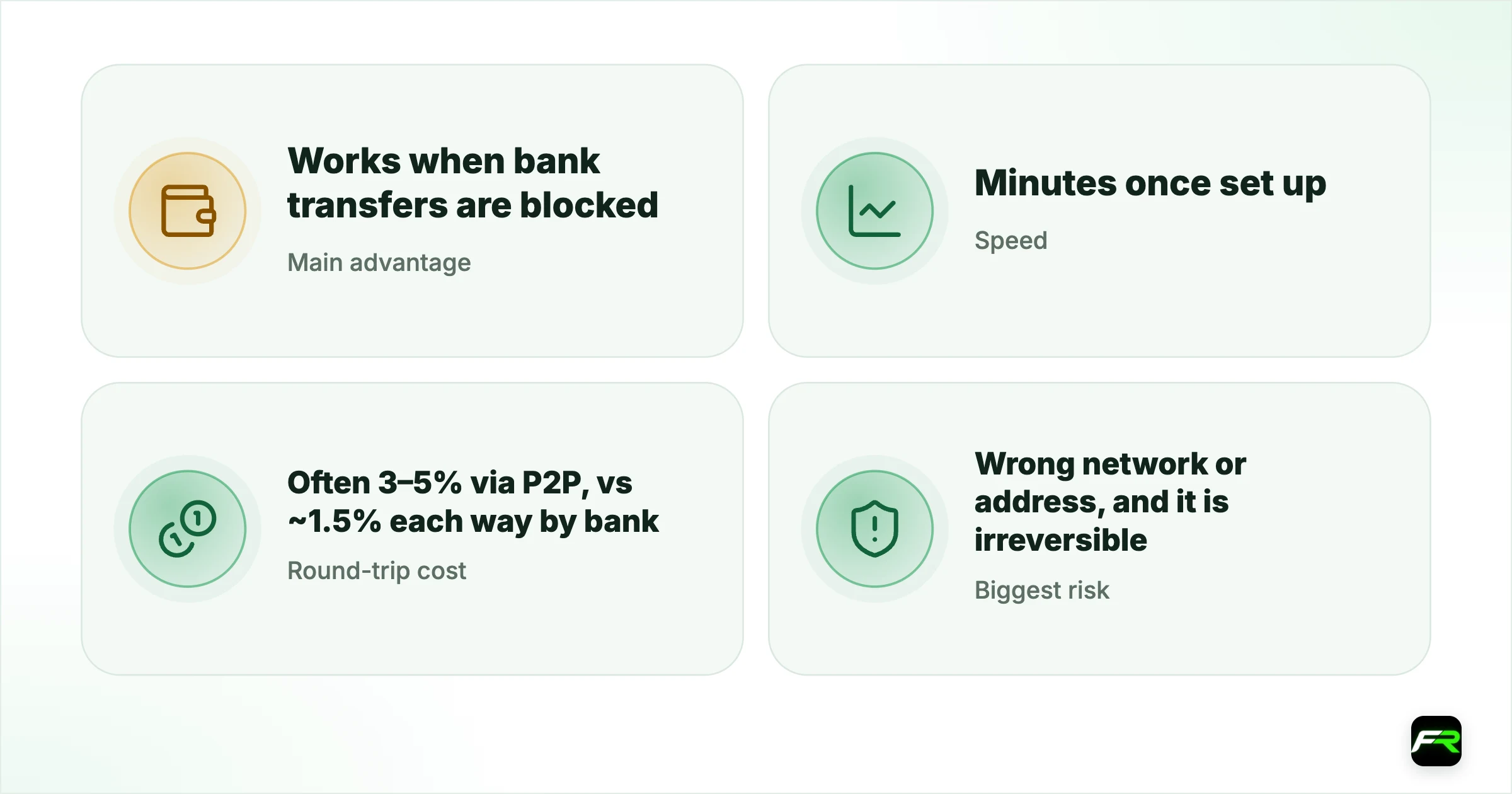
| Main advantage | Works when bank transfers are blocked |
|---|---|
| Speed | Minutes once set up |
| Round-trip cost | Often 3–5% via P2P, vs ~1.5% each way by bank |
| Biggest risk | Wrong network or address, and it is irreversible |
| Second risk | Counterparty when buying USDT locally |
Never send crypto to a deposit address from a message, an email or an ad. Log into the broker directly and generate the address there, and send a test amount first.
Frequently asked
Is it safe to fund a forex broker with USDT?
The transfer mechanism is fine if you get the network and address right. The risks are price movement in transit, irreversible mistakes, wide P2P spreads, and counterparty risk when buying USDT locally. It is a different risk set, not a safer one.
Which network should I use for USDT deposits?
Use the network the broker specifies, which is usually TRC-20 (Tron) for low fees. Sending on the wrong network can lose the funds permanently. Always send a small test amount first.
I sent USDT on the wrong network by mistake, is there anything I can do?
Very rarely. If the transaction reached a valid address format on the wrong chain, some exchanges can attempt a manual retrieval for a fee and with no guarantee, but if it went to an address that does not exist on that network at all, the funds are gone permanently. Contact the exchange or broker’s support immediately with the transaction hash, and do not expect a good outcome, this is why the guide above recommends a small test transfer before sending the full amount.
How much does a USDT round trip cost?
In a country with capital controls, buying and selling USDT on P2P can add up to a noticeable cut of the amount, often more than a bank conversion would. Factor both spreads and any off-peg local price.
Does using crypto make forex trading legal where I live?
No. It changes how money moves, not the legality of the activity or the regulation of the broker. If trading is restricted where you live, USDT funding does not change that.
Can the broker convert my USDT withdrawal to local currency?
Some do, at a rate you cannot verify. It is usually better to withdraw USDT to a wallet you control and sell it yourself where you can see the price.
Should I use USDT if my local bank transfer works fine?
No. Traders in countries where bank transfer or an e-wallet works well often hand over a real slice of their deposit in USDT spreads to save a day, and take on irreversible-transfer risk for no reason. Use USDT when the bank route is closed, not when it is merely slower.
Is a stablecoin other than USDT safer?
USDC is the main alternative and is broadly comparable. What matters more is buying from a reputable exchange, using the network the broker specifies, and sending a test amount first. The coin choice is secondary to the process.
The team behind this guide
Researched, checked and approved by five forex specialists
Every guide is written, fact-checked and edited before it goes live, and updated when the facts change. Spotted an error? Tell us.