IC Markets



































Forex Trading Tax in the Philippines
The BIR treats trading gains as taxable income even though the broker is offshore. Graduated rates apply, or an 8% option if you qualify. Here is how it works and what to file.
 WriterAbir KhanWriterWrites the guides · checks every figure against primary sources View profileAbout Abir →
 Market analysisTanbir Habib RiyadForex & Crypto AnalystForex and crypto analyst · technical and fundamental analysis View profileAbout Tanbir →
 Fact-checking & riskJannatul FerdaushFact-Checker & Risk AnalystFact-checks every figure · risk analysis · Applied Statistics, University of Dhaka View profileAbout Jannatul →
 Trading reviewJowel RanaCo-Founder & Forex TraderCo-founder · forex trader · reviews guides from a trader's view View profileAbout Jowel →
 Final approvalRanjan NiskrityFounder, Owner & Forex TraderFounder and owner · forex trader · signs off every guide View profileAbout Ranjan →
Key takeaways
- Forex profit is taxable income for Philippine residents, even though no local firm is licensed to offer forex.
- It is taxed at the graduated rates of 0% to 35%, stacked on your other income.
- Under the TRAIN law, the self-employed with gross receipts up to PHP 3 million can elect an 8% tax on gross receipts above PHP 250,000.
- The offshore broker withholds nothing, so declaring it is your responsibility.
For a Philippine resident, profit from forex trading is taxable income, and the fact that no company is licensed to offer forex locally does not change that. The BIR taxes worldwide income of residents, the offshore broker withholds nothing, and it is on you to declare it on an annual return.
This is a general overview, not tax advice. Tax rules change, they depend on your personal circumstances, and the treatment of offshore trading is an area where enforcement and interpretation both evolve. Speak to a qualified local accountant before you file, ideally before you have a large gain to explain.
How it is taxed
Trading income for an individual is generally treated as income from a trade or business or as other income, and taxed under the graduated rates that run from 0% up to 35%. Since the TRAIN law, a self-employed individual or professional whose gross receipts are within the VAT threshold can instead elect an 8% tax on gross in lieu of the graduated income tax and percentage tax. Whether that election is available and beneficial for trading income depends on your circumstances and is a question for an accountant.
There is no separate capital-gains regime for forex the way there is for real property or unlisted shares. It is ordinary income, stacked with your salary or business income for the year.
Checking eligibility for the 8% flat tax
The 8% option under the TRAIN law (Republic Act 10963) is available to self-employed individuals and professionals whose gross sales or receipts for the year do not exceed PHP 3,000,000, the same threshold used for the VAT registration requirement (current as of 2026, thresholds are set by law and can change, so confirm the figure is still current before relying on it). It applies to gross receipts in excess of PHP 250,000, in place of both the graduated income tax and the percentage tax. Two practical points worth confirming with an accountant before you elect it: first, whether trading gains count as "gross sales/receipts" the way a professional's fees do, since the 8% option was designed with sole proprietors and professionals in mind rather than trading income specifically; second, that the 8% is charged on gross, with no deduction for losses or expenses, which matters if your trading has any losing periods.
What you file
- An annual income tax return: BIR Form 1701 for graduated rates with itemised or optional standard deductions, or 1701A for the 8% or optional standard deduction route.
- Quarterly income tax returns (1701Q) during the year if you have registered trading as a business activity.
- Registration with the BIR as a self-employed individual if trading is a regular income-earning activity for you.
Many casual traders with a small side account do not register and simply include the net profit in their annual return. Whether that is sufficient in your case is, again, a question for a professional, because the frequency and scale of your trading affect how the BIR would view it.
Paolo traded a small offshore account for two years without declaring anything, on the assumption that an offshore, unregulated activity was invisible. When he applied for a housing loan, the bank asked about the regular inflows to his account from a payment processor, and he had no clean explanation. His accountant helped him file amended returns including the trading income. The lesson was that unreported inflows create problems well beyond the tax office.
Record-keeping
- Monthly net profit or loss from your platform statements.
- Every GCash or bank deposit and withdrawal, with dates and peso amounts.
- The broker’s peso-to-USD conversion rate for each transaction.
- Keep it all for at least the BIR’s assessment period (generally three years, longer for fraud).
A worked example
Suppose you have employment income already taxed through withholding, and a net trading profit of PHP 150,000 for the year. Under the graduated rates, that PHP 150,000 stacks on top of your other taxable income and is taxed at whatever bracket it falls into, which for many salaried people is the 20% to 25% range on the incremental amount. If instead you had registered as a self-employed individual within the VAT threshold and elected the 8% option, the calculation would be 8% of gross trading receipts in lieu of the graduated income tax and percentage tax. Which is lower, and whether the 8% election is even available to you, depends on your full situation.
Tax compliance vs. broker legality
Everything above is about how forex trading profit is taxed. It is a separate question from whether the broker you use is authorised to deal with Philippine residents in the first place, which sits with the Securities and Exchange Commission (SEC) and Bangko Sentral ng Pilipinas (BSP), not the BIR. Neither body directly licenses retail offshore forex/CFD brokers for local residents, which is why almost every Philippine trader ends up using an internationally regulated broker (FCA, ASIC, CySEC) rather than a locally licensed one. Paying tax on the profit does not resolve this separate question; the BIR taxing an income stream is not the same as the SEC or BSP treating the broker relationship as authorised.
What are “badges of trade”?
“Badges of trade” is a UK and wider Commonwealth tax-law concept used to decide whether an activity is a taxable trade or a personal pursuit, based on factors like frequency, method and profit motive. It is worth understanding conceptually, but it is not a doctrine the BIR or Philippine case law is confirmed to use by name, the BIR's own framework (habituality, regularity, and whether the activity is carried on "in the course of trade or business") asks a similar practical question using its own terms. Don't assume a Philippine accountant or the BIR will refer to "badges of trade" specifically; the underlying question, is this a business or an incidental activity, is the same one that matters.
How forex losses are treated
Where trading is classified as business income, losses generally reduce your taxable income for the year in the same way any business loss does, and the net operating loss carryover (NOLCO) mechanism can generally carry an unused loss forward against future business income for a following period. One important limit: if you have elected the 8% flat-tax option, that tax is computed on gross sales/receipts, so it does not allow a deduction for losses or expenses at all, the two features work against each other, which is worth weighing before choosing the 8% route in a year where your trading might not be consistently profitable.
The frequency question
The BIR’s view of your trading is shaped by how it looks. A few trades a quarter on a small side account reads as an incidental activity. Frequent trading of a sizeable account, with the profit forming a real part of your income, reads as a business you should have registered. The grey area in between is where an accountant’s judgement matters. When in doubt, the conservative path of registering, filing quarterly and keeping books is cheaper than an assessment with penalties later.
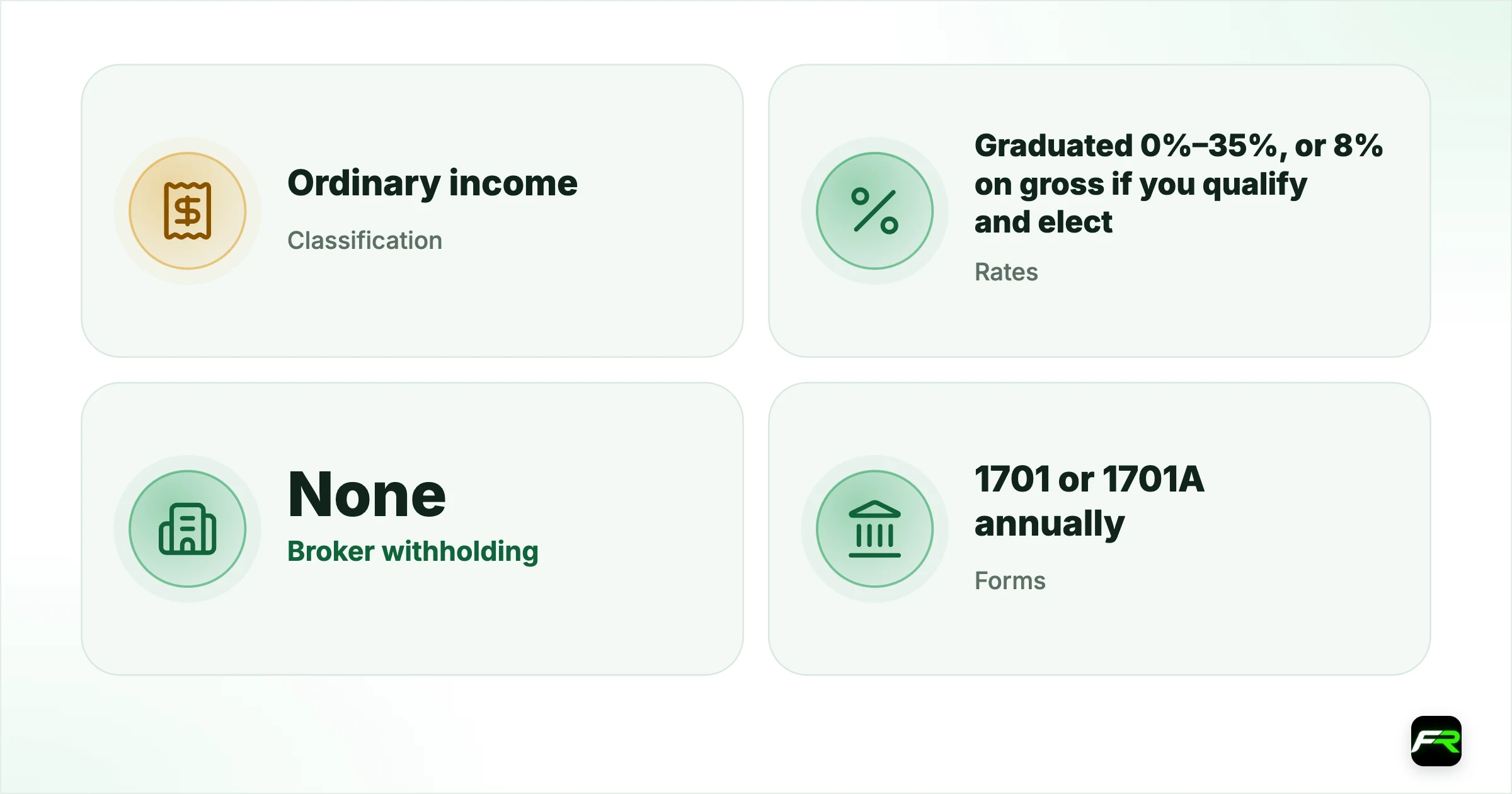
| Classification | Ordinary income (trade/business or other income) |
|---|---|
| Rates | Graduated 0%–35%, or 8% on gross if you qualify and elect |
| Broker withholding | None |
| Forms | 1701 or 1701A annually; 1701Q if registered |
| Capital-gains regime | Does not apply to forex |
Undeclared trading inflows can surface during a loan application, a visa process, or an audit. It is easier to declare as you go than to explain years of processor payments later.
Comparing rules across the region, or funding an account for the first time? See the same question for Malaysia, Pakistan, how to spot a fake forex broker.
Sources and where to check it yourself
- Bureau of Internal Revenue: tax rates, the 8% option and filing guidance
Frequently asked
Do I have to pay tax on forex trading in the Philippines?
Yes. The BIR taxes a resident’s worldwide income, so trading gains are taxable even though the broker is offshore and unregulated locally. Nothing is withheld for you.
How is forex trading income taxed in the Philippines?
As ordinary income under the graduated rates from 0% to 35%. If you qualify as a self-employed individual within the VAT threshold, you may elect the 8% tax on gross instead. There is no capital-gains regime for forex.
Do I need to register with the BIR to trade forex?
If trading is a regular income-earning activity, registration as a self-employed individual is generally expected. Casual traders with a small side account often just include the net profit in their annual return. Ask an accountant about your case.
Which BIR form do I use?
Form 1701 for the graduated rates, or 1701A for the 8% option or optional standard deduction. Form 1701Q quarterly if you have registered trading as a business.
What happens if I do not declare forex income?
Beyond the tax exposure, undeclared inflows from a payment processor can cause problems during loan applications, visa processes and audits, where you are asked to explain regular deposits you cannot account for.
Are forex losses deductible?
Losses from a trade or business can generally be offset against income from the same activity. How losses interact with your other income depends on how the trading is classified, so confirm with an accountant.
Can I use the 8% tax option for forex trading income?
The 8% on gross option is for self-employed individuals and professionals within the VAT threshold. Whether it is available for trading income, and whether it works out lower than the graduated rates, depends on your gross receipts and full situation. Ask an accountant before electing it.
How long should I keep my forex trading records?
At least the BIR’s normal assessment period, generally three years from filing, and longer where fraud is alleged. Keep platform statements, deposit and withdrawal records, and conversion rates for the whole period.
The team behind this guide
Researched, checked and approved by five forex specialists
Every guide is written, fact-checked and edited before it goes live, and updated when the facts change. Spotted an error? Tell us.