IC Markets





































SEBI’s Forex Rules for Indian Traders, Explained
What you can legally trade on an Indian exchange, what the RBI restricts, and why the offshore brokers advertising to you are on an official warning list.
 WriterAbir KhanWriterWrites the guides · checks every figure against primary sources View profileAbout Abir →
 Market analysisTanbir Habib RiyadForex & Crypto AnalystForex and crypto analyst · technical and fundamental analysis View profileAbout Tanbir →
 Fact-checking & riskJannatul FerdaushFact-Checker & Risk AnalystFact-checks every figure · risk analysis · Applied Statistics, University of Dhaka View profileAbout Jannatul →
 Trading reviewJowel RanaCo-Founder & Forex TraderCo-founder · forex trader · reviews guides from a trader's view View profileAbout Jowel →
 Final approvalRanjan NiskrityFounder, Owner & Forex TraderFounder and owner · forex trader · signs off every guide View profileAbout Ranjan →
Key takeaways
- SEBI permits cash-settled futures and options on four rupee pairs, plus some cross-currency contracts, on the NSE and BSE.
- RBI guidance now stresses that exchange currency derivatives are for hedging a real exposure.
- The LRS (up to $250,000 a year) excludes margin trading, and the RBI Alert List names unauthorised platforms.
- Enforcement targets platforms and payment intermediaries, which is why Indian deposits to offshore brokers get frozen.
Indian residents can trade currency derivatives, but only in a narrow, regulated form. The confusion, and the reason so many Indians end up with an offshore account, comes from the gap between what SEBI permits on an exchange and what the ads promise. Here is the actual framework, and for the firms Indian traders use, our best forex brokers in India guide.
What you can trade on an Indian exchange
SEBI-regulated currency derivatives trade on the NSE and BSE. The core products are futures and options on USD/INR, EUR/INR, GBP/INR and JPY/INR. Cross-currency contracts on EUR/USD, GBP/USD and USD/JPY have also been available on the exchanges. All of it is cash-settled, subject to position limits, and traded through a SEBI-registered broker in a normal trading account.
More recently, RBI guidance has emphasised that exchange-traded currency derivatives are meant for hedging a real underlying exposure, with limited room to take positions without one. That has made the exchange route less attractive for pure speculation than it once was. The rules here move, so confirm the current position with your broker before you rely on it.
What the RBI restricts
- FEMA and the LRS. A resident can remit up to USD 250,000 a year abroad under the Liberalised Remittance Scheme, but margin and leveraged trading are not permitted uses. Funding an offshore forex account through the LRS is outside its scope.
- The Alert List. The RBI publishes and updates a public list of electronic trading platforms not authorised to deal in forex or facilitate forex transactions for residents. Most well-known offshore brokers are on it.
- Enforcement. The RBI and the Enforcement Directorate have acted against platforms and, importantly, against payment aggregators and intermediaries that route money to them.
None of this has translated into a wave of prosecutions of individual retail traders. It has translated into blocked transfers, frozen payment channels, and platforms that suddenly cannot process Indian deposits. The disruption lands on you even when the enforcement does not target you directly.
Why the offshore brokers advertise anyway
Offshore brokers are regulated somewhere, by ASIC, CySEC or FSCA, and India is a huge market. Their marketing leans on “regulated” without saying where, and on affiliate networks that pay per funded account. The person telling you it is “100% legal” is usually earning a commission and is not the one whose bank transfer gets frozen.
Priya traded USD/INR futures on the NSE for a year through a discount broker. The spreads were wider than the majors she saw online and the moves were smaller, so she opened an offshore account after seeing an ad. Her first two deposits worked; the third was declined by her bank with a note about foreign trading, and the payment processor she had used stopped accepting Indian cards a month later. She went back to the exchange, on the view that a smaller, legal market she can fund beats a bigger one she cannot.
The legal way to get major-currency exposure
- Trade the exchange-traded cross-currency contracts (EUR/USD, GBP/USD, USD/JPY) through a SEBI-registered broker, within the current rules on underlying exposure.
- Trade USD/INR if a rupee view is what you have.
- If you are a non-resident Indian, you trade under your country of residence’s rules, and FEMA’s restrictions on residents do not apply the same way.
What changes when the rules move
India’s currency-derivative rules have shifted more than once, and each change tends to land on retail traders hardest. When the RBI reiterated that exchange-traded currency derivatives are for hedging contracted exposure, brokers had to add declarations and, in some cases, restrict position sizes for clients without an underlying. If you trade this market, the practical advice is to keep in touch with your broker’s compliance notices rather than assume last year’s setup still applies.
On the offshore side, the direction of travel has been one way: more platforms added to the Alert List, more payment intermediaries cut off, and periodic enforcement news that makes deposits stop working without warning. Planning around “it works today” is how people end up with a balance they cannot withdraw when a channel closes.
Because this area is unusually fluid, treat any specific rule in this guide as a prompt to verify the current position, not as settled fact. The principles are stable: exchange-traded is regulated, offshore margin is not, and funding is the exposure. The details are not.
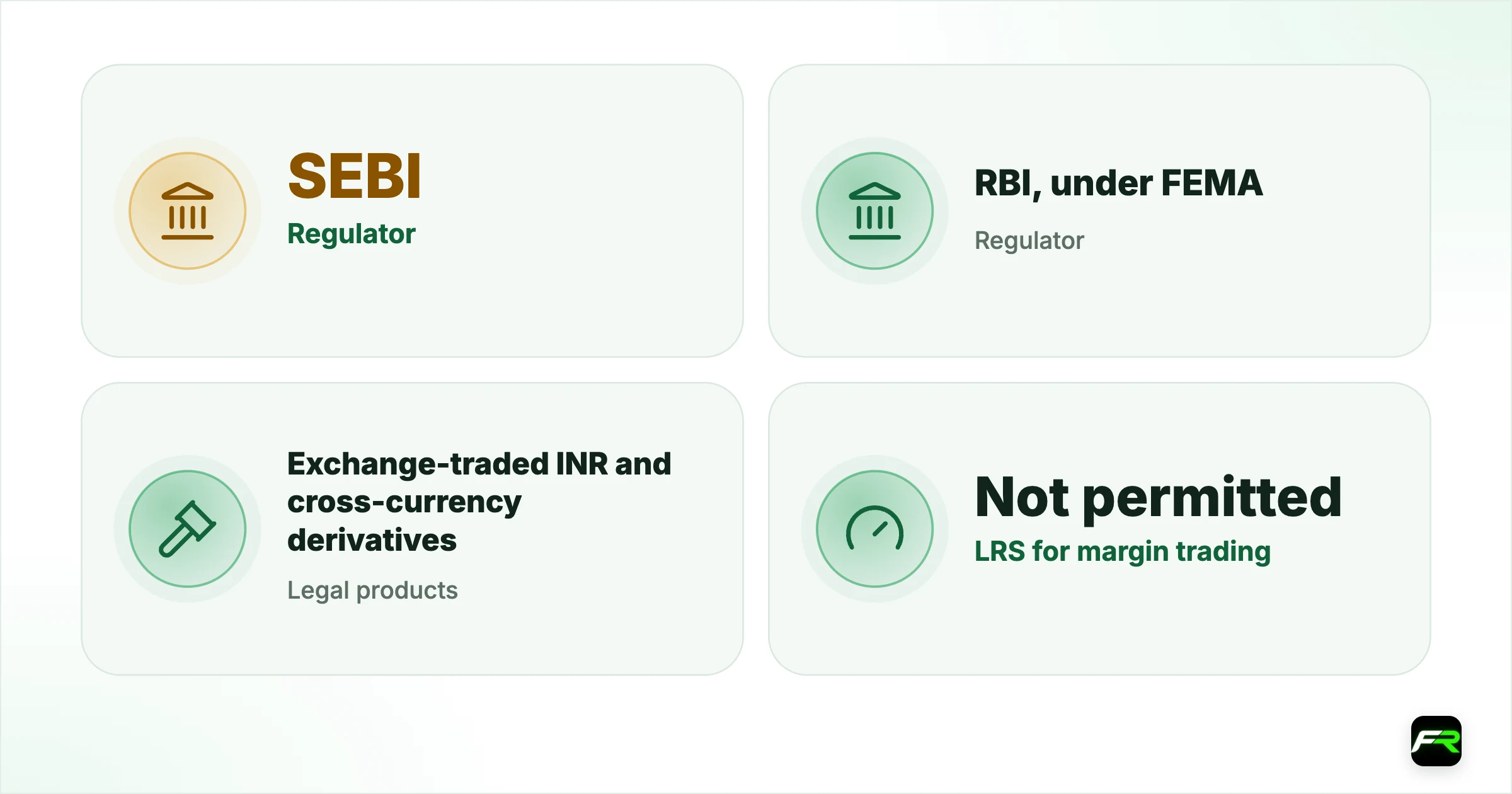
| Regulator (exchange) | SEBI |
|---|---|
| Regulator (cross-border money) | RBI, under FEMA |
| Legal products | Exchange-traded INR and cross-currency derivatives |
| LRS for margin trading | Not permitted |
| Offshore brokers | Mostly on the RBI Alert List |
| Rules stability | Changing, so confirm the current position |
An ad that calls offshore forex “SEBI approved” or “RBI approved” is lying. SEBI regulates exchange-traded products; it does not approve offshore margin brokers, and the RBI lists them as unauthorised.
Sources and where to check it yourself
- Securities and Exchange Board of India: the regulator for exchange-traded currency derivatives
Frequently asked
Can I legally trade EUR/USD in India?
Through exchange-traded cross-currency derivatives on the NSE or BSE, within the current rules, yes. Trading EUR/USD with an offshore margin broker is not permitted for residents.
Is the LRS a way to fund a forex account?
No. The Liberalised Remittance Scheme permits up to USD 250,000 a year abroad for specified purposes, and margin or leveraged trading is not one of them.
What happens if my broker is on the RBI Alert List?
It means the RBI has flagged the platform as not authorised to deal in forex for residents. In practice this often shows up as blocked bank transfers and payment channels that stop working, even if you are never contacted directly.
Are exchange-traded currency derivatives still worth trading?
They are legal and regulated, but recent RBI guidance emphasising underlying exposure has made them less useful for pure speculation. Whether they suit you depends on whether you have a genuine rupee or cross-rate view.
Do NRIs have to follow SEBI and FEMA forex rules?
A non-resident Indian trades under the law of their country of residence. FEMA’s restrictions on residents and the LRS do not apply in the same way, though your local regulator’s rules do.
Can I hedge a real dollar exposure through an Indian exchange?
Yes, and that is increasingly the intended use. If you have contracted foreign-currency exposure, such as an export business or dollar receivables, exchange-traded currency derivatives are the regulated tool for it, and the recent RBI emphasis on underlying exposure works in your favour.
The team behind this guide
Researched, checked and approved by five forex specialists
Every guide is written, fact-checked and edited before it goes live, and updated when the facts change. Spotted an error? Tell us.