IC Markets






























Is Forex Trading Legal in the Philippines?
No Philippine company is licensed to offer it, and the SEC keeps warning people off. Trading with a broker abroad is not a crime for you, but nobody local is watching your back.
 WriterAbir KhanWriterWrites the guides · checks every figure against primary sources View profileAbout Abir →
 Market analysisTanbir Habib RiyadForex & Crypto AnalystForex and crypto analyst · technical and fundamental analysis View profileAbout Tanbir →
 Fact-checking & riskJannatul FerdaushFact-Checker & Risk AnalystFact-checks every figure · risk analysis · Applied Statistics, University of Dhaka View profileAbout Jannatul →
 Trading reviewJowel RanaCo-Founder & Forex TraderCo-founder · forex trader · reviews guides from a trader's view View profileAbout Jowel →
 Final approvalRanjan NiskrityFounder, Owner & Forex TraderFounder and owner · forex trader · signs off every guide View profileAbout Ranjan →
Here is the situation in one line: no company in the Philippines is authorised to offer retail forex or CFD trading, so anyone trading is doing it with a broker based somewhere else. That is not illegal for you as an individual, but the SEC treats the local promotion of these platforms as a violation and publishes advisories against specific ones on a regular basis.
The confusion comes from the marketing. Brokers and their local recruiters lean on words like “registered” and “regulated” without saying where. Once you know no local licence exists, those claims tell you nothing useful. Our best forex brokers in the Philippines guide has the vetted shortlist and the GCash-friendly options.
What the regulators say
Two bodies matter. The Bangko Sentral ng Pilipinas (BSP) oversees foreign exchange dealing by banks. The Securities and Exchange Commission (SEC) oversees investment products and solicitation. Neither has licensed a retail margin-forex broker, and the SEC has been vocal about it, its public advisories page names specific unregistered platforms as it finds them.
The SEC’s advisories name specific platforms and, often, their local recruiters and “mentors”. The message is consistent: soliciting Filipinos to invest in or fund these platforms is an offence. That language is aimed at the people running paid seminars, Telegram signal groups, and “passive income” pitches. It is not aimed at the individual who opens an account and places their own trades.
- There is no Philippine licence to look for, because none exists. Do not trust a “SEC-registered” claim on a forex broker’s site.
- Your protection comes entirely from the broker’s regulator abroad, which makes the quality of that licence the whole question.
- Local outfits that combine “forex training” with taking your deposit are exactly what the SEC pursues. Keep your money with the broker, never a mentor, our scam broker list has more patterns to watch for.
How to report a scam recruiter
If a “mentor” or recruiter takes your money and disappears, three channels matter and they are not interchangeable. The SEC’s Enforcement and Investor Protection Department handles the regulatory side (unregistered solicitation and investment schemes) reachable at [email protected]. For the criminal side, file with the NBI Cybercrime Division or the PNP Anti-Cybercrime Group; either can open a fraud investigation, and a case number from one tends to make the other move faster. Bring everything: the recruiter’s messages, the broker sign-up link they gave you, and your own deposit and withdrawal records.
How Filipinos trade in practice
An account with an ASIC, CySEC or FCA broker, funded by GCash or Maya, or by local bank transfer through a payment partner. GCash is the common choice because it is instant and most brokers serving Southeast Asia support it. Withdrawals come back to the same wallet. The peso is converted at the broker’s rate, slightly worse than mid-market, both on the way in and the way out.
Mika started after a friend’s “mentor” pitched a signals group with a PHP 8,000 buy-in and a broker link to sign up through. She skipped the group and opened an account directly with a CySEC broker, funding PHP 2,000 through GCash. The trading results were her own problem, and she was down about PHP 600 after a month, but she never lost money to a middleman, and her PHP 1,400 withdrawal came back to GCash in a day. The friend who joined the group is still waiting on a withdrawal the “mentor” keeps promising.
What to check
- The broker’s licence number on the regulator’s own website (asic.gov.au, cysec.gov.cy, register.fca.org.uk), not a certificate image on the broker’s site.
- That GCash, Maya or your bank is a supported deposit method before you open the account.
- Which entity you are signing up with. Large brokers run several legal entities, and only some sit under the strong licence. The signup page or the client agreement will say which one you are on.
- A small deposit and a full withdrawal before you trust the account with real money.
Tax
Gains from trading are taxable income for a Philippine resident even though the broker is abroad. The BIR treats them as ordinary income; there is no withholding or reporting done for you, so the record-keeping is yours. Keep your deposits, withdrawals and trading statements. Our Philippines tax guide covers how to declare it and what BIR forms apply.
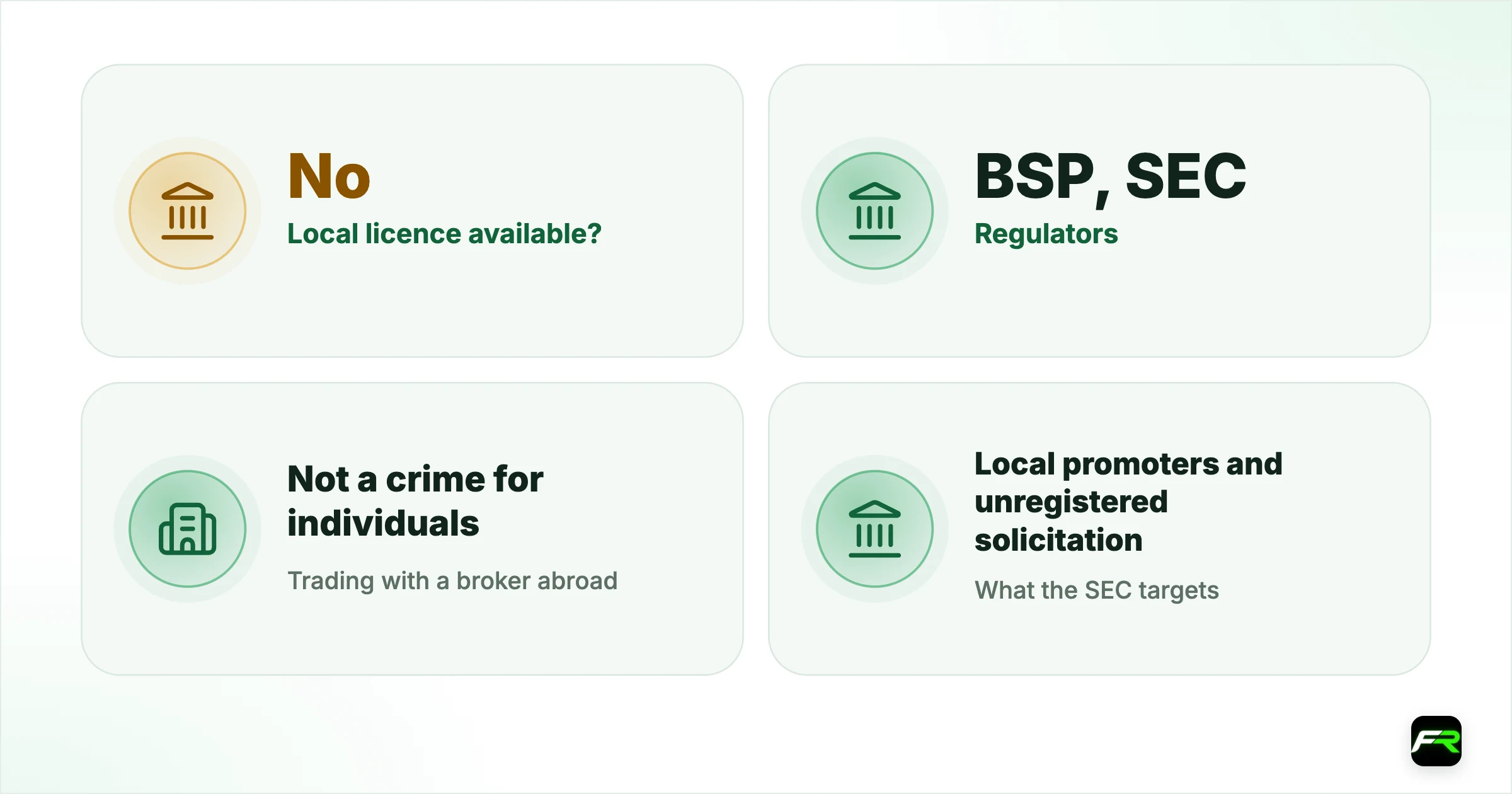
| Local licence available? | No |
|---|---|
| Regulators | BSP, SEC |
| Trading with a broker abroad | Not a crime for individuals |
| What the SEC targets | Local promoters and unregistered solicitation |
| Common funding | GCash, Maya, local bank transfer |
| Tax on gains | Yes, ordinary income (BIR) |
What it costs to trade from the Philippines
GCash deposits to a broker’s payment partner are usually free or close to it. The cost that stays is the peso-to-USD conversion, which runs roughly 0.5 to 1% worse than the interbank rate and applies both when you deposit and when you withdraw. On a PHP 5,000 deposit that is about PHP 25 to 50 each way. Small on its own, but it stacks up if you move money in and out often.
The larger hidden cost for Filipino traders is time and money lost to signals groups and “mentorship” packages. A PHP 8,000 course bundled with a broker sign-up link, promoted as a shortcut, is usually just an affiliate commission with a slideshow attached. Put that PHP 8,000 into a demo-tested plan and a small live account instead, and you keep it and learn more.
If someone offers to trade your account for you for a share of the profit, or asks you to deposit through their referral link from a Telegram group, that is the exact structure the SEC warns about.
Frequently asked
Will I get in trouble for trading forex in the Philippines?
Individual retail trading with a broker abroad is not a crime. The SEC’s action is aimed at local companies and recruiters who solicit Filipinos to invest in unregistered forex platforms.
Which broker is safe to use from the Philippines?
One regulated by ASIC, CySEC or the FCA, with a licence number you can verify on the regulator’s website, that supports GCash or local bank transfer, and that pays a test withdrawal without friction.
Can I use GCash to fund a forex account?
Yes, many brokers serving Southeast Asia support GCash. Confirm it is listed as a deposit method for your account before signing up, and expect withdrawals to return to the same wallet.
Is there any Philippine-regulated forex broker?
No. No BSP or SEC licence exists for retail margin forex, so any broker serving Filipinos is regulated in another country. Ignore “SEC-registered” claims on broker sites.
Do I need to declare forex profits to the BIR?
Yes. Trading gains are ordinary taxable income for a resident, even when the broker is offshore and the money only reaches your bank on withdrawal. Nothing is withheld for you.
How do I report a scam broker or recruiter to the SEC?
Email the SEC’s Enforcement and Investor Protection Department at [email protected], or check its public advisories page to see if the platform is already listed. File a parallel complaint with the NBI Cybercrime Division or PNP Anti-Cybercrime Group for the money itself, the SEC can act against the platform, but recovering funds from an individual recruiter is a police matter.
The team behind this guide
Researched, checked and approved by five forex specialists
Every guide is written, fact-checked and edited before it goes live, and updated when the facts change. Spotted an error? Tell us.