IC Markets




































Is Forex Trading Legal in Vietnam?
Only licensed banks may deal foreign exchange. Retail margin trading has no legal framework, the authorities call the local trading floors illegal, and yet a lot of people trade offshore anyway.
 WriterAbir KhanWriterWrites the guides · checks every figure against primary sources View profileAbout Abir →
 Market analysisTanbir Habib RiyadForex & Crypto AnalystForex and crypto analyst · technical and fundamental analysis View profileAbout Tanbir →
 Fact-checking & riskJannatul FerdaushFact-Checker & Risk AnalystFact-checks every figure · risk analysis · Applied Statistics, University of Dhaka View profileAbout Jannatul →
 Trading reviewJowel RanaCo-Founder & Forex TraderCo-founder · forex trader · reviews guides from a trader's view View profileAbout Jowel →
 Final approvalRanjan NiskrityFounder, Owner & Forex TraderFounder and owner · forex trader · signs off every guide View profileAbout Ranjan →
Vietnam’s position is blunt: foreign exchange dealing is reserved for licensed credit institutions. There is no licence for a retail margin-forex broker, and the State Bank of Vietnam has stated more than once that the local “san forex”, the trading floors that recruit investors, operate illegally. Several have been raided, with organisers arrested and charged, the VND 5,200 billion "Mr Pips" fake trading-floor case, with more than 2,660 victims, is the largest so far.
So there are really two questions here, and they have different answers. Is running a forex trading floor in Vietnam legal? No, clearly not. Is an individual trading their own money with a broker abroad committing an offence? That sits in a grey area nobody has closed. If you are choosing a firm anyway, our best forex brokers in Vietnam guide covers the ones with a verifiable licence and the payment methods that work.
Where that leaves an individual trader
There is no law that says a private person opening an account with a broker in Australia or Cyprus and trading their own money is breaking the rules. There is also no law protecting them, no regulator to complain to, and a clear signal from the authorities that they regard the entire retail-forex industry as unlicensed. Enforcement has concentrated on the operators of local floors and the networks recruiting for them, not on individuals trading quietly from home.
- Local “forex floors” and MLM-style investment schemes: targeted, raided, prosecuted.
- An individual trading their own account with a broker abroad: not a stated enforcement priority, but entirely unprotected.
- Anyone running a group, taking deposits, or promising returns: firmly on the wrong side of the line.
It is worth being precise about what the trading floors were. They were not brokers. They were local operations that took deposits, showed clients a platform, and in many cases paid “profits” out of new deposits until they collapsed. When one is shut down, the people who put money in generally recover nothing, because there was never a real broker or a real segregated account behind it.
The money movement is the real friction
Direct VND bank transfers for forex can be blocked or questioned by the bank. Traders use domestic bank transfer through a broker’s payment partner, e-wallets, or USDT bought locally. Deposits through a payment partner usually land within the hour. Withdrawals take one to three business days and normally return to the same method. As everywhere in the region, the trade is rarely the problem; being able to explain the money trail is.
Huy lost about VND 60 million on a local forex floor in 2022 that promised a fixed 15% monthly return and then stopped paying. When it was raided a few months later, there was nothing to recover, because it had never been a real broker. He now trades a small account with an ASIC-regulated broker, funds it by domestic transfer through the broker’s payment partner, and treats it as his own money at his own risk. That, he says, is a completely different activity from handing cash to a floor with an office and a sales team.
If you decide to trade
- Never use a local “trading floor” or anyone offering to manage your money. That is the model that gets shut down, and it takes deposits with it, our scam broker list has more patterns to watch for.
- Pick a broker with a verifiable ASIC, CySEC or FCA licence, and sign up on the broker’s own website.
- Keep deposits small and keep your own record of every transfer, matched to your name.
- Accept that you have no local recourse whatsoever if the broker fails.
Tax
Personal income tax applies to a Vietnamese tax resident’s worldwide income in principle, and trading gains are income. In practice there is limited guidance on how retail forex profits should be declared, precisely because the activity is unregulated. Keep records of deposits, withdrawals and statements so you can show the position if asked.
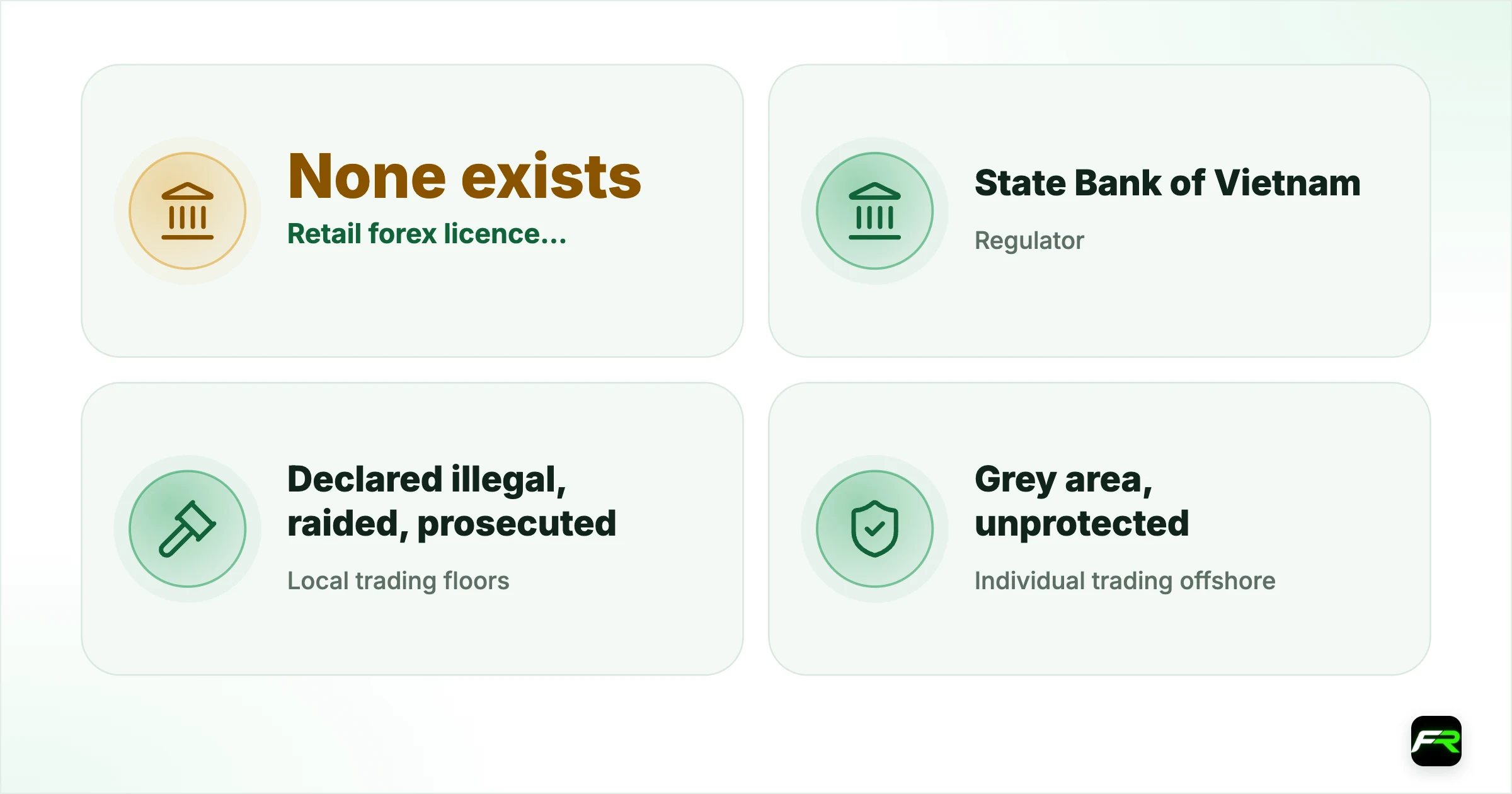
| Retail forex licence in Vietnam | None exists |
|---|---|
| Regulator | State Bank of Vietnam |
| Local trading floors | Declared illegal, raided, prosecuted |
| Individual trading offshore | Grey area, unprotected |
| Common funding | Domestic transfer, e-wallet, USDT |
| Local recourse | None |
Telling a real broker from a floor
This is the distinction that matters most in Vietnam, because the losses cluster on one side of it. A few quick tests:
- Where is the licence? A real broker publishes a number from ASIC, CySEC or the FCA that you can look up. A floor talks about “international standards” and shows a certificate you cannot verify.
- Who holds your money? With a real broker you fund an account in your own name and can withdraw to your own bank. A floor takes a deposit and shows you a balance on its own screen.
- Is there a person selling to you? Real brokers do not have a Vietnamese sales rep calling you about “opportunities”. Floors run on exactly that.
- Does it promise anything? A return, a “signal” win rate, or a bonus that unlocks after you deposit more are all floor behaviour.
A Vietnamese-language “forex san” with a physical office and a sales team is not a broker. Legitimate brokers serving Vietnam are licensed abroad and you deal with them entirely online.
Frequently asked
Is it illegal to trade forex in Vietnam?
Foreign exchange dealing is reserved for licensed banks, and there is no framework for retail margin trading. Local trading floors are treated as illegal and have been prosecuted. An individual trading their own account with a broker abroad sits in a grey area that has not been an enforcement priority, but is completely unprotected.
Why do so many Vietnamese people trade forex then?
Offshore brokers are easy to access online and accept small deposits. The absence of a local framework has not stopped people; it has just meant they trade without any protection.
What happened to the forex floors that were shut down?
The State Bank of Vietnam and police have raided a number of local trading floors that recruited investors with promises of fixed returns. Those were investment schemes, not brokers, and investors generally could not recover their money.
Can I use MT4 or MT5 legally in Vietnam?
The platform is just software. The question is the broker behind it. Using MT4 with a broker licensed abroad is the grey area described here; using it with a local trading floor is the model the authorities pursue.
How do I fund an account from Vietnam?
Domestic bank transfer through the broker’s payment partner is the usual route, along with e-wallets and USDT. Direct international transfers labelled for forex are often declined by the bank.
The team behind this guide
Researched, checked and approved by five forex specialists
Every guide is written, fact-checked and edited before it goes live, and updated when the facts change. Spotted an error? Tell us.