IC Markets



























Is Forex Trading Legal in Thailand?
No Thai company can offer it, and the SEC warns about unlicensed platforms. Trading your own account with a broker abroad is not a crime for individuals, but there is no local safety net.
 WriterAbir KhanWriterWrites the guides · checks every figure against primary sources View profileAbout Abir →
 Market analysisTanbir Habib RiyadForex & Crypto AnalystForex and crypto analyst · technical and fundamental analysis View profileAbout Tanbir →
 Fact-checking & riskJannatul FerdaushFact-Checker & Risk AnalystFact-checks every figure · risk analysis · Applied Statistics, University of Dhaka View profileAbout Jannatul →
 Trading reviewJowel RanaCo-Founder & Forex TraderCo-founder · forex trader · reviews guides from a trader's view View profileAbout Jowel →
 Final approvalRanjan NiskrityFounder, Owner & Forex TraderFounder and owner · forex trader · signs off every guide View profileAbout Ranjan →
Yes, forex trading is legal for individuals in Thailand. What is missing is a licensed local broker to offer it, that gap, not the trading itself, is what the rest of this page is about. Thailand’s position looks a lot like the Philippines’. No Thai entity is licensed to offer retail margin forex trading. The Bank of Thailand controls foreign exchange, the SEC oversees investment products, and the SEC regularly publishes an Investor Alert list naming unlicensed platforms, a good share of them forex brokers. An individual trading their own money with a broker abroad is not committing an offence, but they are unregulated from the Thai side and on their own if something fails.
The Thai-language “forex guru” scene is large, and a lot of it blurs the line between education and taking your deposit. Knowing that no local licence exists helps you see those pitches for what they are. Our best forex brokers in Thailand guide has the vetted shortlist and the local funding options.
The two regulators
- Bank of Thailand: manages foreign exchange and capital flows. Large outward transfers require documentation; small personal amounts are generally fine.
- SEC Thailand: licenses securities and derivatives businesses. It has not licensed a retail forex broker, and its Investor Alert list flags platforms operating without approval, along with the local promoters attached to them.
So the brokers Thai traders use, regulated by ASIC, CySEC or the FCA, are all foreign. That foreign licence is the only protection you have, which is why verifying it directly on the regulator’s website matters more here than the broker’s own marketing.
The law, and what it actually restricts
Two statutes sit behind everything in this guide. The Securities and Exchange Act B.E. 2535 (1992) created the SEC and gives it authority over securities and derivatives businesses, which is why it can license, or refuse to license, a forex broker but has no say over the underlying currency market itself. The Exchange Control Act B.E. 2485 (1942), administered by the Bank of Thailand, governs who may deal in foreign currency and on what terms, it is this Act, not the SEC, that limits your bank transfers abroad.
The current, relatively open rules date to a reform programme the BOT began in June 2017 and extended in November 2019, when it raised the amount an individual can send abroad without supporting documents from USD 50,000 to USD 200,000 a year, and let retail investors put up to the same amount into foreign securities without going through a licensed broker. Larger amounts are still possible through a registered investment channel, but need a stated purpose and supporting paperwork.
Two restrictions actually bind a Thai trader in practice. There is no licensed local leverage cap, because there is no licensed local product to cap, the leverage you get is whatever your offshore broker offers, unregulated from the Thai side. And the BOT’s measures to prevent Thai baht speculation restrict how much THB onshore banks can lend to non-residents without a genuine trade or investment reason, which is a large part of why almost no offshore broker offers real leveraged THB pairs to Thailand-based clients; you will mostly be trading USD, EUR, GBP and JPY crosses on margin, not the baht itself. The USD 200,000-a-year threshold above is the practical ceiling before your bank wants a documented purpose for the transfer, even though funding a forex account is not one of the BOT’s formally recognised investment purposes.
How Thais trade
An account with an international broker, funded by domestic bank transfer through a payment partner or by an e-wallet such as TrueMoney. Withdrawals return the same way. Baht is converted at the broker’s rate, a little worse than mid-market, and that conversion applies both directions. Deposits are usually same-day; withdrawals typically take one to three business days once approved.
Nok opened an account with an FCA-regulated broker, funded THB 3,000 by bank transfer, and made a point of withdrawing THB 1,000 in the first week to confirm the round trip worked. It landed in two days. She turned down a “VIP signals” group a friend joined that required depositing through the group’s own referral link. That is how the friend later lost the entire deposit when the “guru” stopped responding.
What to check
- A verifiable licence number on the regulator’s own website.
- That your bank or e-wallet is a supported deposit method for your account.
- Which of the broker’s entities you are signing up with. Only some carry the strong licence; the client agreement will name the entity.
- A small deposit and a full withdrawal before committing real money.
Tax
Trading gains are assessable income for a Thai tax resident. Recent changes to how foreign-source income is taxed on remittance make it worth checking your position, especially if you bring profits back into Thailand in the same year you earn them. Keep records of deposits, withdrawals and statements. Our tax overview covers the general approach across the region.
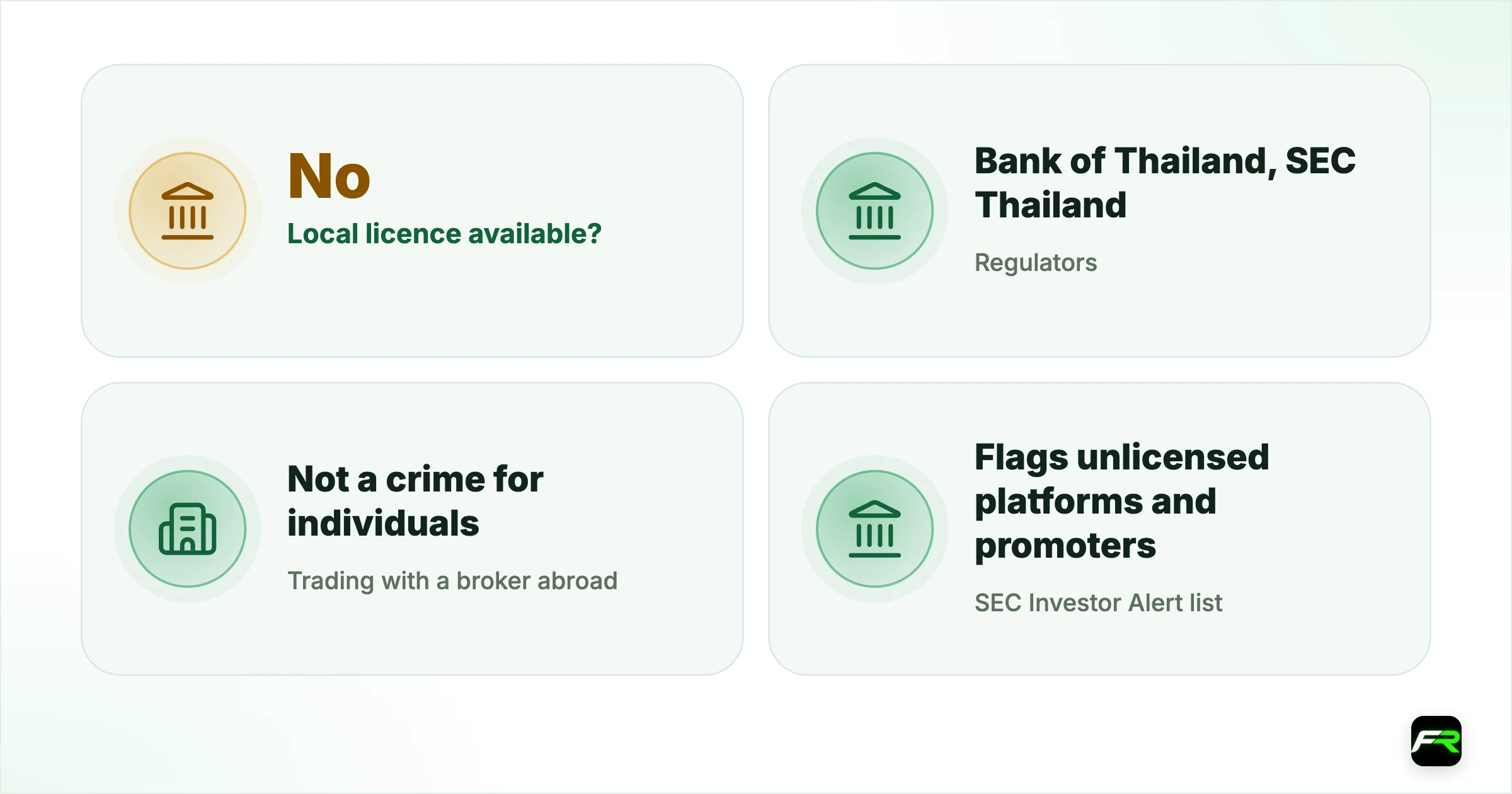
| Local licence available? | No |
|---|---|
| Regulators | Bank of Thailand, SEC Thailand |
| Trading with a broker abroad | Not a crime for individuals |
| SEC Investor Alert list | Flags unlicensed platforms and promoters |
| Common funding | Bank transfer, TrueMoney and other e-wallets |
| Local recourse | None |
What trading costs from Thailand
The trade fees are the same for everyone. The costs specific to trading from Thailand are the baht conversion and the payment friction. On a THB 8,000 deposit, the broker converts to USD at a rate roughly 0.3 to 0.7% worse than interbank, so you lose around THB 25 to 55 before placing a trade, and the same spread applies when you withdraw. Bank transfers through a payment partner are usually free; some e-wallets add a small percentage.
It is not a large number on a single deposit. It becomes one if you fund and withdraw every week, which is why a stable balance you top up occasionally costs less than constant round trips. Traders who chase the feeling of “banking” profits every few days often pay more in conversion spread over a year than they lose on any single trade.
Reading the SEC Investor Alert list
Before you fund any broker, search its name and its exact domain on the SEC Thailand Investor Alert list. A name on it means the SEC has flagged the entity as operating without approval, and the list also names the local promoters attached to specific schemes. Being absent from the list does not certify a broker as safe, but being on it is a clear signal to stay away.
If a platform asks you to deposit through a “partner” link from a Line group or a YouTube channel rather than the broker’s own site, that is a signals-group scam pattern, not a broker.
Frequently asked
Is forex trading illegal in Thailand?
No Thai company is licensed to offer it, and the SEC warns about unlicensed platforms, but an individual trading their own account with a regulated broker abroad is not committing an offence. There is simply no local protection.
Can I move money out of Thailand to fund a forex account?
Small personal amounts are generally fine. Larger outward transfers require documentation under Bank of Thailand rules. Keep records of what you send and the stated purpose.
How do I know if a forex broker is safe to use from Thailand?
Check its licence on the regulator’s own website, confirm your funding method is supported, make sure you are signing up with the regulated entity, and test a small withdrawal first.
Do I pay tax on forex profits in Thailand?
Trading gains are assessable income for a tax resident, and recent changes to the taxation of remitted foreign income make it worth checking your specific position. Keep full records.
Are Thai ‘forex gurus’ legal?
Teaching about markets is not itself regulated. Taking deposits, running a pooled account, or steering people to sign up through a referral link crosses into activity the SEC warns about, and several such promoters appear on its alert list.
Can I trade forex as a foreigner living in Thailand?
Your tax position follows Thai residency rules, and the same lack of a local broker licence applies. Fund from a Thai account and small personal transfers are generally fine; keep records if you move larger amounts.
The team behind this guide
Researched, checked and approved by five forex specialists
Every guide is written, fact-checked and edited before it goes live, and updated when the facts change. Spotted an error? Tell us.