IC Markets





































Trading Forex Around a Full-Time Job in Asia
You do not need to watch the market all day, and trying to will make you worse. Here is how to build a routine around the session you can see, and what to stop doing.
 WriterAbir KhanWriterWrites the guides · checks every figure against primary sources View profileAbout Abir →
 Market analysisTanbir Habib RiyadForex & Crypto AnalystForex and crypto analyst · technical and fundamental analysis View profileAbout Tanbir →
 Fact-checking & riskJannatul FerdaushFact-Checker & Risk AnalystFact-checks every figure · risk analysis · Applied Statistics, University of Dhaka View profileAbout Jannatul →
 Trading reviewJowel RanaCo-Founder & Forex TraderCo-founder · forex trader · reviews guides from a trader's view View profileAbout Jowel →
 Final approvalRanjan NiskrityFounder, Owner & Forex TraderFounder and owner · forex trader · signs off every guide View profileAbout Ranjan →
Key takeaways
- Commit to one trading window you can actually watch, often the Tokyo open or the start of London.
- A 60 to 90 minute routine is enough: check the calendar, mark levels, wait, then act or don't.
- Don't leave positions open through news you won't see, or trade from your phone in short bursts at work.
- One good setup a session beats a dozen rushed trades.
Almost everyone who starts trading forex in Asia has a job. The content they watch is made by people who trade full-time or claim to, and it sets an expectation of screens all day and dozens of trades that is both unrealistic for you and not how most consistent retail traders operate. This guide is about building something that fits a working life.
Pick the session you can watch
For most of the region, that is the Asian session, which runs through your morning and evening. A trader in Jakarta or Manila can catch the Tokyo open before work. A trader in Mumbai can trade 05:30 to 07:30 IST (00:00 to 02:00 GMT), which lines up with the Sydney-Tokyo overlap, one of the session's more active windows even if it is quieter than the London-New York overlap later in the day. A trader who finishes work at 18:00 can catch the late Asian session and the very start of London. The key is to commit to one window and learn it, rather than dipping into random hours when you happen to be free.
Trading hours you cannot watch means either leaving positions unattended through news you will not see, or checking your phone at work and making decisions in ten-second bursts. Both are worse than not trading those hours at all.
A routine that fits 60 to 90 minutes
- Before: check the economic calendar for your pairs. If there is a high-impact release in your window, plan to sit it out.
- Open: mark your levels, meaning the session range, key support and resistance, and yesterday’s high and low.
- Wait: most of the window is waiting. You are looking for one setup that matches your plan, not action.
- Act or don’t: take the trade if it appears, with a pre-decided stop and target. If it does not appear, close the laptop.
- After: log the trade, or log that there was no trade and why. Two minutes.
Arif trades 07:00 to 08:30 before commuting. Three or four mornings a week he takes one trade on USD/JPY or AUD/JPY; the other mornings there is nothing that fits his plan and he does not force it. He set a rule after a bad month: no trades after 08:15, no checking the position from the office. If it is not resolved by the time he leaves, the stop and target handle it. His results turned around not when he found a better strategy but when he stopped trading outside his window.
What to stop doing
- Checking positions at work. Set your stop and target and leave it. A trade you manage in glances between meetings is a trade you manage badly.
- Trading multiple windows. Pick one. Learning one well beats sampling three.
- Revenge trading later in the day after a losing morning. Liquidity in the later Asian hours is often thinner than the Tokyo open, though it varies by pair and picks up again once London opens, and either way you are tilted after a losing morning. Wait for tomorrow.
- Watching trading content during the day that makes you feel you are missing out. You are not missing anything that fits a working life.
Handling trades you cannot watch
The core problem for a part-time trader is the trade that is still open when you have to leave. There are only three sound answers, and “check my phone at work” is not one of them. The first is to be flat before you go: set a hard cut-off time, and if the trade is not resolved by then, close it. The second is to have a genuine set-and-forget trade: a stop and a target both placed, position sized so the stop loss is acceptable, and a firm rule not to touch it. The third is simply not to take a trade you cannot see through in the time you have.
Which of these you use depends on your strategy. A range trade with a tight stop and a target at the opposite edge is a reasonable set-and-forget. A discretionary trade you planned to manage actively is not, so if you cannot manage it, do not open it. Being honest with yourself about which trades you can oversee is more valuable than any entry technique.
The realistic expectation
Trading part-time around a job, the honest goal for the first year is not income. It is to still have your account, to be trading to a plan, and to have a journal that shows you are improving. If you can do that on a small account for a year, you have done better than most people who start. Income, if it comes, comes later and gradually, from a process you have already proven you can follow.
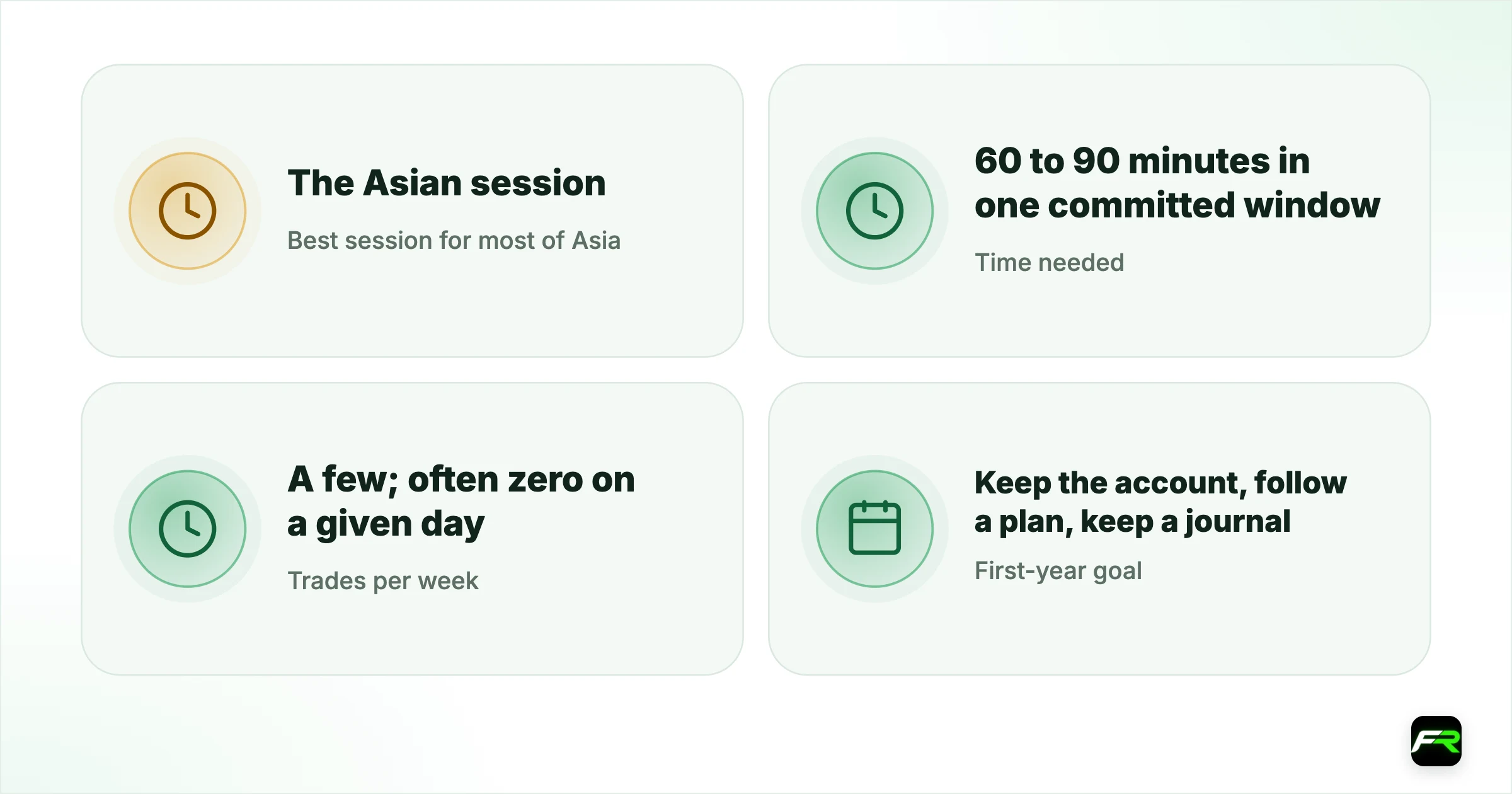
| Best session for most of Asia | The Asian session (your morning/evening) |
|---|---|
| Time needed | 60 to 90 minutes in one committed window |
| Trades per week | A few; often zero on a given day |
| First-year goal | Keep the account, follow a plan, keep a journal |
| Biggest mistake | Managing trades from work in glances |
If your job does not allow you to ignore your phone for a few hours, trade a window that ends before your work day starts, or do not hold positions into work hours. Half-watched trades are how part-time traders blow up.
Frequently asked
Can I trade forex with a full-time job?
Yes, and most consistent retail traders do. The approach is to trade one window you can watch, which for most of Asia is the Asian session in your morning or evening, for 60 to 90 minutes, taking a handful of trades a week to a written plan.
How much time do I need to trade forex part-time?
About 60 to 90 minutes in one committed window, plus two minutes to journal. Most of that time is waiting for a setup that fits your plan, not actively trading.
Should I check my trades during work?
No. Set your stop and target when you enter, and leave the position alone. Trades managed in glances between meetings are managed badly, and the habit leads to impulsive changes.
Which session should I trade if I work 9 to 5 in Asia?
The Asian session, since it runs through your morning and evening. Catch the Tokyo open before work, or the late Asian session after. Commit to one window rather than trading whenever you are free.
Is it realistic to make income from part-time forex trading?
Not in the first year. The realistic goal is to keep your account, trade to a plan, and keep a journal that shows improvement. Income, if it comes, is later and gradual, built on a proven process.
What if I can only trade in the evening?
The late Asian session and the start of London are tradable in the evening for Southeast Asia, though liquidity is thinner around the New York close and Sydney open. Avoid revenge trading a thin evening session after a losing morning.
The team behind this guide
Researched, checked and approved by five forex specialists
Every guide is written, fact-checked and edited before it goes live, and updated when the facts change. Spotted an error? Tell us.