IC Markets





































Forex Trading Tax in Indonesia
Trading profit is income and goes on your annual return at progressive rates. Trades on the local futures exchange have their own final tax. Here is what to keep and how to declare it.
 WriterAbir KhanWriterWrites the guides · checks every figure against primary sources View profileAbout Abir →
 Market analysisTanbir Habib RiyadForex & Crypto AnalystForex and crypto analyst · technical and fundamental analysis View profileAbout Tanbir →
 Fact-checking & riskJannatul FerdaushFact-Checker & Risk AnalystFact-checks every figure · risk analysis · Applied Statistics, University of Dhaka View profileAbout Jannatul →
 Trading reviewJowel RanaCo-Founder & Forex TraderCo-founder · forex trader · reviews guides from a trader's view View profileAbout Jowel →
 Final approvalRanjan NiskrityFounder, Owner & Forex TraderFounder and owner · forex trader · signs off every guide View profileAbout Ranjan →
For an Indonesian tax resident, profit from forex trading is income. There is no separate lower rate for trading gains and no exemption for using an international broker. It is added to your other income and taxed at Indonesia’s progressive personal rates, and you declare it yourself on your annual return (SPT Tahunan). For the broker side, see our best forex brokers in Indonesia guide.
This is a general overview, not tax advice. Tax rules change, they depend on your personal circumstances, and the treatment of offshore trading is an area where enforcement and interpretation both evolve. Speak to a qualified local accountant before you file, ideally before you have a large gain to explain.
Legality vs. tax treatment: two separate questions
Everything above answers how forex trading profit is taxed. It does not answer whether trading with a particular broker is itself compliant with Indonesian rules, and the two questions sit with different authorities. Tax is the Direktorat Jenderal Pajak’s concern. Whether a broker may legally solicit Indonesian clients is Bappebti’s.
Bappebti generally requires brokers offering forex and commodity derivatives to Indonesian residents to hold a local licence. Most international brokers Indonesian traders actually use are not Bappebti-licensed, which places that broker relationship in a grey area under Indonesian rules, separate from and unrelated to the tax question above. Declaring and paying tax on the profit does not resolve that; the tax office taxing an income stream is not the same as Bappebti treating the broker relationship as authorised.
In practice, this article’s advice stands either way: declare the profit as described above, because undeclared income is its own separate risk regardless of the broker’s status. But treat the two questions, tax and broker legality, as genuinely separate rather than assuming one settles the other.
Progressive rates
Indonesia taxes personal income in bands, rising from 5% on the lowest band to 35% on the highest. Your trading profit for the year sits on top of your salary or business income and is taxed at whatever marginal band it falls into. A modest trading profit for someone on an average salary is typically taxed in the 15% band; a large one can reach the higher bands.
Local exchange trades versus offshore
If you trade through a Bappebti-licensed broker on the Jakarta Futures Exchange, certain exchange transactions are subject to a final tax (PPh Pasal 4 ayat 2) collected at the exchange level. Where that applies, the tax is settled at source and the income is not added again to your progressive calculation. Your broker or the exchange documentation will tell you whether your trades fall under it.
If you trade with an offshore broker, which most Indonesian retail traders do, there is no final tax and no withholding. The full trading profit is ordinary income that you self-report. The broker sends nothing to the Indonesian tax office, so the completeness of your return depends entirely on your own records.
Sari trades a small account with an international broker, alongside a salaried job. Her accountant told her the trading profit simply adds to her taxable income for the year and is taxed at her marginal rate, and that the tax office is unlikely to ever see the broker statements, which is exactly why the responsibility to declare is hers. She keeps a spreadsheet of monthly net profit and withdrawals and gives it to the accountant with her other documents each year.
What to keep
- Monthly net trading profit or loss, from your platform statements.
- Every deposit and withdrawal, with dates and IDR amounts.
- The IDR-USD conversion rate applied by the broker, so gains can be stated in rupiah.
- Any documentation from a local broker showing final tax already collected.
Bringing your own capital back from a broker is not itself a taxable event, since it is your money returning. The gain on top of it is what is taxed. Clear records let you show the difference.
A worked example
Suppose your salary places you in the band where the next rupiah of income is taxed at 15%, and you make a net trading profit of Rp 24,000,000 over the year. That profit is added to your taxable income and taxed at your marginal rate. If it all sits in the 15% band, that is Rp 3,600,000 in tax. If part of it pushes you into the 25% band, the portion above the threshold is taxed at 25%. There is no separate lower rate for trading, and no deduction simply for the trading being risky.
If some of your trading was through a Bappebti-licensed broker and a final tax was already collected on those exchange transactions, that income is not added again, because it has been settled at source. Your accountant separates the final-taxed local trades from the self-reported offshore profit so nothing is double-counted or missed.
What draws attention
The tax office is far more likely to ask questions about a large, undocumented bank inflow than about a modest declared trading profit. Regular withdrawals from a payment processor into your account, with no corresponding entry on your return, are the pattern that creates problems, whether during an audit, a loan application, or a property purchase. Declaring the income as you go, even when the amounts are small, keeps the paper trail consistent.
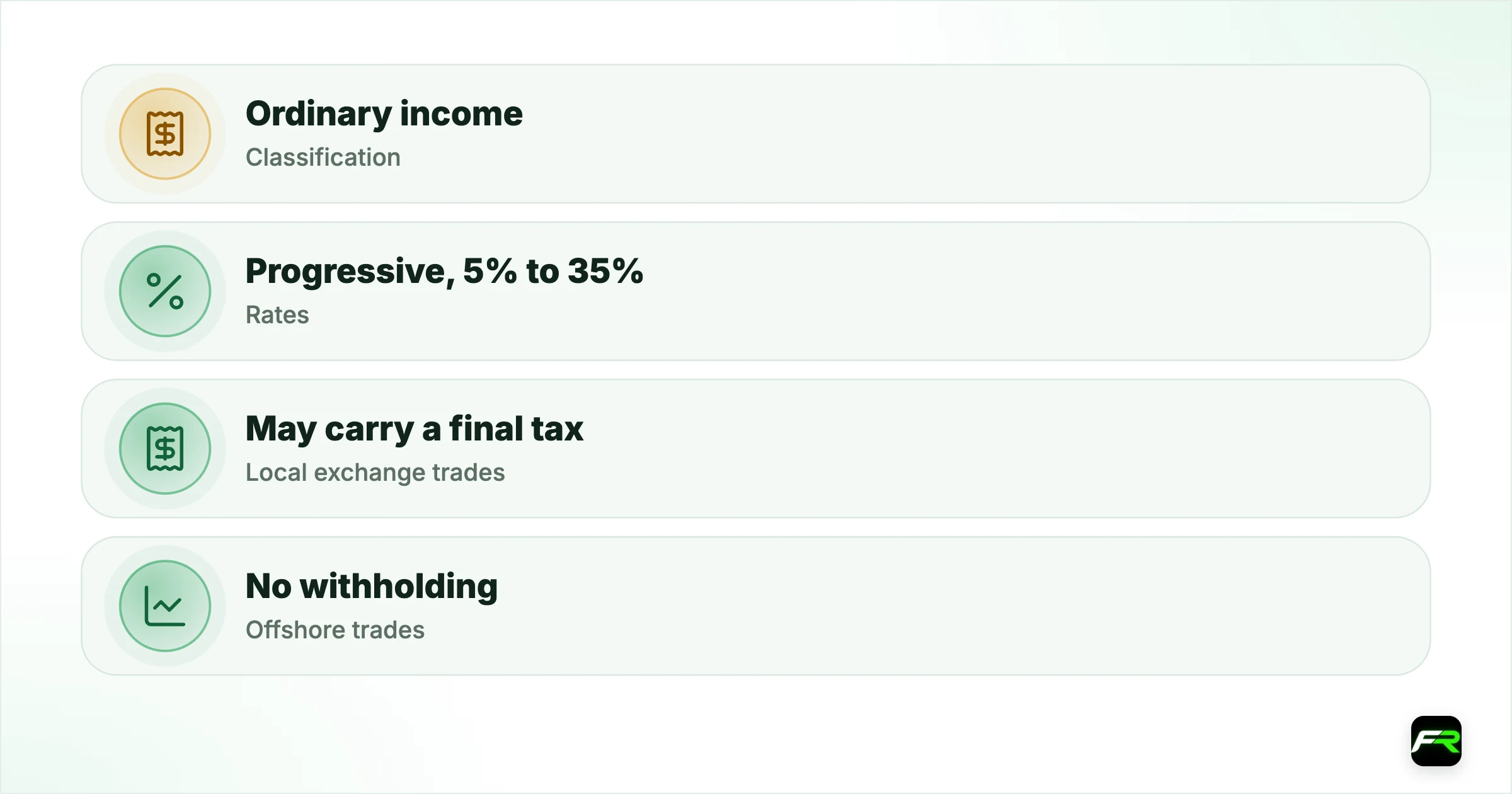
| Classification | Ordinary income |
|---|---|
| Rates | Progressive, 5% to 35% |
| Local exchange trades | May carry a final tax (PPh Pasal 4(2)) at source |
| Offshore trades | No withholding; fully self-reported |
| Return | Annual SPT Tahunan |
A large withdrawal with no records behind it is harder to explain than a documented trading history. Keep the trail from your first deposit, not from the point you start making money.
Comparing rules across the region, or funding an account for the first time? See the same question for India, Malaysia, how to spot a fake forex broker.
Frequently asked
Do I pay tax on forex profits in Indonesia?
Yes. Trading profit is ordinary income for a tax resident, taxed at Indonesia’s progressive personal rates and declared on your annual return. There is no special lower rate for trading gains.
Is offshore forex trading taxed differently?
There is no withholding or final tax on offshore trades, so the full trading profit is ordinary income you self-report. Trades through a Bappebti-licensed broker on the local exchange may carry a final tax collected at source instead.
How much tax will I pay on forex trading in Indonesia?
It depends on your total income. Trading profit stacks on top of your other income and is taxed at your marginal band, which ranges from 5% to 35%. For many salaried traders the profit falls in the 15% band.
Is bringing money back from a broker taxable?
Returning your own capital is not a taxable event. Only the gain on top of it is taxed. Keeping deposit and withdrawal records lets you demonstrate which part is which.
Will the tax office know about my offshore account?
The offshore broker does not report to Indonesian authorities, so in practice the completeness of your declaration depends on you. That is a legal obligation, not an optional one.
What records do I need for forex tax in Indonesia?
Monthly net trading profit or loss from platform statements, every deposit and withdrawal with dates and rupiah amounts, the broker’s conversion rate, and any local-broker documentation showing final tax already paid.
The team behind this guide
Researched, checked and approved by five forex specialists
Every guide is written, fact-checked and edited before it goes live, and updated when the facts change. Spotted an error? Tell us.