IC Markets





































A Simple Asian-Session Range Strategy
Mark the range, wait for price to reach an edge, trade toward the middle with a stop just outside. It works because the Asian session is quiet. Here is the full method and its failure modes.
 WriterAbir KhanWriterWrites the guides · checks every figure against primary sources View profileAbout Abir →
 Market analysisTanbir Habib RiyadForex & Crypto AnalystForex and crypto analyst · technical and fundamental analysis View profileAbout Tanbir →
 Fact-checking & riskJannatul FerdaushFact-Checker & Risk AnalystFact-checks every figure · risk analysis · Applied Statistics, University of Dhaka View profileAbout Jannatul →
 Trading reviewJowel RanaCo-Founder & Forex TraderCo-founder · forex trader · reviews guides from a trader's view View profileAbout Jowel →
 Final approvalRanjan NiskrityFounder, Owner & Forex TraderFounder and owner · forex trader · signs off every guide View profileAbout Ranjan →
Key takeaways
- Mark the high and low of the first one to two hours after the Tokyo open on AUD/JPY, USD/JPY or AUD/USD.
- Sell near the top and buy near the bottom, with the stop just outside the edge you traded from.
- Skip the day if the range is too narrow to cover the spread and a worthwhile reward.
- The strategy fails when news or the London open turns the quiet range into a trend.
The Asian session’s defining feature is exactly what a range strategy needs: low volatility, with price drifting between a high and a low. This guide lays out a simple version you can practise on a demo, along with the situations where it stops working, because a strategy you cannot see failing is a strategy that will surprise you.
The setup
- Pick an active pair for the session: AUD/JPY, USD/JPY or AUD/USD.
- Wait for the first one to two hours after the Tokyo open. Mark the highest high and the lowest low in that window, and that is your range.
- Only proceed if the range is wide enough that a trade from one edge toward the middle covers the spread and offers a reward worth the risk. If the range is 8 pips and the spread is 1.5, skip it.
- When price returns to the top of the range, look for a short back toward the middle or the opposite edge. When it returns to the bottom, look for a long.
- Stop-loss goes just outside the edge you traded from, a few pips beyond the high for a short or beyond the low for a long.
Why it works when it works
In a quiet session with no strong driver, price genuinely does oscillate. Large players are not pushing a trend, so moves to the edge of an established band tend to get sold or bought back toward the middle. You are not predicting direction. You are betting that “quiet stays quiet” for another hour or two, which in the Asian session is often a reasonable bet.
Nurul trades this on AUD/JPY four mornings a week before work. She marks the 08:00 to 10:00 local range, and only takes a trade if it is at least 25 pips wide. Most days she gets one trade; some days none. Her stop is 6 pips outside the range edge and her target is the opposite edge. Over two months her hit rate was about 60%, and the losers were smaller than the winners because it was tight. The days she lost money were the days she took a trade in a band that was too narrow because she was impatient.
The failure modes
A real driver arrives
If there is a Bank of Japan meeting, Australian jobs data, a Chinese data surprise, or a risk-sentiment shock, the range breaks and keeps going. Check the economic calendar before you trade and stand aside on high-impact days for your pair.
The London open
When London arrives, around 07:00 GMT during British Summer Time or 08:00 GMT during UK winter (GMT standard time), volume steps up and price that held steady all session can break decisively. Be flat before then, or move your stop to break-even and accept you may be taken out.
A range that is really a trend pausing
Sometimes what looks like an Asian range is just a strong London-New York trend taking a breather. When it resumes at the London open, the “range” was a continuation pattern. If the days before were strongly trending, be more cautious about fading the edges.
Position sizing for this strategy
Because the stop is tight, only a few pips outside the range edge, you can risk your fixed percentage of the account with a relatively large position, and this is where people get it wrong. A 6-pip stop does not mean “low risk”; it means you should size so that 6 pips against you equals 1 to 2% of the account, no more. On a USD 500 account risking 1%, that is USD 5 over 6 pips, which on AUD/JPY is roughly a 0.08-lot position. Work that number out before the session, not in the moment.
This tightness also means slippage matters. If the range breaks hard and your stop is filled 3 pips worse than the level, that is a 50% larger loss than planned on a 6-pip stop. Trade this on liquid pairs in active hours, not on an exotic cross at 04:00 GMT, and accept the occasional slipped stop as a cost of the strategy.
How to practise it
- Demo it for a month. Mark it every day, log whether you would have traded, and what happened.
- Track your hit rate and your average winner versus average loser. The edge is usually in the second number, not the first.
- Only go live, small, once you can follow the rules on days when there is no clean setup, because that is the hard part.
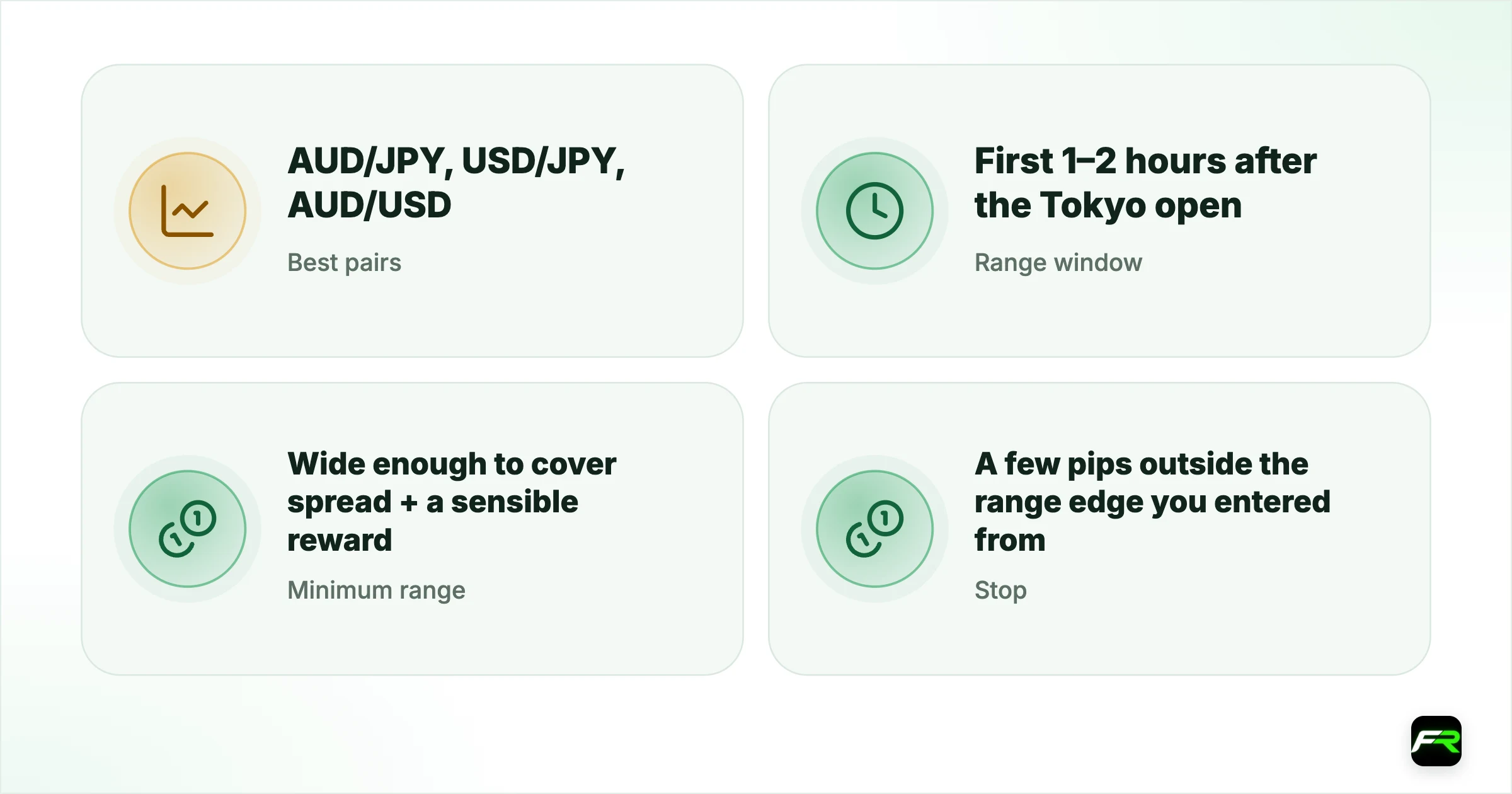
| Best pairs | AUD/JPY, USD/JPY, AUD/USD |
|---|---|
| Range window | First 1–2 hours after the Tokyo open |
| Minimum range | Wide enough to cover spread + a sensible reward |
| Stop | A few pips outside the range edge you entered from |
| Main failure mode | A news driver or the London open breaks the range |
This strategy loses on trending days, and trending days can string together. It is not a system to run mechanically through a Bank of Japan week. Check the calendar, and be flat for the London open.
Frequently asked
How do I trade the Asian session range?
Mark the high and low of the first one to two hours after the Tokyo open. When price returns to an edge, trade back toward the middle with a stop just outside that edge. Only take the trade if the range is wide enough to cover the spread plus a worthwhile reward.
Which pair is best for an Asian range strategy?
AUD/JPY is the common choice because both currencies are active during the session and it tends to swing cleanly between a high and low. USD/JPY and AUD/USD also work.
When does the Asian range strategy fail?
On days with a real driver, such as a Bank of Japan meeting, Australian or Chinese data, or a risk shock, and at the London open, when volume steps up and the range can break. Check the calendar and be flat before London.
How wide should the range be to trade it?
Wide enough that a move from one edge toward the middle covers the spread and offers a sensible reward, usually at least 20 to 25 pips on AUD/JPY. Skipping narrow ranges is the discipline that keeps this profitable.
Do I need to be at the screen the whole session?
No. You mark the range after the first hours, then you can set alerts at the edges and check when price reaches one. The strategy suits someone with a couple of hours in the morning rather than the full day.
Is range trading better than trend trading for beginners?
In the Asian session specifically, yes, because the conditions favour it and the decisions are clearer. In trending sessions like London, trend approaches work better. Match the strategy to the session.
The team behind this guide
Researched, checked and approved by five forex specialists
Every guide is written, fact-checked and edited before it goes live, and updated when the facts change. Spotted an error? Tell us.