IC Markets




































Is Forex Trading Legal in Sri Lanka?
The Central Bank has said repeatedly that leveraged forex trading through electronic platforms is not permitted, and that you cannot send money abroad for it. That is the rule to work from.
 WriterAbir KhanWriterWrites the guides · checks every figure against primary sources View profileAbout Abir →
 Market analysisTanbir Habib RiyadForex & Crypto AnalystForex and crypto analyst · technical and fundamental analysis View profileAbout Tanbir →
 Fact-checking & riskJannatul FerdaushFact-Checker & Risk AnalystFact-checks every figure · risk analysis · Applied Statistics, University of Dhaka View profileAbout Jannatul →
 Trading reviewJowel RanaCo-Founder & Forex TraderCo-founder · forex trader · reviews guides from a trader's view View profileAbout Jowel →
 Final approvalRanjan NiskrityFounder, Owner & Forex TraderFounder and owner · forex trader · signs off every guide View profileAbout Ranjan →
The Central Bank of Sri Lanka (CBSL) has issued public notices more than once stating that leveraged forex trading through online platforms is not a permitted foreign exchange transaction, and that outward remittances to fund such trading are not allowed under the Foreign Exchange Act, No. 12 of 2017. There is no licensed retail forex broker in Sri Lanka, and no local body to take a complaint to.
This is one of the more explicit positions in the region. It is not a grey area you can read around, and the notices name both the activity and the way money would move to fund it. One disclosure up front: broker rankings elsewhere on this site, including our Sri Lanka forex guide, compare firms for a global audience and are not a suggestion to fund a leveraged account against CBSL’s stated position, that guide covers the rule and the risks alongside the shortlist.
If you have seen a Sinhala or Tamil forex ad promising a monthly income, that promotion is running against the regulator’s stated position, and the person in it is paid whether you succeed or not. The gap between how confident those pitches sound and how direct CBSL has been is the tell.
Why the rule is strict right now
Sri Lanka has spent recent years managing a severe foreign-currency shortage, and capital-outflow controls have been tight as a result. Money leaving the country for speculative trading is exactly what those controls exist to prevent. Even before the crisis, the Foreign Exchange Act did not provide for retail margin forex; the recent notices simply made the position loud, specific, and impossible to misread.
- Sending USD abroad to a trading account is outside permitted current and capital transactions.
- Local agents and “investment schemes” built around forex are named in CBSL warnings.
- There is no domestic licence, so any broker serving Sri Lanka is regulated elsewhere.
What that means for an individual
You would be trading outside the exchange-control framework, with no local recourse, and with a funding route that the rules specifically restrict. Enforcement has concentrated on scheme operators and promoters rather than individuals, but the CBSL notices are unusually direct, and banks are alert to forex-related transfers, so one flagged as being for online trading is likely to be declined.
Dilani tried to send USD 500 to an offshore broker in 2023. Her bank declined the transfer and flagged the stated purpose. She looked into routing it through crypto instead, then read the CBSL notice properly and decided the combination of no protection, restricted funding, and a volatile rate environment was not worth it for a small account. She paper-trades and studies until the rules change, on the view that there is no rush to lose money.
If the exchange-control situation eases and CBSL’s position changes, this guide will be updated. For now, the accurate answer is that it is not permitted and the funding route is restricted.
The scheme problem
Because people want to trade and cannot do it cleanly, a market in local “forex investment” groups has grown up: someone pools deposits, claims to trade them, and promises a monthly return. These are not brokers. They are not regulated. They are the exact structure CBSL warns about, and when they stop paying, which they always do, there is no mechanism to recover anything. If you are going to take the risk of trading at all, do it in your own account, not someone else’s pool, our scam broker list covers the pattern in more detail.
To flag an unauthorised platform or scheme, CBSL’s Financial Consumer Relations Department takes public information on 1935, the same complaints channel that produced its original notices. If you have actually lost money to a scheme, that is a police matter for the Financial Crimes Investigation Division rather than a CBSL one.
If and when the rules relax
Sri Lanka has eased capital controls in stages before, as reserves recover. If retail forex is ever brought into a licensed framework, it would most likely sit under CBSL supervision with limits on leverage and outward remittance. Until an official statement changes, though, treat the current notices as the rule.
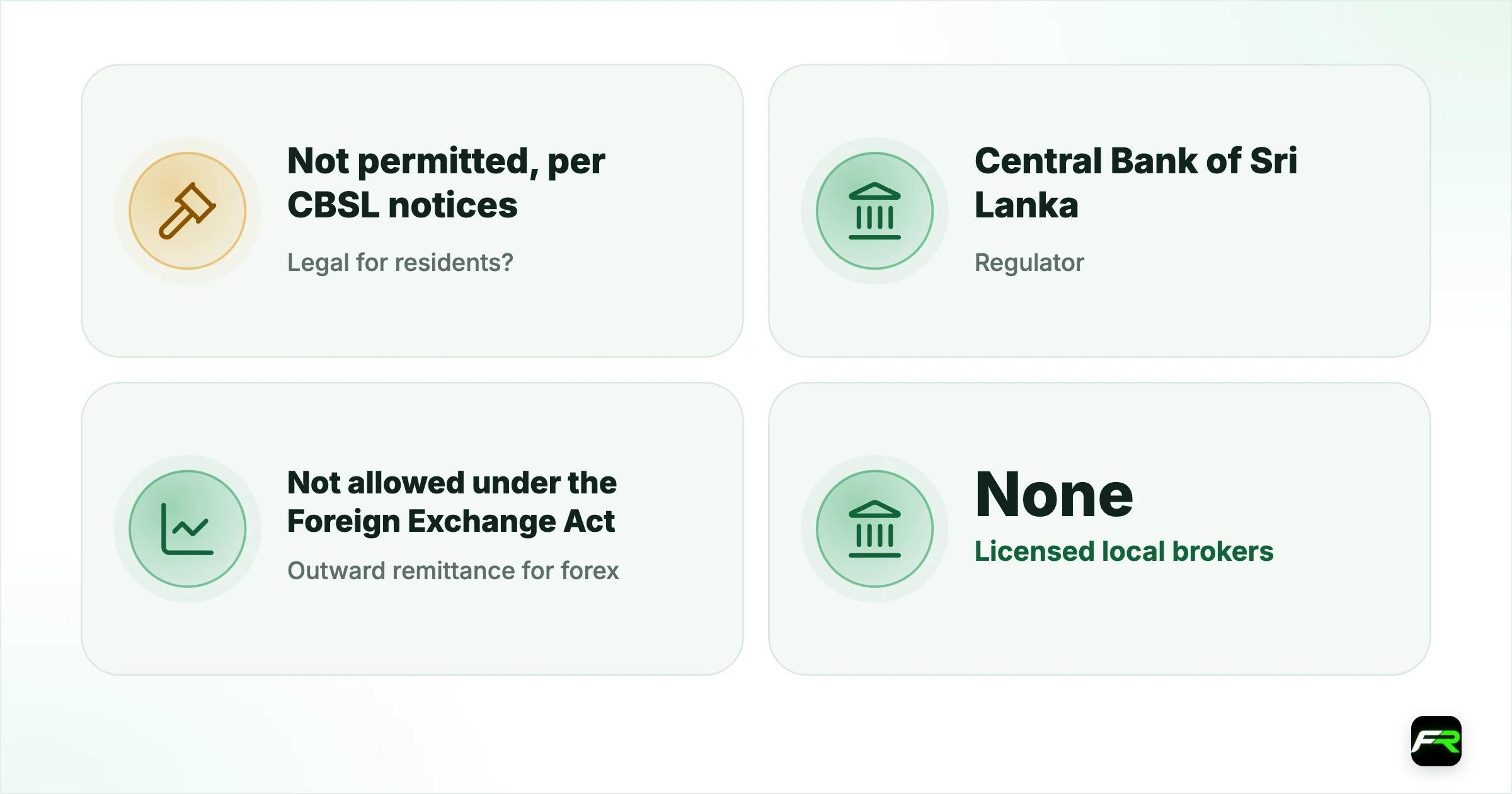
| Legal for residents? | Not permitted, per CBSL notices |
|---|---|
| Regulator | Central Bank of Sri Lanka |
| Outward remittance for forex | Not allowed under the Foreign Exchange Act |
| Licensed local brokers | None |
| Context | Tight capital-outflow controls |
| Local recourse | None |
What Sri Lankan traders do in the meantime
The people who take the market seriously and cannot fund an account are not sitting idle. They demo-trade, they keep a written trading plan and a journal, and they build the habit of only acting on a setup they can define in advance. When the exchange-control situation eases, and it has eased in stages before, they will start with real money already knowing how they trade.
It is not a satisfying answer if you want to be in the market today. It is a much better position than the one you land in by routing money through crypto to an unregulated broker, taking on price risk in transit, and discovering your trading plan does not survive contact with a real loss. There is no rush to lose money.
Local “forex investment” groups promising monthly returns are the exact thing CBSL warns about. They are not brokers, and there is no way to recover money from them once they stop paying.
Frequently asked
Has the Central Bank of Sri Lanka banned forex trading?
It has stated that leveraged forex trading through electronic platforms is not a permitted foreign exchange transaction and that money cannot be remitted abroad to fund it. There is no licensed local broker.
Can I fund a forex account from Sri Lanka?
Outward remittances for margin trading are not allowed under the Foreign Exchange Act, and banks flag forex-related transfers. Routing money through other channels puts you further outside the rules.
Is it safe to join a local forex investment group?
No. Groups that pool money and promise returns are what CBSL specifically warns against. They are not brokers, they are not regulated, and recovering money from them is generally not possible.
Will the rules change when the currency situation improves?
Possibly. Capital controls have been eased in stages before. This guide will be updated if CBSL’s stated position on retail forex changes.
What about trading forex from a foreign-currency account?
Holding a foreign-currency account does not create permission to use it for margin trading, which remains outside the permitted transaction types under the Foreign Exchange Act.
Is copy trading or a signals service allowed in Sri Lanka?
The same restrictions apply. A signals service does not change the fact that you would be funding a leveraged trading account abroad, and a pooled or managed arrangement adds the scheme risk CBSL specifically warns about.
How do I report a forex investment scheme in Sri Lanka?
Report an unauthorised platform or scheme to CBSL’s Financial Consumer Relations Department on 1935. If you have already lost money to one, file a separate report with the police Financial Crimes Investigation Division, recovering funds is a criminal matter, not something CBSL itself handles.
The team behind this guide
Researched, checked and approved by five forex specialists
Every guide is written, fact-checked and edited before it goes live, and updated when the facts change. Spotted an error? Tell us.