IC Markets





































The Hidden Admin Fee on Some Swap-Free Accounts
The swap is gone, but a per-lot-per-night administration fee often takes its place after a few days. For swing traders that can cost more than the swap did. Here is how it works and how to check.
 WriterAbir KhanWriterWrites the guides · checks every figure against primary sources View profileAbout Abir →
 Market analysisTanbir Habib RiyadForex & Crypto AnalystForex and crypto analyst · technical and fundamental analysis View profileAbout Tanbir →
 Fact-checking & riskJannatul FerdaushFact-Checker & Risk AnalystFact-checks every figure · risk analysis · Applied Statistics, University of Dhaka View profileAbout Jannatul →
 Trading reviewJowel RanaCo-Founder & Forex TraderCo-founder · forex trader · reviews guides from a trader's view View profileAbout Jowel →
 Final approvalRanjan NiskrityFounder, Owner & Forex TraderFounder and owner · forex trader · signs off every guide View profileAbout Ranjan →
A swap-free account removes the overnight interest on your positions. That costs the broker the swap revenue it would otherwise earn, so a common way brokers recover it is a fixed administration fee: a set amount per lot, per night, usually starting after a grace period. It is disclosed somewhere in the terms, but rarely prominently, and swing traders regularly discover it on a statement rather than up front.
How the fee is structured
There is no single model. Across brokers you will see:
- Grace period then flat fee: free for three to ten nights, then a set charge per lot per night. This is the most common.
- Pair-dependent: nothing on the majors, a fee on minors and exotics.
- From the first night: a smaller fee but no grace period.
- Genuinely nothing: a minority of brokers, usually with slightly wider spreads to compensate.
The fee itself ranges from around USD 1 to USD 15 per lot per night depending on the broker and the pair. On a single micro-lot held for a day or two it is trivial. On a full lot held for a month it is a serious number.
The maths that catches swing traders
Say you hold 1 standard lot of GBP/JPY for 20 nights on a swap-free account with a USD 6 per-lot-per-night admin fee after a three-day grace period. That is 17 charged nights at USD 6, so USD 102 in fees. On a normal account, the swap on that position might have been a charge of USD 2 to 3 a night, so USD 40 to 60 over the same period, or, depending on direction, a small credit. The swap-free account, meant to save you money on interest, cost you more.
Rashid ran a swing strategy on GBP/JPY and EUR/AUD, holding positions one to three weeks. He opened a swap-free account to avoid riba and did not read the fee schedule closely. Over his first two months the administration fees came to about USD 260, more than double what the swaps would have been. He moved his longer holds to the majors, where his broker’s fee did not apply, and started closing positions before rollover on the pairs where it did. The fees dropped to near zero.
Why brokers do it this way
It helps to understand the broker’s side. On a normal account, the swap on your overnight position is a small revenue stream for the broker, built from the interest-rate differential between the two currencies plus a markup. A swap-free account gives that up. Some brokers absorb the cost and widen spreads slightly to compensate; most prefer a visible, separate administration fee because it does not make their headline spreads look worse in a comparison.
The fee also does a second job for the broker: it discourages the carry traders who were opening swap-free accounts purely to avoid paying negative swaps on high-differential pairs like GBP/JPY or exotic crosses. That is why the fee so often lands hardest on exactly those pairs, and why the majors are frequently free. If your swing trading is on EUR/USD and USD/JPY, many brokers will not charge you anything. If it is on GBP/JPY, check very carefully.
How to check before it costs you
- Before opening the account, ask support directly: is there an administration fee on the swap-free account?
- Get the number, the pairs it applies to, and the grace period, in writing.
- Check the fee against how long you hold trades. Day trader: it will not matter. Swing trader: it might dominate your costs.
- If the fee is heavy on the pairs you trade, either choose a different broker or keep those positions intraday.
A quick test of a broker’s honesty: ask for the swap-free fee schedule in a chat and see whether you get a clear number or a link to a 40-page terms document. The clear number is the better broker.
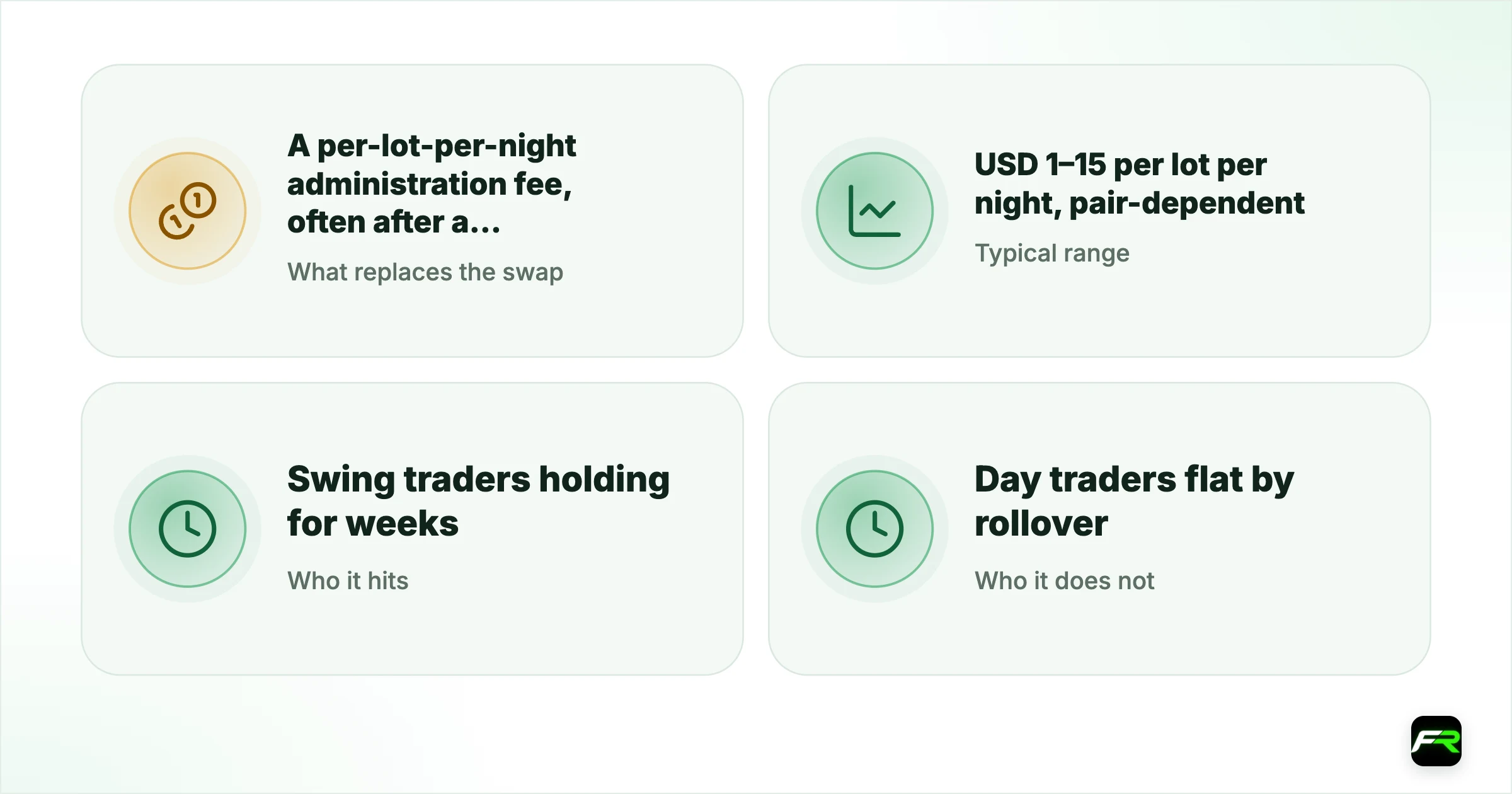
| What replaces the swap | A per-lot-per-night administration fee, often after a grace period |
|---|---|
| Typical range | USD 1–15 per lot per night, pair-dependent |
| Who it hits | Swing traders holding for weeks |
| Who it does not | Day traders flat by rollover |
| How to avoid surprises | Get the schedule in writing before opening |
If a broker’s swap-free account has a large admin fee on the pairs you trade and holds you for weeks, it can quietly become your biggest trading cost. Check first, not after.
Frequently asked
Do swap-free accounts have hidden charges?
Often. Many brokers replace the swap with a fixed administration fee per lot per night, usually after a grace period of a few days, sometimes only on certain pairs. It is disclosed in the terms but rarely prominently.
How much is the swap-free admin fee?
Roughly USD 1 to 15 per lot per night, depending on the broker and the pair. Majors are often free or cheap; minors and exotics carry the higher fees.
Is a swap-free account cheaper than a normal account?
For a day trader who closes positions before rollover, yes, because there is no swap and no admin fee. For a swing trader holding for weeks, the admin fee can cost more than the swap would have.
How do I find out my broker’s swap-free fee?
Ask support directly and request the number, the affected pairs, and the grace period in writing. A broker that gives you a clear answer is treating you better than one that points you to a long terms document.
Can I avoid the admin fee?
Keep positions intraday on the pairs it applies to, hold longer positions only on pairs where your broker charges nothing (usually the majors), or choose a broker that genuinely does not charge one.
Why do brokers charge this fee at all?
A swap-free account gives up the broker’s swap revenue, so the administration fee is how they recover that cost. Brokers that charge nothing usually compensate with slightly wider spreads.
Does the admin fee apply if my position is in profit?
Yes. The administration fee is charged per lot per night regardless of whether the position is up or down. It is a cost of holding the trade overnight on that account, not a share of profit or loss.
Can I get the admin fee refunded?
Generally no. It is a disclosed cost of the account, even if it is disclosed obscurely. The remedy is to check the schedule before opening, keep affected positions intraday, or use a broker that does not charge one.
The team behind this guide
Researched, checked and approved by five forex specialists
Every guide is written, fact-checked and edited before it goes live, and updated when the facts change. Spotted an error? Tell us.